


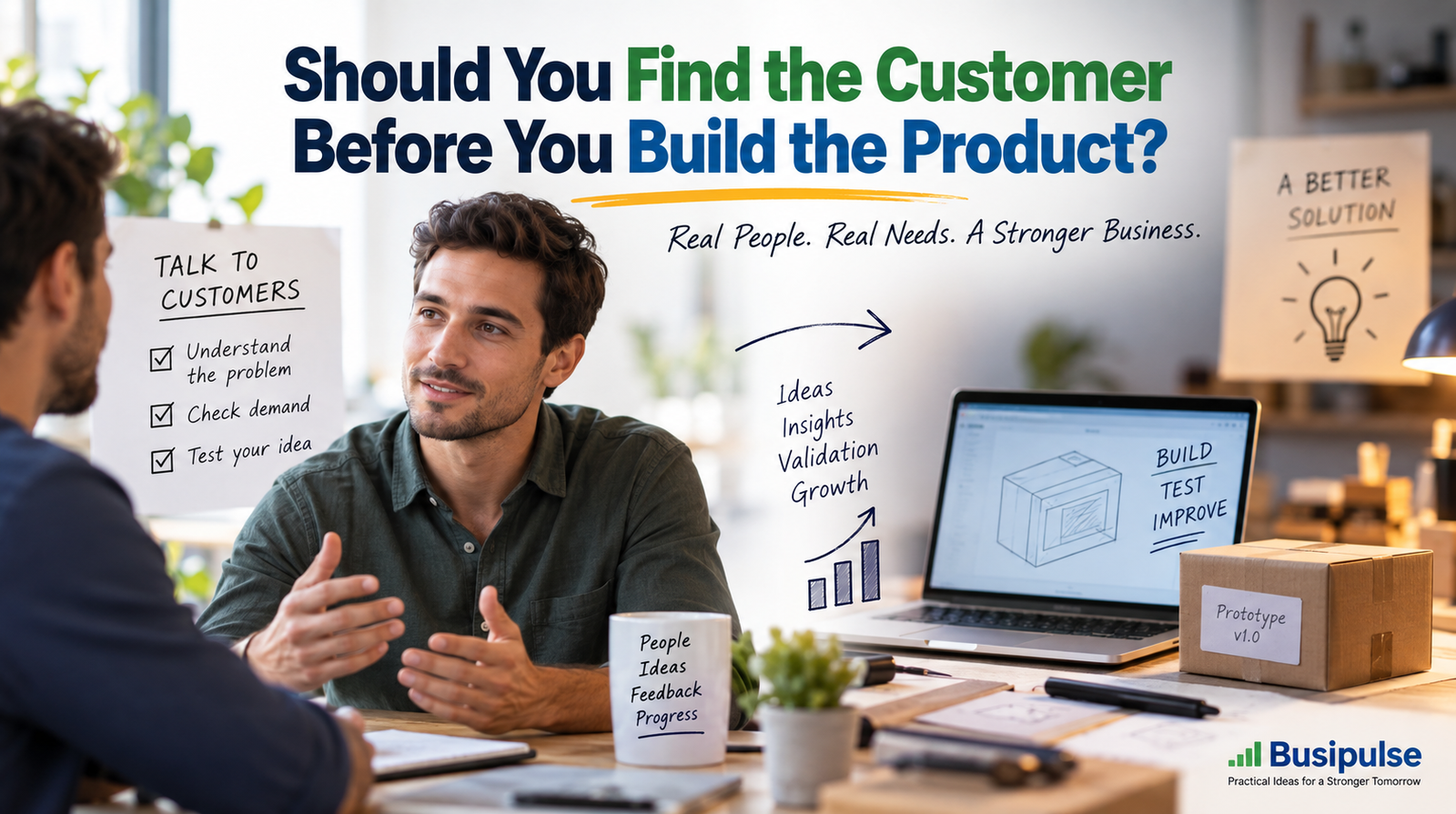
Customer before product is a simple idea: understand who might buy before you spend heavily building what you want to sell. You have a business idea, and it feels promising. Perhaps you have already imagined the name, the website, the product, the customers, and what the business could eventually become. You may even have started calculating how much money you could make if it succeeds. That excitement matters. Most businesses would never begin without it. But before you spend heavily turning the idea into reality, there is one question that deserves an answer: Who is going to buy it?
It sounds obvious. Yet entrepreneurs can become so focused on building the product that they leave the customer until later. A customer-before-product approach turns that thinking around by asking whether there is real demand before too much money is spent. This does not mean you should wait for customers to tell you exactly what to create. Good business ideas often begin with the entrepreneur. The point is simpler: before investing heavily in an idea, find some evidence that real customers have a reason to care about it.
A Good Idea Is Not Yet a Good Business
Almost everyone who starts a business believes the idea has potential. Otherwise, why start? But liking your own idea is different from having a market for it. Imagine you want to open a coffee shop. Before signing a long lease, buying equipment, and spending heavily on the interior, wouldn’t you want to know how many potential customers are nearby, what competitors charge, and whether the area really needs another café?
The same principle applies when evaluating different small business ideas. Before ordering large quantities of a product, investigate demand. Before making a major investment in a service, find out whether enough customers need it.
The U.S. Small Business Administration recommends market research when planning a business because it can help entrepreneurs understand customers, demand, competitors, and market conditions. In ordinary language: look around before you spend. You cannot remove all the risk from entrepreneurship, nor should you wait for certainty. But you can avoid making some expensive decisions before answering basic questions.
Start With a Problem Worth Solving
A useful business often begins with a problem somebody wants solved. This is the basic logic behind a customer before product approach: understand the problem before committing too much money to the solution. People pay businesses to save time, reduce inconvenience, improve results, lower costs, or make life easier.
Suppose you are considering a local delivery service. You assume businesses want cheaper delivery, but conversations with local shops reveal something different. Their biggest frustration is unreliable same-day delivery. That discovery could change your entire offer. Instead of becoming another low-cost courier, you might compete on reliability and speed.
This is the value of talking to potential customers. You are not asking them to invent your business. You are trying to understand what bothers them enough that they might pay someone to solve it. The opportunity often becomes clearer when you stop asking, “What can I sell?” and start asking, “What problem can I solve better?”
Don’t Spend $10,000 to Learn What You Could Learn for $100
Suppose you have $10,000 available for a new business. You could spend most of it immediately on equipment, stock, branding, and advertising. Or you could use a small amount first to test whether the basic idea works.
A physical product could begin with a small quantity instead of a huge order. A service could begin with a few customers before every possible piece of equipment is purchased. An online business might test a simple offer before paying for an elaborate platform. The exact test depends on the business. The principle does not:
The more expensive a mistake would be, the more evidence you should want before making it.
You don’t need to become a market-research expert. You need to avoid using large amounts of money to answer questions that could have been answered more cheaply. And there is an encouraging side to this. Starting small does not mean thinking small. A small test gives you room to experiment, make mistakes, and change direction before those mistakes become expensive. Your first version does not need to look like the company you hope to build five years from now. Its job is to discover what deserves to become bigger.
Talk to People, But Don’t Confuse Compliments With Customers
Customer conversations can teach you a lot, but people are often polite. Tell friends about your business idea, and you may hear, “That’s brilliant. You should definitely do it.” Encouraging? Yes. Evidence of demand? Not necessarily. Even potential customers may say they like an idea and behave differently when money is involved. That is why an entrepreneur should gradually move from listening to what people say toward observing what they do.
Someone saying your product looks interesting is useful. Someone asking where they can buy it is better. Someone actually paying for it gives you much stronger information.
MIT entrepreneurship guidance also points to stronger signs of demand, including customers actually using and paying for a product. Compliments can encourage an entrepreneur. Customers can build a business.
Customers Know the Problem, But You Still Need the Idea
There is another side to customer-first thinking. Customers do not always know what the best solution should be. A business owner might say, “I spend too much time answering the same customer questions.” That person understands the problem very well. But should the solution be another employee, better software, automated responses, or an AI assistant? That is where the entrepreneur comes in.
Research discussed by Harvard Business School also shows why understanding what customers need does not necessarily mean they can tell you the best solution. Listening matters, but so do judgment and experimentation. So don’t treat customer research as an order form. Customers can show you where the pain is. Your job is to find a better way to remove it. That is where entrepreneurship becomes creative.
Build Enough to Learn
A customer before product mindset does not mean avoiding action. It means building enough to learn before building too much. Research can only take you so far. Eventually, you need to put something in front of customers. But that does not mean everything has to be perfect first. The first version of a business can be simple. A service might initially be delivered manually. A product could begin with a small batch. A digital business might start with one useful function rather than every feature the founder has imagined. Then watch how customers respond and learn from what they actually do.
Do customers understand the offer? Will they pay the expected price? What makes them hesitate? What do they value most? Do they return? Those early reactions may teach you more than another month spent polishing a business plan.
The purpose of the first version is not to look successful. It is to learn what works.
If something goes wrong, that does not automatically mean the business has failed. Perhaps the price needs changing, the offer is unclear, or you approached the wrong customers. Find out why. Improve. Test again. That ability to learn quickly can be more valuable than getting everything right on the first attempt.

The First Sale Changes Everything, But It Proves Only One Thing
There is something special about the first paying customer. Until then, much of the business exists as an assumption. You believe people will pay. The first sale shows that at least one person actually did. Celebrate it. Then get back to work.
One sale does not prove that you have a successful business. The next question is whether you can do it again. Can you find ten customers? Do they remain satisfied? Do some return? Can you make money after paying your costs? Your first sale proves somebody will buy. Repeated profitable sales begin to show that you may have a business.
This is also why entrepreneurs should not become discouraged if the first attempt does not work perfectly. The early stage of a business is partly a learning process. The goal is not to prove that your original idea was flawless. The goal is to discover what customers will actually support.
Customers Want It. But Can You Make Money?
Suppose customers love your product, but it costs you $80 to provide, and they will only pay $60. You have demand. You do not yet have a good business.
A company can become busier without becoming more profitable. Customers may want faster service, better quality, and lower prices at the same time, but providing everything they want may leave little money for the owner.
This connects with what we examined in our previous Busipulse article about building a million-dollar business. Revenue sounds exciting, but profit and cash flow can tell a very different story. Before investing substantially more, understand a few numbers. What will customers pay? What does each sale cost? How much are you spending to attract customers? Will they buy again? You don’t need to be an accountant to ask whether selling more actually leaves the business better off.
What Should You Do With Your Idea?
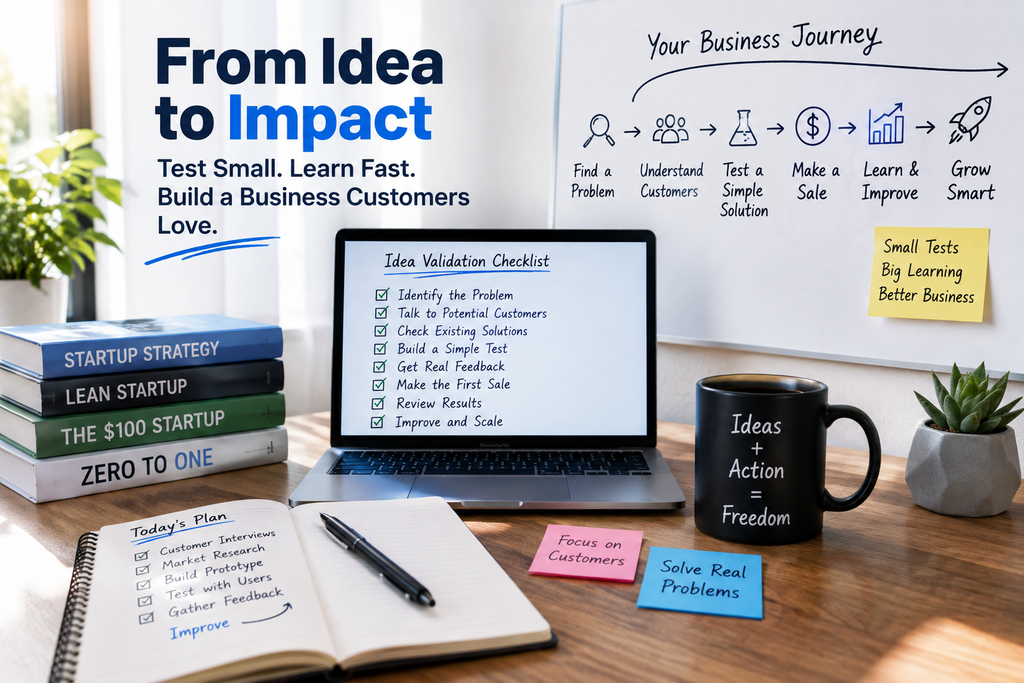
If you have a business idea today, don’t make the process more complicated than it needs to be. Identify the customer and the problem you believe you can solve. Talk to some potential customers. Look at what they already use and pay for. Then create the simplest sensible way to test your solution and try to make a real sale.
If nobody buys, learn why before spending more. If people buy, deliver what you promised, understand your costs, and see whether you can repeat the result. Then improve. The process can be remembered simply:
Find a problem → understand the customer → test a simple solution → make a sale → learn → improve → invest more when the evidence becomes stronger.
You may move backward and forward between those stages. That’s normal. Building a business is rarely a perfectly straight road.

Customer Before Product: What Should Come First?
The answer is not as simple as choosing one. Sometimes you need a product, sample, or prototype before customers can properly understand what you are offering. Some genuinely innovative products also begin with an inventor’s idea rather than with customers requesting them. But that does not mean the market should be ignored until the product is finished. For most entrepreneurs, a better rule is:
Build enough to test, but not so much that being wrong becomes financially painful.
Final Thoughts
Starting a business requires confidence. At some point, every entrepreneur has to act without knowing exactly what will happen. But there is a difference between taking a calculated risk and risking everything because you have fallen in love with an idea.
Talk to customers. Look at what people already buy. Test something small. Ask for a real price. Understand what happened and improve from there. Your first attempt may confirm the idea. It may lead to a better version. It may even show you that another opportunity is stronger. All three outcomes can be valuable if you discover them before spending too much. So before asking, “How quickly can I build this?”, ask: “What is the cheapest way I can find out whether customers really want it?”
You do not need to build the entire business to take the first serious step toward one. Sometimes the smartest way to pursue a big opportunity is to begin with a very small test.
Author’s Note
Entrepreneurship requires ambition, but a promising idea does not necessarily require a large investment on day one.
Research cannot remove uncertainty, and entrepreneurs should not wait forever before acting. A practical approach is to learn where possible, test an idea at a sensible scale, and increase the investment as the evidence becomes stronger.
At Busipulse, the aim is to discuss business in a practical and research-based way so that useful ideas remain understandable to the people who may actually want to put them into practice.

[…] we discussed in our previous Busipulse article about finding the customer before building too much of the product, real customer behavior can tell an entrepreneur much more than friendly opinions. The same […]