



When exploring small business ideas for 2027, the best opportunity may not involve artificial intelligence, a sophisticated app, or a revolutionary invention. It could be a gym, a cleaning company, a delivery service, a mobile car-detailing business, or a food operation that simply makes life easier for its customers.
Entrepreneurship remains strong worldwide. The latest Global Entrepreneurship Monitor (GEM) report, based on more than 160,000 respondents across 53 economies, found record levels of startup activity while also warning that many new businesses face significant challenges in becoming sustainable, established companies. (GEM Global Entrepreneurship Monitor)
That distinction is important.
Starting a business is relatively easy compared with building one that survives. So, rather than producing another long list of fashionable business ideas, this article focuses on nine practical opportunities selected for their recurring demand, potential for repeat revenue, accessibility to smaller operators, and relevance across different markets. Entrepreneurs specifically interested in digital-first opportunities can also explore our guide 7 Smart Online Businesses to Start in 2026.
These are not guaranteed money-makers. Each has advantages, risks, and operating challenges that prospective entrepreneurs should understand before investing.
What Makes a Small Business Idea Worth Starting in 2027?
There is no universally “best” small business. When evaluating small business ideas for 2027, recurring demand, realistic operating costs, and the ability to differentiate are more useful measures than simply following the latest trend.
The right opportunity depends on your capital, skills, location, competition, customer base, and ability to execute. However, some characteristics make a business model more attractive. A strong small business usually solves a recognizable problem, has customers who are willing to pay, offers a reasonable path to repeat purchases, and has enough margin to cover its operating costs. The environment for small businesses is also changing.
The 2026 Global MSMEs Report from the International Council for Small Business highlights the rise of solo entrepreneurs, niche markets, digital transformation, AI-assisted businesses, and increasingly global small firms. It also emphasizes that technology alone will not determine which businesses succeed; ecosystems, human skills, access to markets, finance, and resilience remain critical. (ICSB) That suggests an important lesson for 2027:
Technology can make a good business better, but it cannot turn a bad business model into a good one.
With that principle in mind, here are nine opportunities worth examining.
1. Gym and Fitness Center
Fitness is one of the clearest examples of a business built around recurring revenue. Customers do not normally visit a gym once and disappear. Memberships can generate monthly or annual payments, while personal training, group classes, and specialized programs can create additional revenue. The opportunity is also broader than the traditional bodybuilding gym. An entrepreneur could focus on:
- Women-only fitness
- Strength and functional training
- Personal training
- Small-group classes
- Senior fitness
- Weight-management programs
- Specialized athletic training
The wider wellness economy provides a strong backdrop. The Global Wellness Institute reported that the global wellness economy reached $6.8 trillion in 2024, having doubled since 2013, and projects it to approach $9.8 trillion by 2029. (Global Wellness Institute)
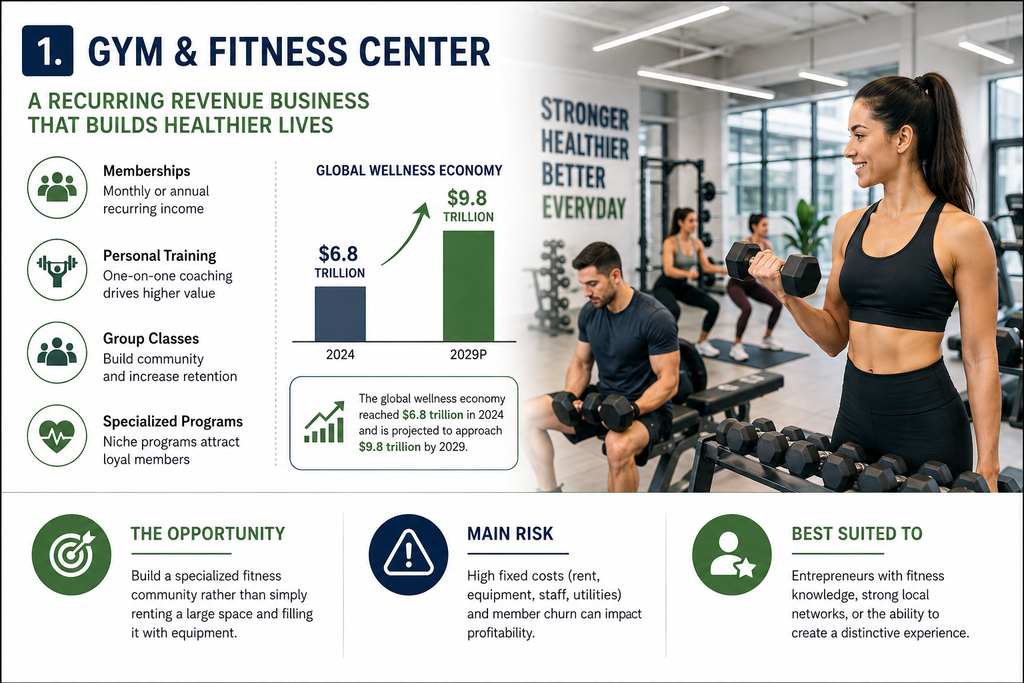
But a gym is not automatically a good investment. Rent, equipment, utilities, maintenance, employees, and marketing can create substantial fixed costs. A gym with too few members can lose money even when its membership price appears attractive.
The opportunity: Build a specialized fitness community rather than simply renting a large space and filling it with equipment.
Main risk: High fixed costs and member churn.
Best suited to: Entrepreneurs with fitness knowledge, strong local networks, or the ability to create a distinctive customer experience.
2. Delivery and Courier Service
The growth of e-commerce has created a continuing need for businesses that move goods from sellers to customers. The global last-mile delivery market was estimated at $181.6 billion for 2026 and is projected by Grand View Research to reach about $348.8 billion by 2033, with Asia-Pacific identified as the fastest-growing region. (Grand View Research) That does not mean a small entrepreneur should attempt to compete with global logistics companies. The more realistic opportunity is specialization
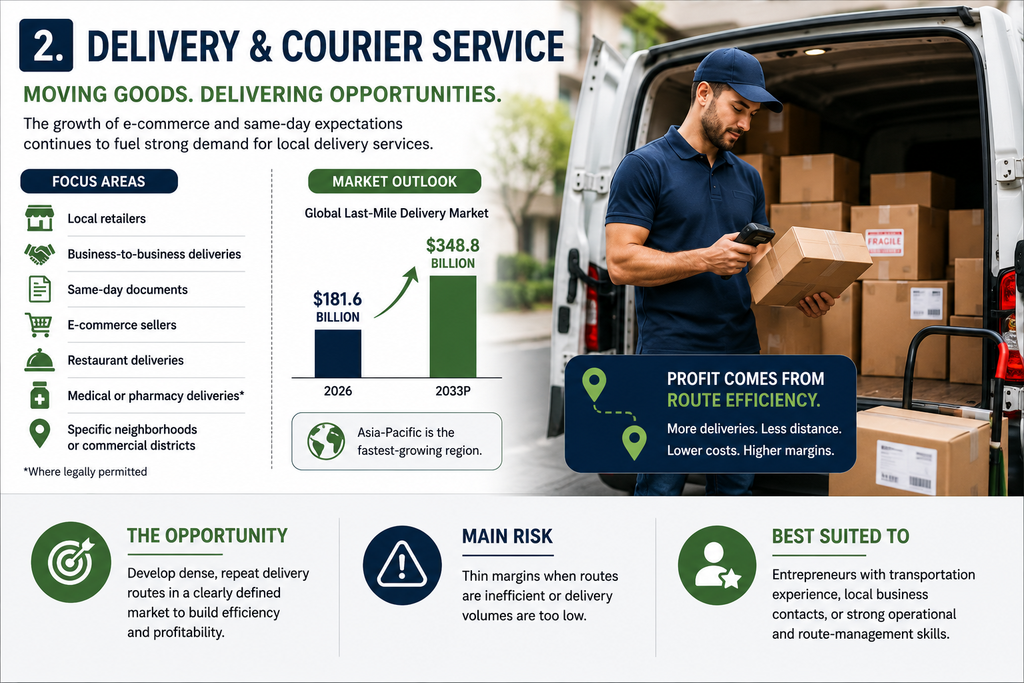
A small courier business could focus on:
- Local retailers
- Business-to-business deliveries
- Same-day documents
- E-commerce sellers
- Restaurant deliveries
- Medical or pharmacy-related deliveries where permitted
- Specific neighborhoods or commercial districts
The economics depend heavily on route efficiency. A courier spending most of the day driving long distances for low-value deliveries can quickly lose money through fuel, vehicle maintenance, and labor costs. A concentrated customer base can be much more valuable.
The opportunity: Develop dense, repeat delivery routes in a clearly defined market.
Main risk: Thin margins when routes and delivery volumes are inefficient.
Best suited to: Entrepreneurs with transportation experience, local business contacts, or strong operational skills.
3. Pickup and Drop-Off Service
Pickup-and-drop-off businesses are related to delivery but have a different value proposition. The customer is not merely buying transportation. They are buying convenience.
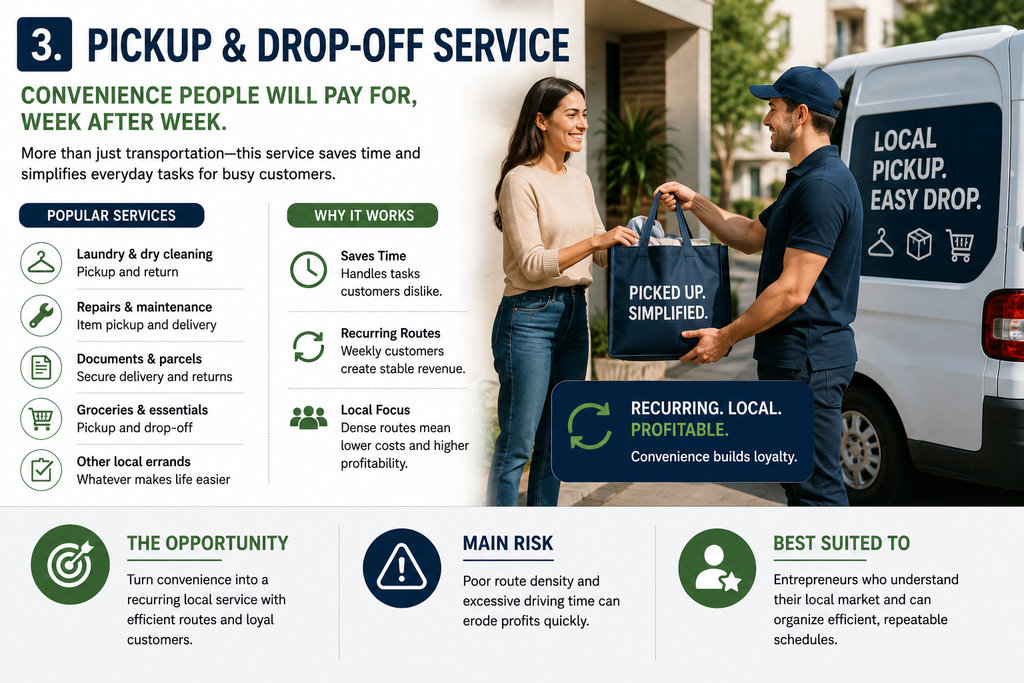
Consider laundry collection and return, dry-cleaning pickup, repair-item collection, document delivery, parcel returns, grocery pickup, or other local errands.
The business can potentially begin on a small scale with one vehicle and a limited service area. Its real strength is the possibility of recurring routes. A customer who uses the service every week is far more valuable than a customer who orders once.
The challenge is geographic concentration. If customers are scattered across a large city, transportation costs can consume the margin. The business therefore works best when the entrepreneur builds a recognizable service area and gradually increases the number of customers within it.
The opportunity: Turn convenience into a recurring local service.
Main risk: Poor route density and excessive driving time.
Best suited to: Entrepreneurs who understand their local market and can organize efficient schedules.
4. Specialized Local Transportation Service
Ride-hailing is another large market built around convenience. But this is one of the businesses on our list where entrepreneurs should be particularly cautious. The attraction is obvious: people need transportation, and smartphones make it possible to connect passengers with drivers. The problem is that established ride-hailing platforms already benefit from enormous networks of drivers and customers. A new business therefore needs a reason to exist.
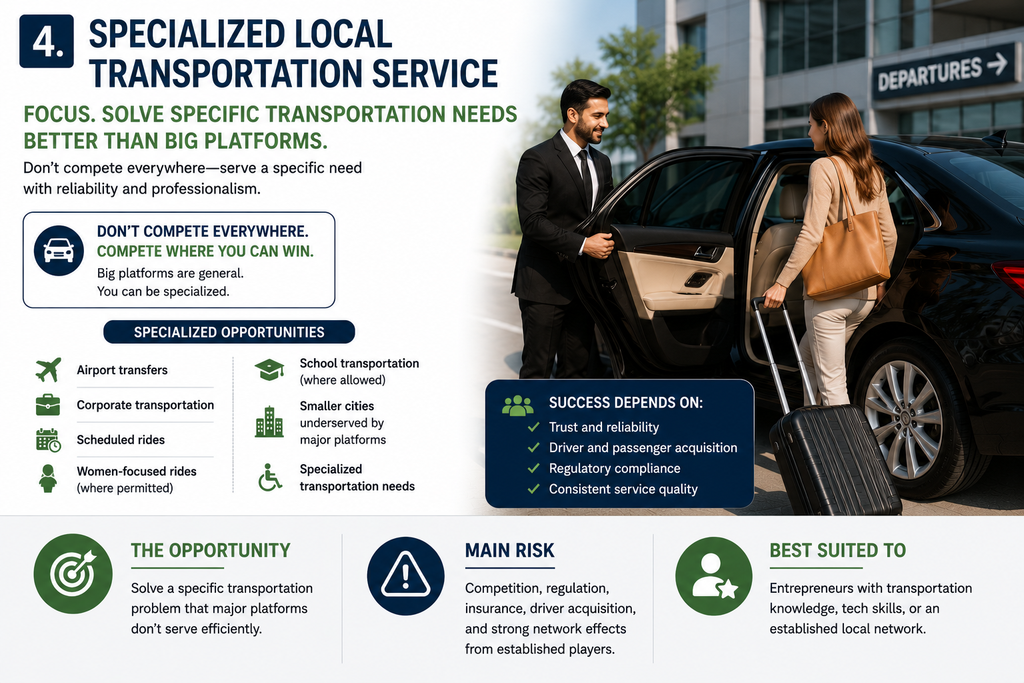
That could mean focusing on:
- Airport transfers
- Corporate transportation
- Scheduled rides
- Women-focused transportation where legally permitted
- School transportation where regulations allow
- Smaller cities underserved by major platforms
- Specialized transportation needs
The key lesson is simple:
Do not build another general ride-hailing app unless you have a genuine competitive advantage.
Technology is relatively easy to obtain. Building trust, attracting drivers, attracting passengers, complying with regulations, and maintaining service quality are much harder.
The opportunity: Solve a specific transportation problem that major platforms do not serve efficiently.
Main risk: Competition, regulation, insurance, driver acquisition, and network effects.
Best suited to: Entrepreneurs with transportation knowledge, technology expertise, or an established local network.
5. Herbal and Natural Wellness Products
The growing wellness economy creates opportunities beyond gyms and fitness centers.
Herbal teas, botanical products, natural personal-care products, and other wellness-oriented goods can appeal to consumers seeking traditional or natural alternatives. But this is a category where trust and compliance are more important than clever marketing.
The World Health Organization is actively working toward greater international harmonization of standards for herbal medicines, with an emphasis on quality, safety, and regulatory standards. (World Health Organization)
That means entrepreneurs need to understand the regulations in their target market. A business should not make unsupported claims that an herbal product can treat or cure a disease. Product quality, sourcing, labeling, testing, and permitted claims all matter. The strongest opportunity may therefore be to build a trustworthy brand around carefully sourced products rather than simply selling whatever is currently fashionable.
The opportunity: Create a transparent, quality-focused natural wellness brand.
Main risk: Regulatory requirements, product quality, and unsupported health claims.
Best suited to: Entrepreneurs with access to reliable suppliers and a strong understanding of consumer wellness preferences.
6. Home Cleaning and Maintenance Services
Cleaning is rarely described as an exciting business. That may actually be an advantage. People and organizations need clean homes, offices, commercial buildings, and rental properties regardless of whether the latest technology trend succeeds or fails.
Recent market research estimates the global cleaning services market at $481.75 billion in 2026, with projected growth to about $859.2 billion by 2034. North America accounted for the largest regional share in 2025, while Asia-Pacific is projected to grow at the fastest rate. (Fortune Business Insights) A small company can begin with residential cleaning and gradually add:
- Deep cleaning
- Move-in and move-out cleaning
- Office cleaning
- Post-renovation cleaning
- Duct cleaning
- Window cleaning
- Property maintenance
The most attractive feature is recurring business. A weekly household customer or monthly commercial contract can provide much more predictable revenue than one-time jobs. The difficult part is operational: recruiting reliable staff, maintaining quality, scheduling efficiently, and controlling labor costs.
The opportunity: Build recurring contracts and a reputation for reliability.
Main risk: Labor management and quality control.
Best suited to: Entrepreneurs who are strong at operations and customer service.
7. Mobile Car Wash and Auto Detailing
A mobile car-wash and detailing business combines a familiar service with a powerful selling point: the business comes to the customer. Instead of driving to a fixed facility and waiting, customers can have their vehicles cleaned at home, at work, or in another convenient location.
Services can range from basic exterior washing and interior cleaning to premium detailing, paint correction, and other specialized treatments. The mobile model can also reduce the need for a large commercial facility at the beginning. But entrepreneurs must consider equipment, water access, transportation, weather, wastewater rules, and local environmental requirements.
The business becomes more attractive when it moves beyond competing on price. A customer may be willing to pay more for a reliable professional who arrives on time and delivers consistently good results.
The opportunity: Sell convenience and quality rather than the cheapest car wash.
Main risk: Local competition, equipment costs, and operational limitations.
Best suited to: Entrepreneurs who can provide high-quality service and build a strong local reputation.
8. Pet Care and Grooming Services
Pet care has developed into a substantial consumer industry rather than a niche hobby. Euromonitor estimates global pet-care spending reached $224.5 billion in 2026, although it also notes that consumers are becoming more selective and price-conscious. Premium health and wellness categories continue to attract interest, but value matters increasingly. (Euromonitor) For a small entrepreneur, that does not necessarily mean opening a large pet store. Services may include:
- Pet grooming
- Dog walking
- Pet sitting
- Bathing
- Mobile grooming
- Small-scale daycare
The strongest businesses can benefit from recurring customers. But there is another factor that makes this sector different: trust. Pet owners are handing over animals that are often treated as members of the family. Cleanliness, safety, reliability, and professional handling can therefore be more important than simply offering the lowest price.
The opportunity: Build a trusted recurring service with a clear specialization.
Main risk: Reputation damage from poor handling or inconsistent service.
Best suited to: Entrepreneurs who genuinely understand animal care and customer service.
9. Food Delivery and Meal Preparation
Food is one of the most durable small-business categories because the underlying demand is constant. But that does not mean every food business is a good investment.
Restaurants can carry substantial costs in rent, labor, equipment, utilities, and food waste. A smaller entrepreneur may find a more focused meal-preparation or delivery model easier to manage. Possible niches include:
- Healthy prepared meals
- Office lunches
- Family meal packages
- Specialized diets
- Ethnic cuisine
- Subscription meal plans
- Frozen prepared foods
The key is specialization.
A small operator cannot realistically outspend major delivery platforms on technology or marketing. But it can build a loyal customer base around a particular product, cuisine, neighborhood, or customer group. The goal is not to serve everyone.
The opportunity: Build a focused food concept that encourages repeat orders.
Main risk: Food costs, waste, regulatory requirements, and intense competition.
Best suited to: Entrepreneurs with food expertise and a clear understanding of their target customer.
How to Choose Among These Nine Businesses
When comparing small business ideas for 2027, the biggest mistake is choosing an opportunity simply because it appears on a popular list. Instead, compare each opportunity against your own circumstances.
1. Do I understand the customer?
You should be able to describe your first customer clearly. “Everyone” is not a customer segment.
2. Will customers buy repeatedly?
Recurring revenue can make a small business considerably more stable. Gym memberships, cleaning contracts, pet grooming, meal subscriptions, and regular delivery services all illustrate this principle. This same principle is explored further in our guide to businesses built around recurring revenue and systems.
3. Can the numbers work?
Estimate startup costs, monthly fixed expenses, variable costs, customer-acquisition costs, and realistic revenue. A business can have enormous demand and still be unprofitable.
4. Can I differentiate?
If ten competitors offer exactly the same service at similar prices, you need a reason customers should choose you.
Differentiation might come from location, specialization, convenience, quality, speed, customer service, or trust.
5. Can I operate it consistently?
A business model that looks attractive on paper can fail because the owner cannot manage employees, suppliers, schedules, customers, or cash flow effectively. This is where many entrepreneurs underestimate the challenge of moving from starting a business to running one.
Final Thoughts
The best small business opportunities for 2027 are unlikely to be determined by a single technology trend. Some will use AI. Others will barely need it. Some will operate through apps. Others will depend on a local reputation and a reliable team. What connects the strongest opportunities is simpler:
They solve recurring problems for customers who are willing to pay.
That is why businesses such as fitness centers, delivery services, cleaning companies, transportation services, pet care, and meal preparation remain worth considering even in an increasingly digital economy.
The latest global MSME research makes the same broader point: small businesses are becoming more digital and increasingly capable of serving niche and even international markets, but technology is only one part of the equation. Human capability, market access, resilience, finance, and execution remain critical. (ICSB) Ultimately, the strongest small business ideas for 2027 will not be determined by a single technology trend.
So don’t ask only:
“What are the best business ideas for 2027?”
Ask the more useful question:
“Which recurring problem can I solve better than the alternatives, with the resources and skills I actually have?”
That question is much more likely to lead to a business that survives beyond its first year.
Author’s Note
This article is provided for general informational and educational purposes. Business opportunities, startup costs, regulations, licensing, taxation, and profitability vary significantly by country, city, and industry. Readers should conduct their own local market research and obtain appropriate professional advice before committing capital to a business.

[…] customers, at what price, and with what margin?” An aspiring entrepreneur considering different small business ideas can begin by identifying a group of customers with a genuine problem or unmet need. The next task […]
[…] same principle applies when evaluating different small business ideas. Before ordering large quantities of a product, investigate demand. Before making a major […]