



Imagine you have $1,000 left in your startup budget. Your product is good, but it could be better. A few customers have shown interest, but sales are still slow. Where should that money go? Should you improve the product, run advertising, redesign the website, improve the packaging, offer a promotion, or simply find more people willing to give the business a chance?
That decision captures one of the oldest arguments in business: what matters more, a great product or great marketing? Entrepreneurs hear both sides. Some are told that a truly great product will sell itself. Others are told that even the best product will fail if nobody knows it exists. Both arguments contain some truth, but neither gives a startup owner much help when money is limited and a decision has to be made.
The more useful question is not which one always wins. It is what your business needs most right now. Marketing can help customers discover you. The product gives them a reason to be satisfied after they buy. And the financial model determines whether those sales actually help you build a sustainable business.
A Great Product Can Still Be Invisible
Entrepreneurs naturally become attached to what they create. They may spend months improving a product, service, app, menu, course, or website because they believe quality will eventually attract customers. But customers cannot buy something they do not know exists.
Imagine a small restaurant serving excellent food at reasonable prices. The service is friendly, and customers who visit are impressed. Yet the restaurant sits unnoticed on a quiet street, has almost no online presence, and does little to make local customers aware of it. The food may be excellent, but empty tables will still create a business problem.
The same thing happens online. A useful software tool can disappear among thousands of alternatives. A skilled consultant may struggle because potential clients do not understand what makes the service different. An online store can offer excellent products while receiving almost no meaningful traffic.
This is where marketing matters. It is not merely advertising. Marketing involves understanding whom you want to reach, what they care about, how you communicate value, and where those people can be found. The U.S. Small Business Administration recommends using market research to examine demand, market size, customer location, competing alternatives, and pricing. In other words, building something useful is only part of the job; entrepreneurs also need to understand who might buy it and why. A strong product gives you something worth selling. Good marketing helps the right people understand why it may be worth buying.
Great Marketing Can Create the Wrong Kind of Success
Now imagine the opposite. A startup launches an impressive campaign. The website looks professional, social media begins generating attention, advertisements attract clicks, and a discount persuades people to buy. Orders start arriving, and for a moment everything appears to be working. Then customers actually experience the product.
Perhaps it breaks easily. Delivery is unreliable. The service does not match the promise. The software is frustrating. Customers may have been persuaded to make the first purchase, but they have little reason to make another.
Marketing has done its job. The product has failed to do its own. This can be more dangerous than having little marketing at all because the entrepreneur may mistake a burst of sales for proof that the business is healthy. More advertising can then send more customers toward the same disappointing experience.
A startup should therefore pay attention not only to how many people arrive but also to what happens afterward. MIT entrepreneurship guidance makes a useful distinction here: meaningful evidence of product-market fit requires customers who are actually using and paying for the product, rather than relying only on interviews or unpaid testing. Marketing can win attention quickly. It cannot force disappointed customers to remain impressed.
Your First Customers Are Giving You More Than Revenue
For a new entrepreneur, the first few customers provide something almost as valuable as revenue: information. Did they understand the offer immediately? What convinced them to buy? What nearly stopped them? Did the product solve the problem they expected it to solve? Would they recommend it? Would they pay the same price again? These questions turn early sales into something more useful than a number on a dashboard.

As we discussed in our previous Busipulse article about finding the customer before building too much of the product, real customer behavior can tell an entrepreneur much more than friendly opinions. The same principle continues after launch. You are no longer asking only whether someone might buy. You are learning why they bought and whether the experience gave them a reason to stay.
MIT’s entrepreneurship guidance also emphasizes testing assumptions with customers, learning from the results, and changing the business model when necessary rather than rushing too quickly into full execution.
A startup does not need to know everything on day one. But it should become smarter with every real customer it serves.
Where Should You Spend the Next $1,000?
The great product or great marketing question becomes much easier when you stop treating it as a general rule and start looking at the specific weakness in your business. Now return to the $1,000 decision from the beginning. You have $1,000 available. Product or marketing? Instead of guessing, look for the bottleneck. If customers who try your product are satisfied, some return, recommendations are appearing, and the economics look reasonable, but very few people know the business exists, you may have a marketing problem. Spending more on reaching the right audience could make sense.

If plenty of people visit your website, enter your shop, request information, or make an initial purchase, but complaints are common and few return, you may have a product or customer-experience problem. More advertising could simply buy more disappointment.
If people see your offer but regularly ask, “What exactly does this do?” or “Why should I choose this instead?”, the weakness may be positioning and communication. The product might be good, and the audience might be there, but the value is not clear enough. And if customers like the product, marketing generates sales and revenue is growing, but every additional sale leaves little or no money behind, you may have an economics problem involving pricing, costs, or margins.
This is a much more useful way to think about growth. A small business does not need to win everywhere at once. It needs to identify what is holding it back now. That changes the entrepreneur’s question from “Should I spend more on marketing?” to “What evidence tells me where the next dollar can do the most useful work?”
More Sales Are Not Always the Answer
Marketing performance is often judged by sales, and understandably so. But more sales do not automatically mean better business. Suppose a company receives $100 from a new customer but spends $60 finding that customer. Producing, delivering, and supporting the product costs another $50. The marketing may have generated a sale, but the company has not generated a profit from that transaction. Scale the same economics to 10,000 customers, and the problem becomes larger.
This is why entrepreneurs should understand the basic cost of acquiring customers alongside the money those customers generate. MIT’s entrepreneurship resources emphasize that business-model elements such as customer segments, channels, revenue streams, and cost structure work together rather than independently. Its financial guidance also highlights gross margin and operating economics when considering how a company can scale.
This connects with our earlier Busipulse discussion about building a million-dollar business. Revenue can make a business look successful from the outside while the underlying costs tell a different story. For a startup, the lesson is straightforward: do not buy growth you cannot afford.
Sometimes the Product Becomes Part of the Marketing
There is a reason some businesses grow without enormous advertising budgets: customers help spread the message. A homeowner recommends a reliable contractor to a neighbor. Someone discovers a useful piece of software and tells a colleague. A customer enjoys a restaurant and brings friends the next time. A buyer posts a positive review because the product performed better than expected.
In each case, the customer experience has started doing some of the marketing. This does not mean entrepreneurs should sit back and wait for word of mouth. New businesses usually need deliberate ways to reach customers. But it demonstrates why money spent improving a product or service can sometimes influence future customer acquisition as well.
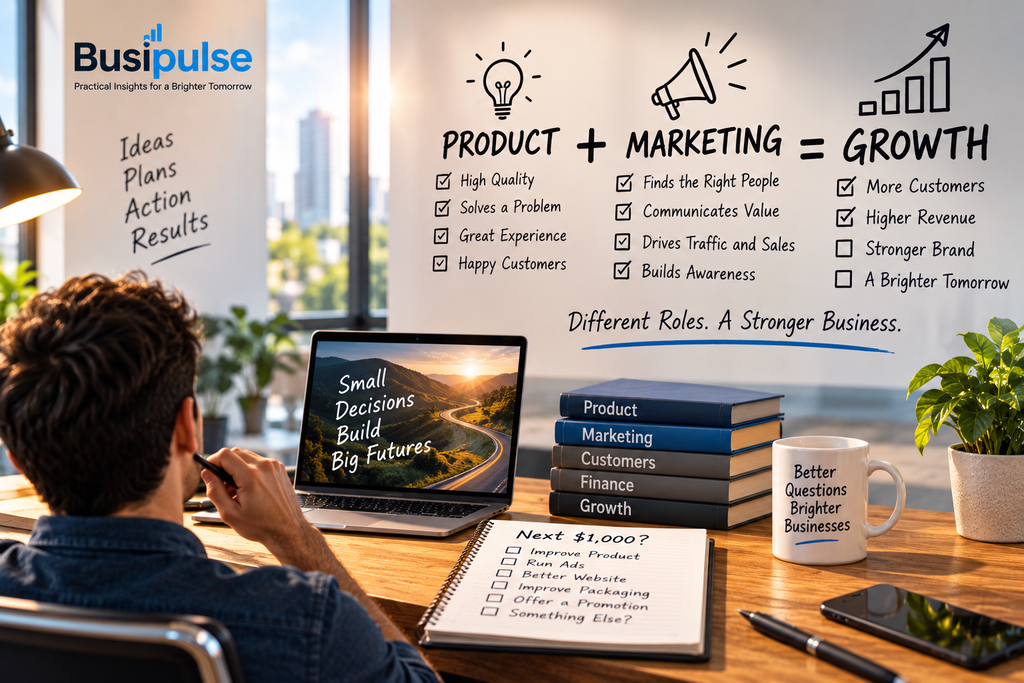
The opposite is also true. Marketing can improve the product because it exposes the business to real customer reactions. Which message attracts attention? Which problem makes people respond? Which customers buy most easily? What questions appear repeatedly? What causes people to walk away? This is why the great product or great marketing debate is not always an either-or question. In practice, one can strengthen the other. Product and marketing work best when each teaches the other something.
Don’t Try to Look Bigger Than You Are
Startups can feel pressure to appear established immediately. A sophisticated website, expensive branding, large advertising campaigns, and polished social media can create the appearance of momentum. But appearance is not the same as progress. There is nothing wrong with professional branding or ambitious marketing. The danger comes when a startup spends heavily creating the image of a successful company before learning whether customers genuinely value what it sells.
A smaller experiment can sometimes produce more useful information. Test one marketing channel. Improve one part of the customer experience. Try a clearer message. Talk to customers who did not return. Find out why some buyers recommend you while others disappear. This is not thinking small. It is learning cheaply before scaling expensively.
A startup with limited resources has one advantage over a large organization: it can often change direction quickly. MIT entrepreneurship guidance explicitly describes startup development as iterative and encourages entrepreneurs to test, learn, and revise rather than becoming attached to the first business model. Use that flexibility while you still have it.
When Should You Push the Marketing Harder?
There is no magic number that tells every business when to increase its marketing budget. But there are useful signals. Customers are buying without extraordinary discounts. Complaints are manageable. Some customers return or recommend the business. You understand why people choose you. You have a reasonable idea of what it costs to produce and sell the product. And additional sales do not obviously make the financial position worse.

At that point, increasing marketing becomes more than an act of hope. You have evidence supporting the decision. Even then, scaling gradually can be sensible. Increase the budget, observe what happens, and make sure the economics still work. A marketing channel that performs well with a small budget does not automatically perform equally well at ten times the spending. Ambition should make a startup move forward. Evidence should help decide how fast.
Great Product or Great Marketing: Which Actually Wins?
The answer should now be clearer. A great product without enough marketing can remain invisible. Great marketing attached to a disappointing product can generate first purchases without building lasting value. But there is a third player in this argument: the business model.

Marketing has to bring the right customers at a sensible cost. The product has to provide enough value for those customers to be satisfied. That gives us a more useful formula than simply choosing product or marketing: Marketing earns attention. The product earns satisfaction. The business model must turn both into sustainable growth. For a startup, the winner is therefore not product or marketing in isolation. The winner is the business that discovers which one needs attention next.
Final Thoughts
You do not need the world’s best product before you start marketing, and you do not need a huge marketing budget before you can build a meaningful business. You need to pay attention. If customers love what you provide but too few people know about it, improve the marketing. If people arrive but leave disappointed, improve the product. If customers are interested but confused, improve the message. If sales are growing but the money is disappearing, examine the economics.
Most importantly, do not spend simply because growth feels urgent. Spend because you understand what problem the money is supposed to solve. A startup rarely becomes strong by perfecting everything at once. It becomes stronger by finding the biggest weakness, improving it, watching what happens, and making the next decision with better information than before. So if you have that $1,000 left in your startup budget, perhaps the first question is not, “Product or marketing?” Ask instead: “What is stopping this business from becoming better right now?” Find that answer, and you will have a much better idea where the next dollar belongs.
Author’s Note
My professional background in financial administration naturally leads me to examine business growth alongside the costs and financial risks behind it. Marketing can create impressive sales numbers, while product development can consume substantial resources of its own. Neither deserves investment simply because conventional business advice says it should come first.
The arguments in this article represent an analytical perspective, not a formula that every entrepreneur is expected to follow. Readers do not need to agree with the author’s conclusions. Different products, industries, markets, and stages of business can lead reasonable entrepreneurs to make very different decisions. The purpose is to provide a framework for thinking about those decisions, not to replace professional advice, independent research, or the entrepreneur’s own judgment.
At Busipulse, the aim is to examine popular business questions from a practical and research-based perspective while leaving room for readers to question the argument, compare it with their own experience, and reach informed conclusions.

[…] we discussed in our previous Busipulse article about great products and great marketing, a business should diagnose what is actually holding growth back before throwing money at the […]
[…] one who simply concludes, “Customers aren’t spending anymore.”That makes understanding what is actually holding a business back especially important before spending more on marketing or changing the […]