



Lower prices win customers in some markets, but that does not mean a lower price automatically builds a stronger business. You have launched a business, and a competitor sells something similar for $100. You are new, customers do not know your name, and getting those first sales is proving harder than expected. Then an obvious solution appears: sell yours for $80. You will be cheaper, customers will notice, and sales should follow. It sounds like one of the easiest ways for a startup to compete.
But what happens when the competitor drops to $75? Do you go to $70? What if another business offers $65? You may keep attracting customers, but with every price cut, less money remains from each sale. Before long, you can find yourself working harder, processing more orders, and wondering why a growing business does not feel financially stronger.
That is the danger of competing mainly on price. Being cheaper can help a startup win a customer, but winning a customer and building a profitable business are not the same thing. Low-price strategies can work extremely well, but only when the business model can support them. Before reaching for the discount button, a startup should understand what that lower price will actually cost.
Why Being the Cheapest Is So Tempting
A new business begins with an obvious disadvantage: customers already know somebody else. Established competitors may have reviews, repeat buyers, recognizable brands, and years of experience. Building those advantages takes time. Lowering a price can be done today.
The logic feels convincing. If two businesses appear to offer roughly the same thing, many customers will naturally prefer the cheaper option. A lower price can also persuade someone to try an unfamiliar company, particularly when buyers are sensitive to price. This is why the idea that lower prices win customers can be so attractive to a new entrepreneur. In some markets, it may be true, but the real question is whether those customers can still be served profitably.
The danger begins when “we’re cheaper” becomes the main reason to choose you. A competitor can copy a price cut much faster than it can copy excellent service, specialist knowledge, customer relationships or a genuinely distinctive product. If price is your only advantage, that advantage can disappear as soon as somebody becomes cheaper. This does not mean a startup should avoid low prices. It means price should be a strategy rather than a reflex.
What a 20% Discount Can Really Cost You
Consider a simple example. You sell a product for $100, and the variable costs associated with producing and delivering it are $60. That leaves $40 per sale to contribute toward fixed costs and eventually profit.

Now reduce the selling price by 20% to $80, while the $60 variable cost remains unchanged. Revenue per sale has fallen by 20%, but the amount remaining after variable costs has fallen from $40 to $20. That is a 50% reduction.
At the original price, 100 sales generate $4,000 toward fixed costs and profit. At the discounted price, you need 200 sales to generate the same $4,000, assuming the costs and other conditions remain unchanged.
That is the calculation many entrepreneurs miss. A 20% discount does not necessarily mean you need only 20% more customers. In this example, you need twice as many sales simply to return to the same contribution dollars.
The U.S. Small Business Administration’s break-even guidance uses the same underlying relationship: selling price and variable cost determine how much each unit contributes toward fixed costs, which in turn affects how many units a business must sell to break even. The practical lesson is simple: never judge a discount only by whether it increases sales; ask whether sales increase enough.
More Customers Can Make You Busier, Not Richer
Suppose the lower price works and orders double. That sounds like success, but twice as many orders can mean more stock, packaging, deliveries, payment-processing fees, customer questions, and returns. You may even need additional staff or equipment.
More customers therefore do not automatically mean more profit. This is similar to what we found when examining the economics behind building a million-dollar business: higher revenue can look impressive while margins and costs tell a very different story. If the amount remaining from each sale becomes too small, growth can increase workload much faster than it improves the financial position. This matters especially for startups. A large company may negotiate lower supplier prices, spread fixed costs across huge volumes, or deliberately accept a thin margin on one product. A small business may have none of those advantages.
That leads to an important distinction: a low price is not the same as a low cost. A business built to operate efficiently at low cost can compete aggressively on price. A business with ordinary costs that simply charges less may be giving away the margin it needs to survive.
But Customers Really Do Care About Price
There is an easy mistake on the other side of this argument: pretending price does not matter. Of course it matters. Customers have budgets, compare alternatives, and sometimes choose primarily on price. A startup charging substantially more than established competitors needs to give people a convincing reason to pay the difference.
The lesson is therefore not “charge more.” It is to know why you are charging what you charge. A lower price may make sense when introducing a product, encouraging trial, clearing inventory, serving a highly price-sensitive market, or operating with a genuine cost advantage. A temporary promotion can also have a clear purpose without turning the company into a permanently cheap brand.
What is dangerous is lowering the price simply because you are afraid customers will say no. Fear can trigger a discount, but it cannot tell you whether the discount makes business sense.
What Are Customers Really Paying For?
Imagine two cafés. One sells coffee for $2.50 and another charges $4.50. Why would anybody choose the more expensive cup? Perhaps the coffee is better. Maybe the location saves ten minutes. The service could be faster, the environment more comfortable, or the quality more consistent. One café might provide a convenient place to work or meet clients. Customers may trust the brand or simply prefer the experience. They are not necessarily comparing two identical cups of coffee.
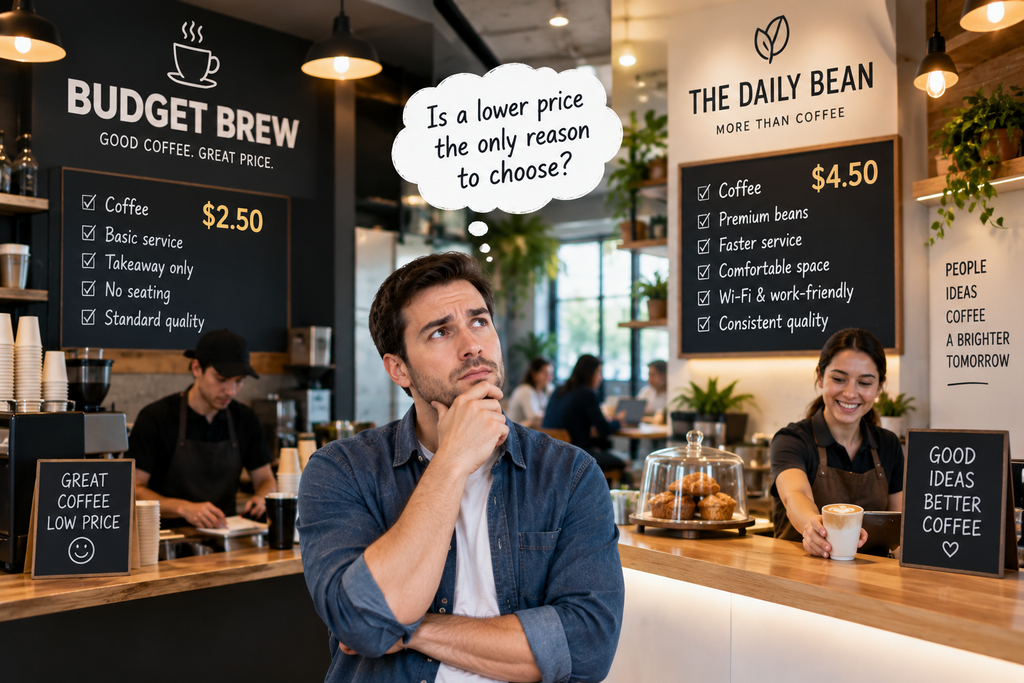
This is where a startup can compete without becoming the cheapest business in town. A small company may not match a large competitor’s purchasing power or advertising budget, but it may offer faster service, specialist expertise, customization, convenience, reliability, or more personal attention.
Harvard Business School’s strategy work distinguishes competing through lower costs from competing through differentiated value. That distinction matters for a startup because differentiation gives customers reasons to choose a business that cannot be reduced to one number on a price tag.
Your Competitor Just Cut Its Price. What Should You Do?
When a competitor reduces its price, it is easy to assume that lower prices win customers automatically. This is where entrepreneurs can make expensive decisions quickly. Before matching the discount, find out whether you are actually comparing the same offers. Does the competitor include the same service, quality, delivery, guarantee, and support? Is the lower price permanent or promotional? Does that company have purchasing power or operating efficiencies you do not have? Then ask an even more important question: Are your customers actually leaving because of price?
If they are, you need to understand whether your cost structure allows you to compete profitably. If they are not, matching a competitor’s discount may mean sacrificing margin to solve a problem you never had. A startup does not need every customer in the market. It needs enough of the right customers at economics the business can sustain.
Give Every Discount a Job
Discounts can be useful. They can encourage a first purchase, introduce a new product, move unwanted inventory, reward loyal customers, or test how strongly customers respond to price. But every discount should have a purpose.
Suppose you normally sell for $100 and introduce an $80 promotional price. Before launching it, decide what success means. Are you trying to attract new customers? Increase repeat purchases? Enter a new market? How many additional sales would compensate for earning less from each transaction?
If you cannot explain what the discount is supposed to achieve, there is a risk that you are simply charging less to customers who might have bought anyway. That is why a better rule for a startup is not “never discount.” It is discount deliberately, measure the result, and know when the promotion should end.
Your Price Is Sending a Message
Price does more than generate revenue. It also helps customers decide what kind of business they are dealing with. A premium service offered at a suspiciously low price can create confusion. A basic product carrying a luxury price creates a different problem. Pricing works best when it matches the rest of the offer.
If your business promises convenience, make the experience convenient. If you charge more because you provide expertise, demonstrate that expertise. If reliability is your advantage, customers should experience that reliability after paying. The strongest price is therefore not automatically the highest or the lowest. It is a price that the business can justify to customers and support financially.
Before You Cut the Price, Ask Four Questions
When sales slow down, resist changing the price immediately. First ask what each sale currently leaves after variable costs, how much will remain after the proposed discount, how many additional sales would be required to recover the difference, and whether there is a realistic reason to expect that increase. Those four questions can prevent a surprisingly expensive mistake.

If the numbers work and a lower price supports your strategy, reduce the price confidently. If they do not, a discount may simply exchange one problem for another: you solve a sales problem and create a profit problem. And if customers still are not buying, investigate before assuming price is responsible. The real weakness may be trust, product quality, positioning, marketing, customer experience, or the audience you are targeting.
When Being the Cheapest Can Be a Powerful Strategy
Some businesses are successful precisely because they compete aggressively on price. There is nothing inherently weak about that strategy. Perhaps technology allows the company to operate with fewer employees. Maybe it has negotiated significantly better supplier terms, eliminated expensive extras, or developed a cheaper distribution model. High sales volume may allow a small margin on each transaction to produce attractive overall economics. In those cases, a lower relative price can become part of a genuine competitive advantage when the business can still provide acceptable value and profitability.
But notice what makes the strategy work. The company is not cheap because the founder became nervous when a competitor lowered a price. The business has been designed to operate successfully at that price. That is the question a startup should ask before entering a price war: What advantage allows us to win this fight? If you cannot identify one, a larger or more efficient competitor may be much better equipped to keep lowering prices than you are.
Do Lower Prices Win Customers? What Your Startup Should Know
Not automatically. Your objective is not to charge the highest price possible, nor is it to charge the lowest. The objective is to find a price customers are willing to pay that also leaves the business enough room to operate, improve, and grow. Sometimes that means being cheaper than competitors. Sometimes it means charging roughly the same. Sometimes a stronger offer can justify charging more.

As we discussed in our previous Busipulse article about great products and great marketing, a business should diagnose what is actually holding growth back before throwing money at the problem. Pricing deserves the same discipline. If customers are not buying, price may be responsible, but so might the product, message, marketing, trust, or target customer. Before cutting the price, understand what you are trying to fix.
Final Thoughts
Being the cheapest can attract customers quickly, and for the right business it can become a powerful strategy. But a startup should never confuse a lower price with an automatic competitive advantage. Understand your costs before reducing your price. Calculate what the discount does to the money remaining from each sale. Ask how many additional customers you would need. Look at what competitors actually provide rather than comparing price tags alone. Most importantly, understand what your customers value besides price.
If your company genuinely has a cost advantage and customers care strongly about price, compete confidently. If it does not, give customers another reason to choose you. That reason might be quality, speed, convenience, expertise, reliability, customization, or service.
A startup does not need to be the cheapest business in the market. It needs to give the right customers a reason to believe its price is worth paying. So when a competitor cuts its price, resist the urge to immediately do the same. Ask yourself one question first: “Can I afford to win customers this way?” The answer may be more valuable than the next sale.
Author’s Note
My professional background in financial administration naturally makes me cautious about pricing decisions that increase sales while reducing the amount each sale contributes toward running a business. Discounts and low-price strategies can be effective, but their financial consequences deserve to be understood before they are used simply as a reaction to competition.
The argument presented here is an analytical framework rather than a universal pricing rule. Readers do not need to agree with the author’s conclusion. Different industries, customer groups, cost structures, and competitive conditions can justify very different pricing strategies. Entrepreneurs should consider their own circumstances, conduct independent research, and seek appropriate professional advice when a pricing decision could materially affect their business.
At Busipulse, the aim is not to tell entrepreneurs that there is only one correct way to build a business. It is to examine popular business assumptions, test them against practical economics and credible evidence, and give readers a stronger basis for making their own decisions.

[…] watch how economic pressure changes customers rather than assuming the answer is always a lower price. Customers may value durability, convenience, smaller packages, flexible payment arrangements, or a […]