


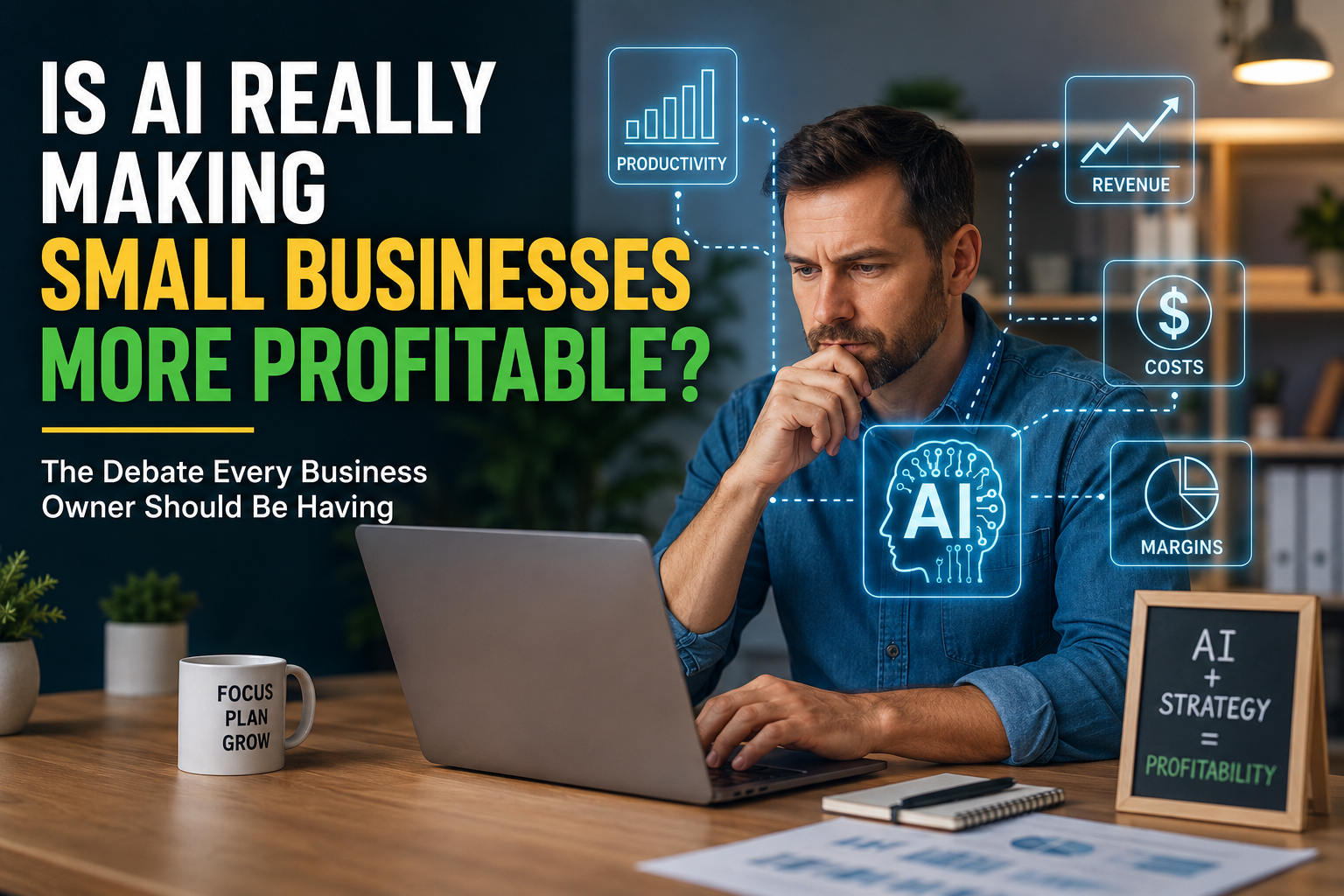
Artificial intelligence has moved from an experimental technology to an everyday business tool remarkably quickly. AI for small businesses is now being used for writing, research, customer service, administration, marketing, data analysis, and a growing range of routine tasks. But while adoption is accelerating, a more important question remains: is AI actually making small businesses more profitable?
The economic argument sounds straightforward: if AI helps a business accomplish more work in less time, costs should fall, and profits should rise. But that assumption skips an important step.
Is AI actually making small businesses more profitable, or is it simply making certain tasks faster?
Productivity and profitability are related, but they are not the same thing. A business can save hours without generating another dollar of profit. It can increase output while prices fall. It can generate more leads without converting more customers. And it can adopt several AI tools only to discover that subscriptions, training, oversight, and mistakes have introduced new costs.
Evidence emerging in 2026 shows that small-business AI adoption is accelerating and that many users report meaningful productivity gains. What remains less certain is how consistently those gains translate into stronger margins and lasting financial performance. That distinction may become one of the most important business questions heading into 2027.
Small Businesses Are Adopting AI Quickly
The direction of travel is clear even though different studies report different adoption rates. Research from the JPMorganChase Institute, based on actual payments by businesses for AI services, found that adoption accelerated sharply after 2023. Newer companies have been particularly quick to adopt: businesses founded in 2025 reached a 10% adoption rate within six months, compared with more than six years for businesses founded in 2019.
Goldman Sachs reported in March 2026 that 76% of small businesses in its survey were using AI. Among those users, 93% said AI had positively affected their business, while 84% identified efficiency and productivity as the main benefit.
Federal Reserve research has also documented rapid adoption, although its estimates vary depending on how AI use is defined and which businesses are surveyed.
The percentages therefore should not be compared as though they measure exactly the same thing. They do not. What they collectively show is more important: AI is moving into ordinary business operations rather than remaining a technology used primarily by large corporations and technology companies. That creates opportunity, but adoption alone tells us little about profit.
The Productivity-Profitability Gap
Imagine a small marketing agency where an employee previously spent three hours creating the first draft of a campaign. With AI, that draft might take 30 minutes. The agency has unquestionably become more productive. But what happens to the remaining two and a half hours? If the employee uses that time to serve additional paying clients, revenue could rise. If the agency avoids hiring another employee, costs could fall. If faster delivery improves customer retention, the financial benefit may appear later. This distinction is especially important when evaluating AI for small businesses, because saving time or producing more work does not automatically mean that a company is earning more profit.
But if the saved time simply gets absorbed by more internal work, the agency may be more efficient without becoming substantially more profitable. This is the gap that gets lost in many discussions about AI.
Saving time creates economic capacity. Management determines what happens to that capacity.
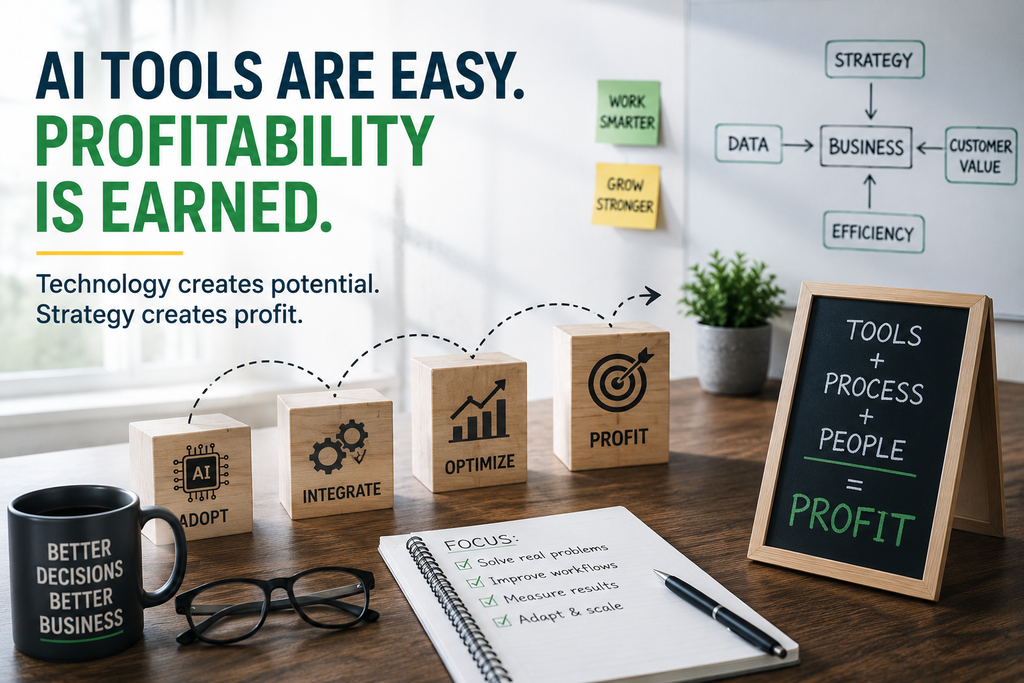
For AI to improve profitability, the benefit eventually needs to appear somewhere measurable: more customers, higher revenue per employee, lower operating costs, improved retention, fewer errors, faster delivery, or better margins.
The same principle applies to entrepreneurs. As we discussed in our analysis of online businesses and emerging digital opportunities, access to new technology does not automatically create a good business. The technology becomes valuable when it solves a problem customers are willing to pay to have solved.
The Benefits Are Real
Questioning AI profitability does not mean dismissing AI as hype. There is growing evidence of genuine operational benefits.
Consider a property-management company. Employees might use AI to summarize maintenance requests, draft routine tenant communications, organize information, prepare reports, or assist with administrative tasks. If the same team can then manage more properties without sacrificing service quality, productivity has become commercially useful.
Or consider a small professional-services firm. AI might reduce the time spent on first drafts, research summaries, scheduling, or documentation. That can free employees to spend more time with clients or on higher-value work. The benefit is not necessarily fewer people. It can be more valuable work from the same people.
Federal Reserve research on small businesses found that nearly half of small employer firms were using AI in some capacity, and 71% of those using it reported increased productivity.
The Bigger Problem Is Implementation
Using an AI chatbot occasionally is not the same as integrating AI into a business. The real challenge with AI for small businesses is therefore not simply gaining access to the technology, but integrating it into workflows where it can produce measurable business value. Goldman Sachs found that although 76% of surveyed small businesses were using AI, only 14% had fully integrated it into their core operations. Nearly three-quarters said they would benefit from additional training and resources. That gap deserves attention. There is a considerable difference between saying:
“Our employees use AI.”
and:
“AI has changed how our company operates and improved its economics.”
The second requires more than buying software. Businesses need to identify suitable processes, train employees, redesign workflows, establish quality controls, protect data, and measure results. This echoes a broader point from our Busipulse discussion of how prompt engineering is evolving: the durable skill may not be knowing the perfect instruction for an AI system. It may be understanding how people, information, AI, and business processes should work together. That is a management challenge, not merely a technology challenge.
More Revenue Does Not Always Mean Better Margins
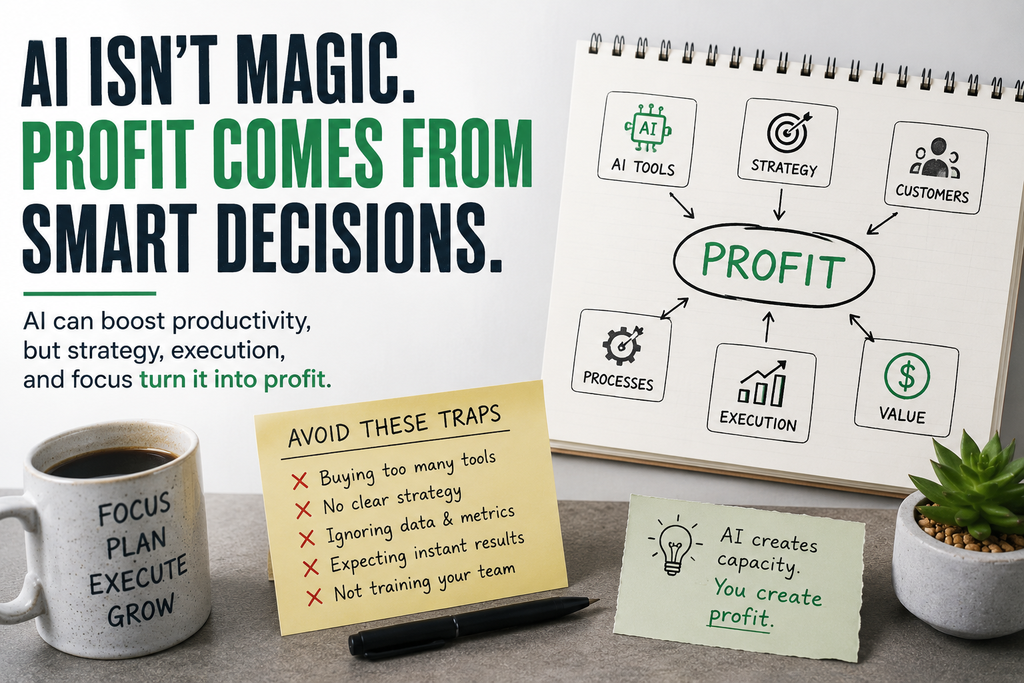
Suppose a design company previously completed ten projects each month. AI helps it complete fifteen. Revenue rises. On the surface, AI appears to have worked. But perhaps competitors are also using AI and charging lower prices. The company may need to spend more on advertising to win clients. Software subscriptions increase. Employees spend additional time reviewing AI-generated work. Customers begin expecting faster turnaround without accepting higher prices. The company has increased capacity, but its profit margin may barely change. This possibility becomes more important as AI tools become widely available.
When only a few businesses possess a powerful technology, it can create a competitive advantage. When everyone can buy similar capabilities for a modest monthly subscription, the technology itself becomes less distinctive. The question changes from: “Does your business use AI?” to: “What does your business do with AI that creates measurable value?”
AI Itself May Not Be the Competitive Advantage
This may be the most important lesson for small businesses. If your competitor can subscribe to the same AI service tomorrow, access to the tool is not much of a moat.
A real estate company can use AI to summarize property information. A marketing company can use it to generate campaign ideas. A retailer can use it to draft product descriptions. Thousands of competitors can do the same. The stronger advantage comes from combining AI with assets that are harder to copy:
- Proprietary or specialized data
- Industry expertise
- Customer relationships
- Brand reputation
- Efficient workflows
- Distribution
- Local knowledge
- Human judgment
A company with strong customer relationships and excellent processes may become significantly better when AI is added. A badly managed company does not become well managed simply because it purchases AI software.
AI Has Costs Too
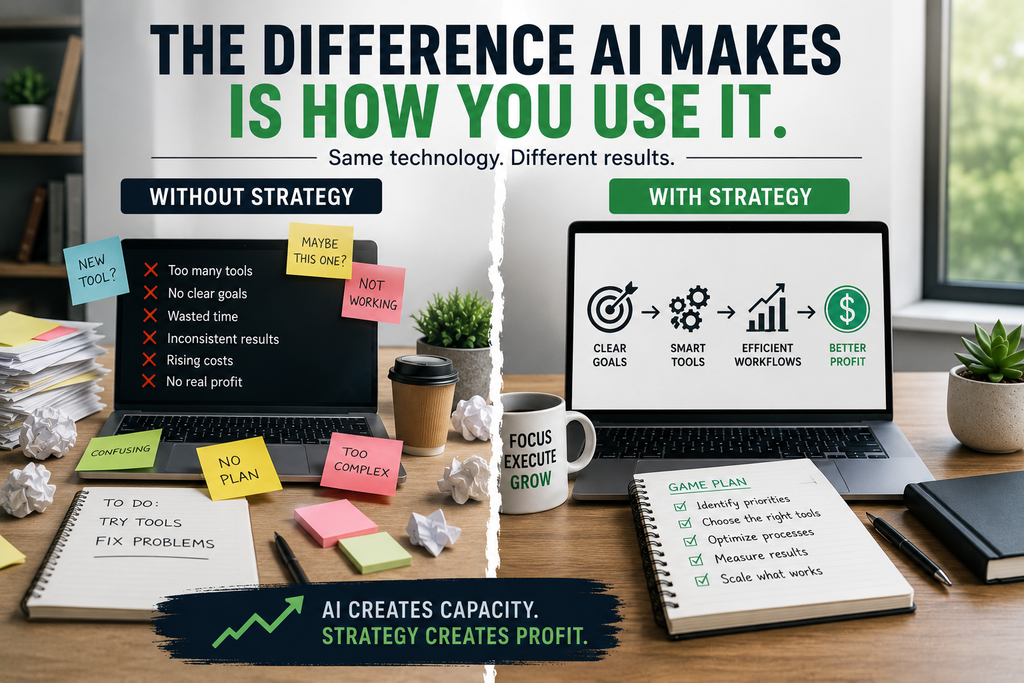
Many AI tools appear inexpensive compared with hiring additional employees or purchasing traditional enterprise software. But businesses should measure more than the monthly subscription. AI can introduce direct and indirect costs through:
- Multiple software subscriptions
- Employee training
- System integration
- Data-security requirements
- Human review
- Incorrect outputs
- Workflow disruption
- Time spent testing and replacing tools
Goldman Sachs’ survey found that small businesses continue to report concerns about data privacy, security, technical expertise, and choosing appropriate AI tools. For management, the useful calculation is therefore not simply: How much does this AI tool cost? It is: What is the total cost of using it, and what measurable financial benefit does it produce? That question can prevent a business from accumulating an expensive collection of tools that employees barely use.
Does Every Small Business Need AI?
Probably not in the same way. The case for AI for small businesses depends heavily on the type of work being performed, the cost of implementation, and whether the technology solves a real operational problem. A software company and a neighborhood plumbing business have very different requirements. The plumber may never need an elaborate AI infrastructure. But AI could still help with appointment scheduling, customer follow-ups, estimates, marketing, bookkeeping, and organizing inquiries.
A restaurant might use AI for marketing and demand analysis without allowing it anywhere near decisions that require human judgment about food safety or customer care. The objective should not be to introduce as much AI as possible. A better starting point is:
Which activities in this business are repetitive, expensive, slow, or unnecessarily manual?
Then ask whether AI can improve them safely and economically. That approach starts with the business problem rather than the technology.
What About Jobs?
Profitability discussions inevitably raise another question: if AI increases output per employee, will businesses simply employ fewer people? So far, the evidence is more complicated than that.
The U.S. Chamber Foundation’s 2026 research found that workers at small businesses were predominantly using AI to increase productivity rather than automate themselves out of employment.
Goldman Sachs similarly reported that 87% of surveyed small businesses using AI said the technology was augmenting rather than displacing their workforce.
That does not guarantee future employment will remain unchanged. Routine tasks are likely to become increasingly automated. Some roles will change, and some businesses may eventually require fewer employees for particular functions. But another possibility is equally important: employees spend less time on repetitive work and more time on sales, customer relationships, problem-solving, supervision, and higher-value decisions. The economic outcome will depend on how companies use the productivity gains they achieve.
How Small Businesses Should Measure AI
Instead of asking employees whether they “like” an AI tool, businesses should measure what changes after introducing it. The financial value of AI for small businesses should ultimately be judged by results, not by how many AI tools a company uses. A simple evaluation can begin with five questions:
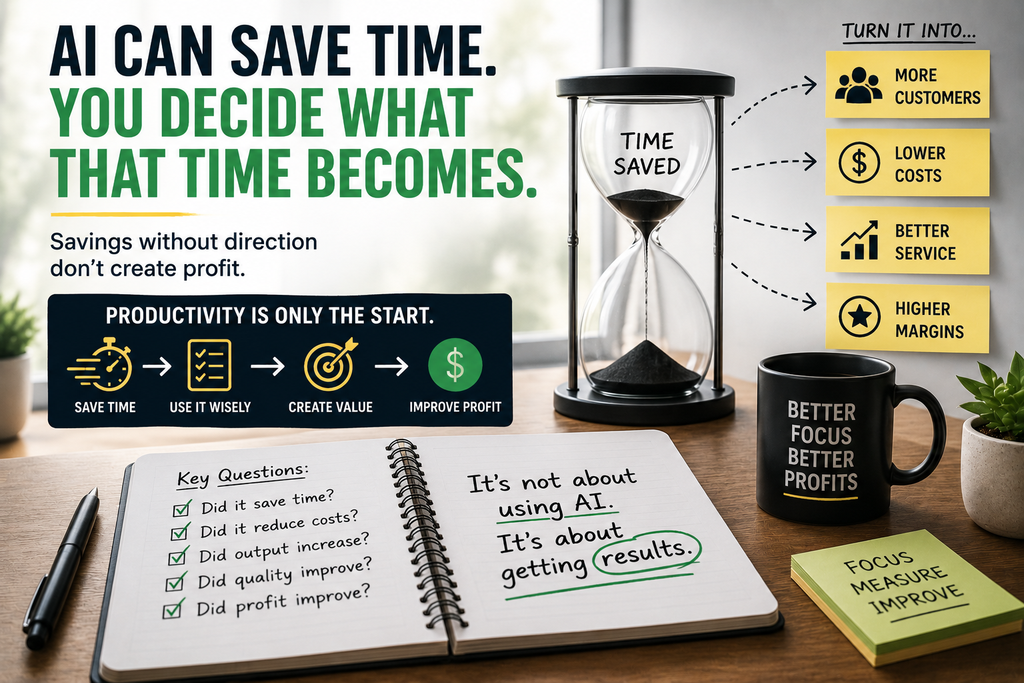
- Did the task become faster? Measure actual time saved.
- Did the task become cheaper? Include software, training, and review costs.
- Did output increase? Track customers served, projects completed, or transactions handled.
- Did quality improve or deteriorate? Efficiency is worthless if errors and complaints rise.
- Did the financial result improve? Look at revenue per employee, customer retention, operating costs, and margins.
If none of those measures improves after a reasonable testing period, the business should question whether the tool is creating value at all. This is where disciplined small companies may outperform enthusiastic ones. The winner is not necessarily the business with ten AI subscriptions. It may be the business that identifies two expensive bottlenecks, improves them, and measures the result.
So, Is AI Making Small Businesses More Profitable?
For some businesses, almost certainly. For others, not yet. The evidence is increasingly persuasive that AI can improve productivity and help small businesses complete work faster. Business owners and workers also report substantial perceived benefits. What remains less established is whether those productivity gains are consistently translating into higher profit margins across the small-business economy. That is the evidence worth watching next. Instead of focusing only on adoption rates, researchers and business owners should pay attention to:
- Revenue per employee
- Operating margins
- Customer acquisition costs
- Customer retention
- Output per worker
- Return on AI investment
Those measures will tell us far more about AI’s economic impact than the number of businesses with an AI subscription.
Final Thoughts
AI is already changing how small businesses operate. The debate is no longer whether entrepreneurs should pay attention. They should. The more important question is whether they can convert AI’s productivity gains into lasting economic value. That still requires things technology cannot provide by itself: good management, a product or service customers value, sensible pricing, cash-flow discipline, strong relationships, reliable execution, and sound judgment.
AI can make some work faster and cheaper. It can allow small teams to accomplish things that previously required larger organizations. But a business that saves ten hours has not necessarily made more money. A business that turns those ten hours into additional customers, lower costs, better service, or higher-value work may have.
That is the difference between using AI and benefiting from AI.
As we move toward 2027, the strongest small businesses may not be those using the most artificial intelligence. They may be the ones that understand what to automate, what to measure, where AI genuinely improves the economics, and where human judgment remains more valuable.
Author’s Note
This article is intended for general informational and educational purposes. AI adoption, costs, productivity gains, security requirements, and financial outcomes vary significantly by business, industry, and market. Businesses should evaluate AI investments against their own objectives, operating costs, risks, and measurable results rather than assuming that AI adoption will automatically increase profitability.
Readers are not required to agree with the author’s views. The purpose of this article is to encourage informed discussion, critical thinking, and independent analysis of the issues presented.

[…] is similar to the profitability question surrounding AI for small businesses: productivity and technological capability matter, but they do not automatically become financial […]
[…] but capacity does not automatically become profit. As we discussed in our Busipulse analysis of AI for small businesses, productivity becomes financially meaningful when a company converts it into lower costs, greater […]