



By Nick Gentle | Founder & Writer | Busipulse
For a while, prompt engineering looked like one of the clearest new skills created by the generative-AI boom.
People learned how to structure instructions, provide examples, define roles, add constraints, and refine their wording. Companies began discussing prompt libraries and prompt-engineering roles. A seemingly simple question—how do you get an AI model to produce a better answer?—became a specialized discipline. But something has changed.
The newest AI systems are becoming better at understanding ordinary language, handling context, using tools, and working through multi-step tasks. The result is an awkward question for an industry that spent years teaching people how to write the “perfect prompt”: what happens when AI becomes good enough that the prompt itself matters less?
The evidence does not support declaring prompt engineering dead. In fact, recent labor-market data shows that demand for AI skills, including skills such as prompt engineering, is still growing. PwC’s 2026 Global AI Jobs Barometer, based on more than one billion job advertisements, found that jobs requiring specific AI skills grew 69% year over year, compared with 9% growth across the overall jobs market. (PwC)
The more interesting story is not that prompting is disappearing.
It is that prompting may be becoming only one component of a much larger skill: designing how people, AI, information, and business processes work together.
1. How Prompt Engineering Became a Business Skill
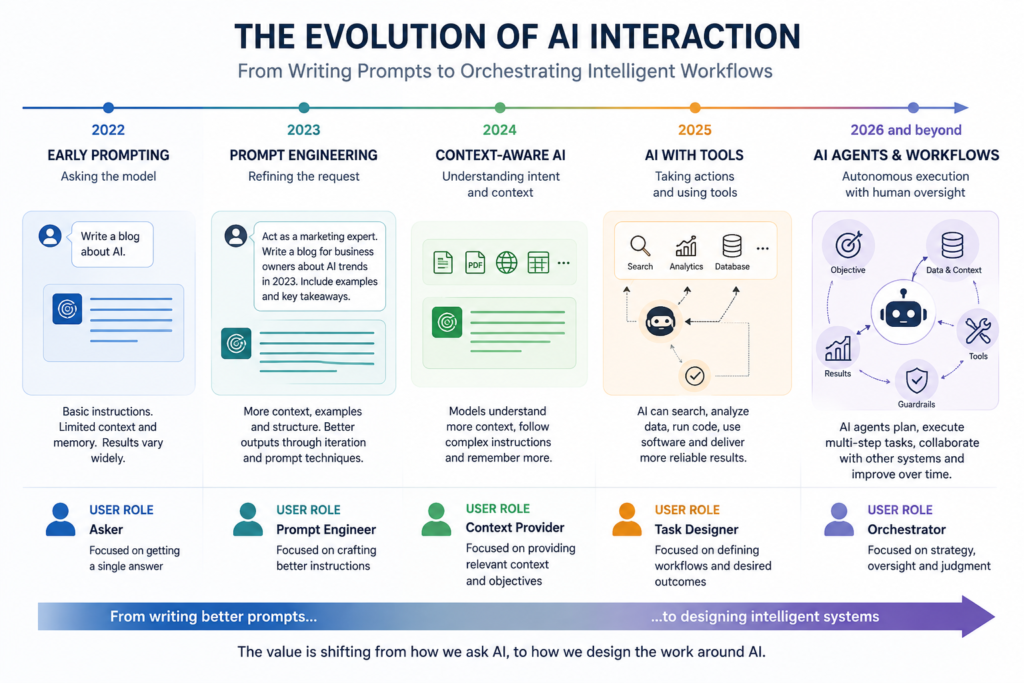
Early generative-AI systems were surprisingly sensitive to how users communicated with them. A vague request could produce a vague answer. A carefully structured instruction, supported by examples and constraints, could produce something considerably better. Users discovered that specifying the objective, providing context, and showing the desired output format often made a substantial difference. That led to the rise of prompt engineering.
The discipline was never simply about writing long prompts. At its core, it was about understanding how an AI model responds to instructions and finding ways to make its output more useful, consistent, and controllable. For businesses, the attraction was obvious.
A marketing team could use AI to produce campaign variations. A software team could ask it to analyze code. An analyst could summarize large amounts of information. A customer-service department could use AI to draft responses.
The better employees became at communicating with the system, the more useful the system appeared to become. Prompt engineering therefore emerged at the intersection of communication and technology. But it was always partly dependent on the limitations of the technology available at the time. As those limitations change, the skill itself has to change.
2. Why AI Is Making the “Perfect Prompt” Less Important
The first reason to question the future of traditional prompt engineering is simple: AI models are getting better at understanding what people mean. Users increasingly interact with models through ordinary language rather than carefully engineered commands. Modern systems can handle more context, follow complicated instructions, reason through problems, and interact with external tools.
That does not mean prompting has stopped mattering. OpenAI’s current API guidance still treats prompt engineering as an important part of developing reliable applications and recommends testing prompts through evaluations as models and applications evolve. (OpenAI Developers)
But there is an important distinction between prompting becoming easier and prompting becoming irrelevant. They are not the same thing. If an AI model can infer what a user means from a naturally worded request, the value of memorizing elaborate prompt formulas declines. The user may no longer need to know exactly which instruction sequence produces the best result. The technology can increasingly do some of that interpretive work itself.
The rise of AI agents makes the shift even more significant. OpenAI now describes agents as applications that can plan, call tools, collaborate across specialists, and maintain enough state to complete multi-step work. (OpenAI Developers) In that environment, the central problem is no longer always:
“What words should I put in the prompt?”
It becomes:
“How should this task be structured so the AI can actually complete it?”
That is a much bigger question.
3. Why Prompt Engineering Isn’t Dead
There is a danger in taking the argument too far. The phrase “prompt engineering is dead” makes for a good headline, but the available evidence does not justify it.
PwC’s 2026 research found that jobs requiring specific AI skills—including prompt engineering and machine learning—are growing substantially faster than the overall labor market. It also found that AI-skilled workers command a wage premium and that companies gaining the most from AI are not necessarily shrinking their workforces; leading companies are showing stronger productivity, wage, and employment growth. (PwC) So why would prompting remain valuable if AI is becoming easier to use? Because business problems are rarely as simple as asking a question.
Consider a company trying to use AI for financial analysis. The challenge is not merely getting the model to produce an answer. The company has to determine which data should be supplied, what assumptions should be permitted, which calculations require verification, what sources are authoritative, and what conclusions require human approval.
The same applies to legal research, software development, medical information, investment analysis, customer intelligence, and enterprise automation. In these environments, instructions still matter. But they are only part of the equation. A useful distinction is between asking AI a question and designing a reliable AI workflow. The first can often be done with ordinary language. The second requires considerably more thought.
This is why sophisticated prompting is unlikely to disappear completely. It is more likely to become embedded inside larger systems—templates, applications, agents, evaluation processes, and business workflows.
Anthropic makes this evolution particularly explicit. Its engineering team describes context engineering as a natural progression from prompt engineering: rather than focusing only on the wording of instructions, developers need to determine what information and context an AI system receives at each stage of a task. (Anthropic) That may be the more important transition.
4. The Real Shift: From Prompt Writing to AI Workflow Design
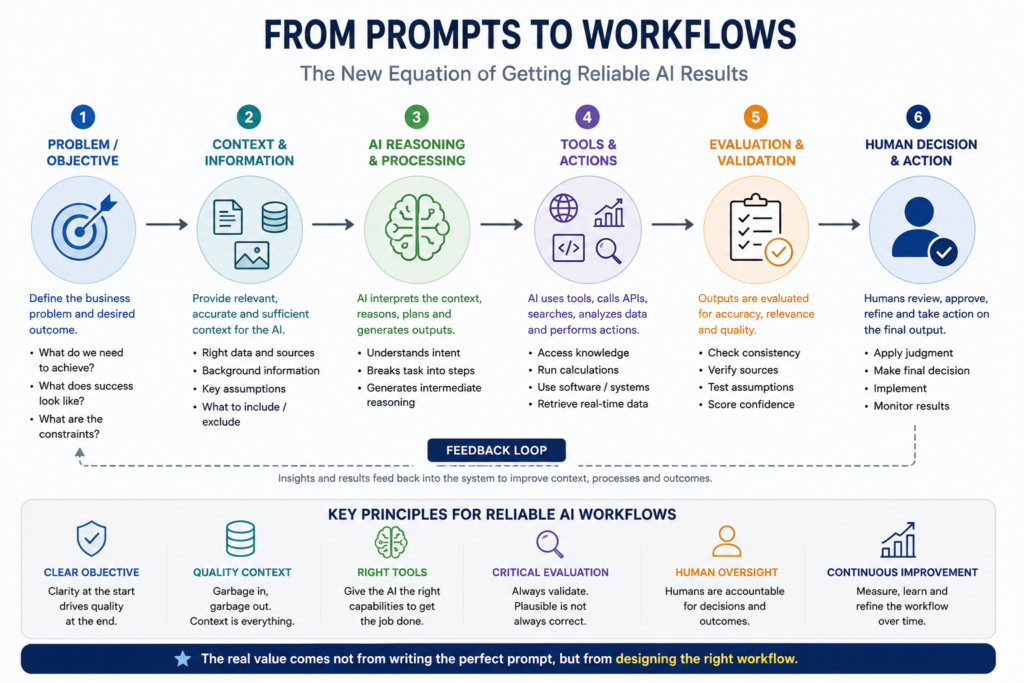
The most valuable AI skill may increasingly be found one level above the prompt.
Imagine two employees.
The first knows how to write an impressive instruction asking an AI to analyze a company’s sales performance.
The second understands which sales data the AI should access, how the information should be cleaned, what questions the analysis should answer, which tools the system should use, how the result should be tested, and when a manager needs to review the conclusion.
The second employee is doing something much closer to AI workflow design. That difference will matter as AI systems become more capable. A business workflow might eventually look like this:
Business objective → relevant context → AI reasoning → tool use → intermediate results → evaluation → human decision
The prompt may still exist somewhere inside that chain. But it is no longer the whole skill. This broader capability includes several elements.
Problem definition. Before asking AI to solve something, someone must understand what problem actually needs solving.
Context management. The system needs accurate and relevant information rather than simply more information.
Tool selection. An AI agent may need access to databases, search, spreadsheets, software, or other applications.
Evaluation. A plausible-looking answer is not necessarily a correct answer.
Human oversight. Someone must determine when the system can act independently and when a person should intervene.
Domain expertise. An AI system may generate an impressive analysis, but an industry expert is often better positioned to recognize whether the analysis makes sense.
This is why the future of AI skills may be less about mastering a particular interface and more about understanding the entire system surrounding it.
5. What Businesses Should Train Employees to Do
This has a direct implication for corporate training. Businesses should certainly teach employees how to interact effectively with AI. But making “prompt engineering” the universal objective may be too narrow.
The World Economic Forum’s Future of Jobs Report 2025 found that employers expect 39% of workers’ existing skill sets to be transformed or become outdated by 2030. It also identifies AI and big data among the fastest-growing skills, while analytical thinking remains a leading core skill. (World Economic Forum) That points toward a broader training model.
Teach people to define problems
Employees should learn to distinguish between a task that is merely time-consuming and a problem that AI can meaningfully improve.
A badly defined problem does not become a good problem simply because AI is involved.
Teach context management
Employees need to understand what information an AI system needs, what information it should not receive and how the quality of context affects the result. This becomes particularly important when AI is connected to company data and internal systems.
Teach critical evaluation
AI literacy without skepticism can create a dangerous combination: employees who are extremely productive at producing unreliable information. Workers need to recognize unsupported claims, hallucinations, weak reasoning, inconsistent calculations, and fabricated sources.
Preserve domain expertise
AI does not eliminate the value of knowing finance, marketing, engineering, law, real estate, or supply-chain management. In many cases, domain expertise becomes more valuable because someone still has to judge whether the machine’s output is commercially meaningful.
Teach workflow design
The biggest productivity gain may come not from writing a clever prompt but from redesigning a repetitive process around AI. That requires understanding where AI fits, where automation makes sense, and where humans should remain involved.
Develop judgment
The more capable AI becomes, the more important judgment may become—not less.
The World Economic Forum’s research points toward a labor market in which technological skills and human capabilities increasingly coexist rather than simply replacing one another. (World Economic Forum) The goal, therefore, should not be to turn every employee into a prompt engineer. It should be to create employees who know when, where, and how to use AI responsibly and effectively.
6. What AI Agents Change
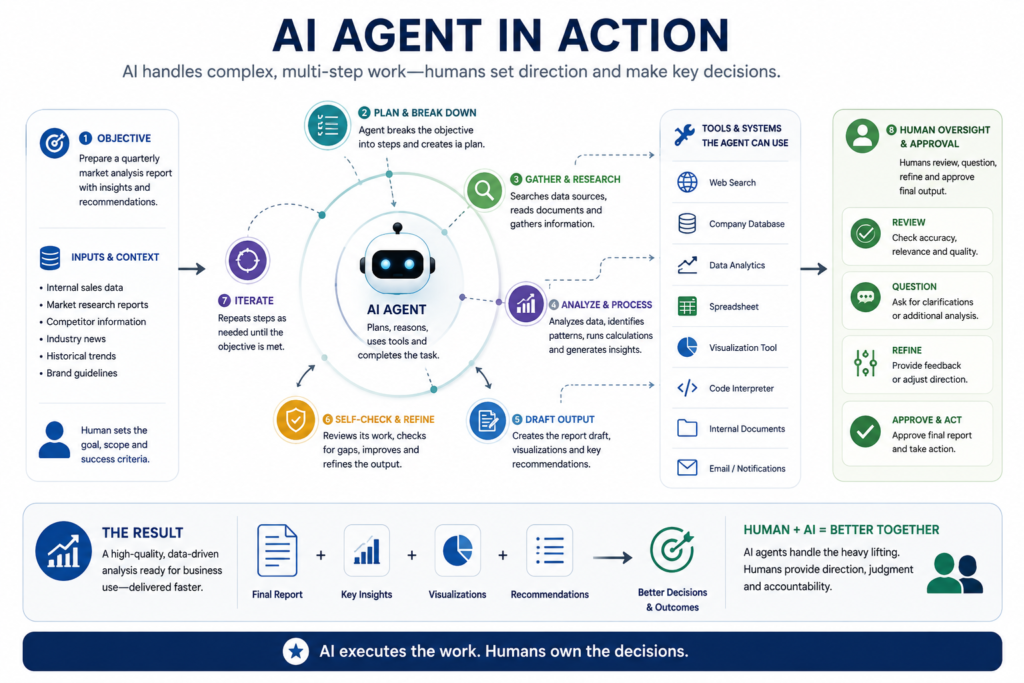
The arrival of AI agents could accelerate this transition. A conventional chatbot waits for a user to ask something and then produces an answer. An agent can operate differently. It can break a task into steps, use tools, inspect results, continue working, and potentially hand off tasks between specialized systems. OpenAI’s current agent documentation describes agents as systems capable of planning, tool use, collaboration across specialists, and multi-step work. (OpenAI Developers)
Anthropic is also working on systems capable of handling increasingly complex, long-running tasks, while emphasizing the engineering challenges involved in making such systems reliable. (Anthropic) This changes the role of the human. Instead of manually providing every instruction, the human may increasingly provide an objective, constraints, context, and authority. The AI then performs more of the intermediate work. That does not remove the need for human expertise. It changes where that expertise is applied. The human may become the:
problem definer, system designer, evaluator, and decision maker.
This also explains why AI governance and security matter. Once AI systems can access tools and act on behalf of users, a bad instruction is no longer merely capable of producing a bad paragraph. It can potentially lead to an inappropriate action.
OpenAI’s 2026 work on protecting agents against prompt injection illustrates the issue: securing agentic systems increasingly means limiting the consequences of manipulated instructions rather than assuming every malicious input can simply be detected perfectly. (OpenAI) The more autonomous AI becomes, the more important system design becomes.
7. What This Means for Careers and Businesses
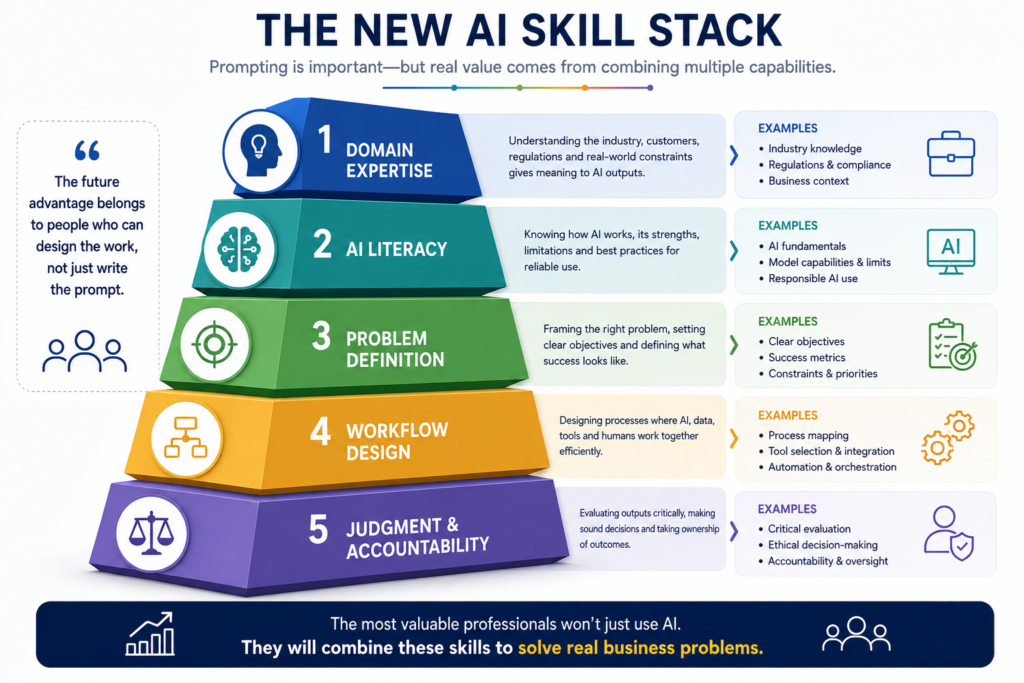
For people considering careers in AI, the lesson is not to abandon prompt engineering. It is to avoid treating it as the entire career. A standalone ability to produce clever prompts may become less differentiated as models improve and AI products absorb more of the underlying complexity. A stronger combination is:
AI capability + domain expertise + analytical thinking + workflow design + judgment.
That combination is harder to commoditize. The labor-market evidence already points toward growing demand for AI skills rather than their disappearance. PwC’s research shows rapid growth in jobs requiring specific AI skills, while the World Economic Forum expects substantial changes in workplace skill requirements through 2030. (PwC)
For entrepreneurs, the implication may be even more important. The opportunity is unlikely to remain concentrated in businesses selling clever prompts. There is potentially greater value in solving the underlying business problem. That could mean building AI implementation services, workflow-automation businesses, vertical AI applications, evaluation systems, enterprise integrations, AI training programs, or governance tools. The distinction is simple:
A prompt is an instruction. A business solves a problem.
Entrepreneurs should therefore look beyond the interface. Where does a company lose time? Where does information get trapped? Which decisions are repetitive? Which processes require too much manual work? Where could AI produce a measurable improvement? Those questions are likely to remain valuable even as the underlying AI models change.
The safest strategy is not to build a business around a temporary trick in the interface. It is to build around a durable problem. Businesses looking to turn emerging AI capabilities into practical ventures can also explore our guide to 7 Smart Online Businesses to Start in 2026.
Conclusion: The Prompt May Become Smaller. The Skill Around It May Become Bigger.
Prompt engineering is not obsolete. But the version of prompt engineering that treats the perfect sentence as the main competitive advantage may have a limited shelf life.
AI models are becoming better at interpreting natural language. AI products are absorbing more of the complexity of interaction. Agents are beginning to plan, use tools, and execute multi-step workflows. At the same time, employers continue to increase their demand for AI-related skills. Those developments are not contradictory. They suggest that the skill is moving. The question used to be:
How do I tell the AI exactly what to do?
Increasingly, the harder question is:
What should the AI do, what information should it use, how should the work be structured, and how will we know whether the result is good enough?
That is a much broader capability.
For businesses, the lesson is therefore not to stop teaching employees how to prompt AI. It is to put prompting in its proper place as one tool within a larger discipline of AI literacy, workflow design, evaluation, and human judgment. The people who understand that shift may have an advantage over those still searching for the perfect prompt. Because as AI gets better at understanding instructions, the scarce skill may no longer be telling machines what to say. It may be knowing what is worth asking them to do.
Sources & Further Reading
- PwC — 2026 Global AI Jobs Barometer: AI-skilled employment, productivity, wages and changing workforce demand. (PwC)
- World Economic Forum — Future of Jobs Report 2025: changing skills, AI adoption, analytical thinking and workforce transformation. (World Economic Forum)
- OpenAI — Agents documentation: planning, tool use, specialist collaboration and multi-step AI work. (OpenAI Developers)
- OpenAI — New tools for building agents: the transition toward AI systems capable of independently accomplishing tasks. (OpenAI)
- Anthropic — Effective context engineering for AI agents: the evolution from prompt engineering toward context engineering. (Anthropic)
- Anthropic — Long-running agents: engineering challenges involved in increasingly autonomous AI systems. (Anthropic)
Editorial Note
This article examines the evolving role of prompt engineering as AI models become more capable of understanding natural language, using tools, and performing multi-step tasks. Its central argument is based on current research and industry developments available at the time of publication. Because AI technology is developing rapidly, some capabilities, practices, and labor-market trends discussed here may change.
Disclaimer
Disclaimer: This article is intended for general informational and educational purposes only. References to companies, technologies, employment trends or future developments reflect publicly available information and editorial analysis, not investment, career or business advice. Readers should conduct their own research before making professional or commercial decisions based on the information presented.

[…] protect data, and measure results. This echoes a broader point from our Busipulse discussion of how prompt engineering is evolving: the durable skill may not be knowing the perfect instruction for an AI system. It may be […]
[…] changes. This trend also connects with a broader question Busipulse has examined before: how prompt engineering is evolving as AI tools become easier to use and the value shifts toward broader capabilities. The lesson is […]