


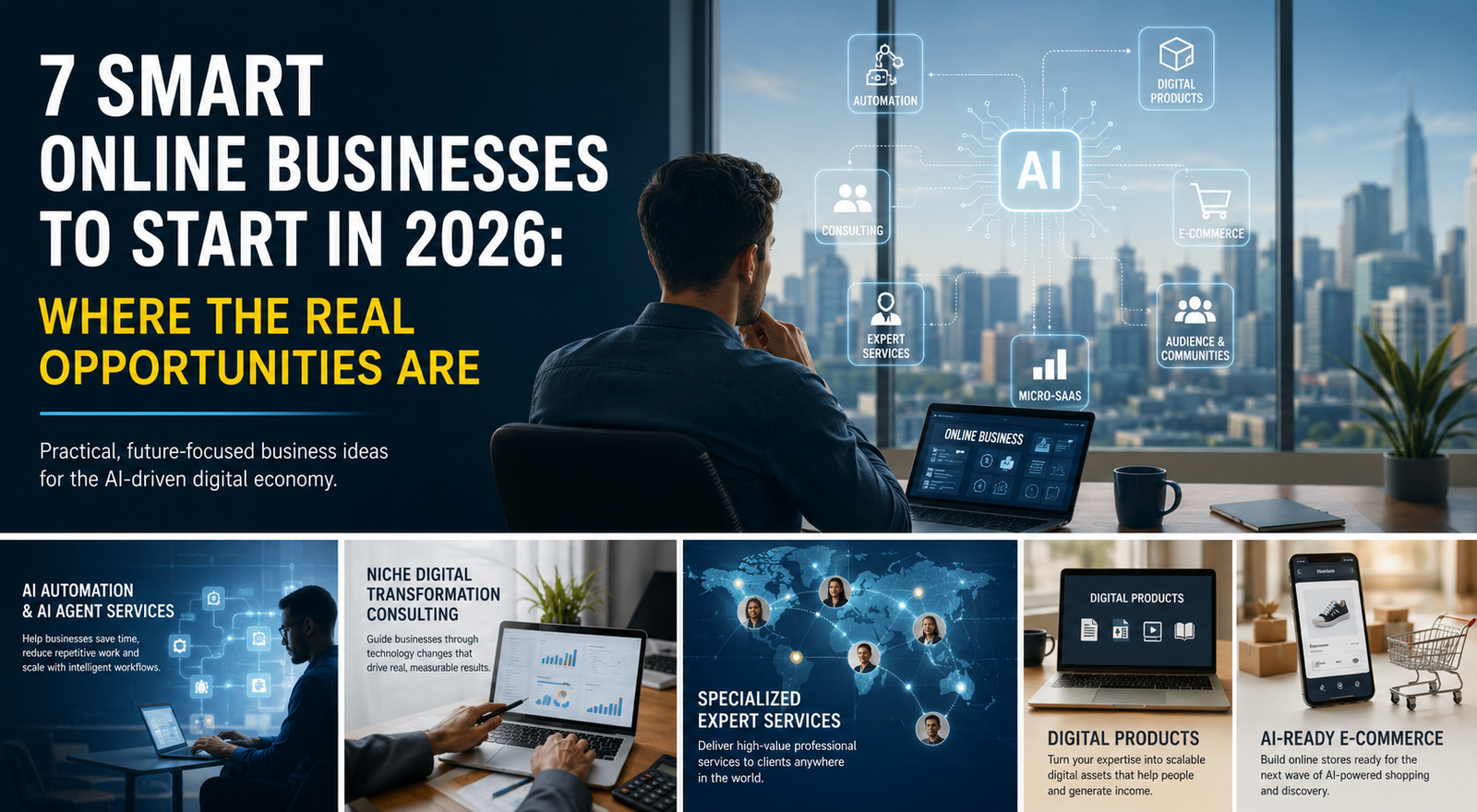
Online businesses to start in 2026 are no longer limited to traditional e-commerce stores or freelance services. Advances in AI, changing consumer behavior, and increasingly accessible digital tools are creating new opportunities for entrepreneurs willing to solve real problems.
A business idea does not become good simply because it is online.
That may sound obvious, but it is worth remembering in 2026, when almost every week seems to bring a new AI tool, a new digital platform, and another promise that anyone can build a business from a laptop. The more interesting question is this:
Where is technology creating a gap between what businesses can do and what they are actually able to do?
That gap may be where some of the most interesting opportunities are emerging. Artificial intelligence is a good example. The World Economic Forum’s Future of Jobs Report 2025, based on more than 1,000 employers representing more than 14 million workers across 55 economies, identifies technological change as one of the major forces reshaping business through 2030. It also ranks AI and big data, networks and cybersecurity, and technological literacy among the fastest-growing skill areas. (World Economic Forum) Yet adoption is not the same as effective implementation.
McKinsey’s 2025 global survey found that 88% of respondents said their organizations were regularly using AI in at least one business function, but most organizations were still experimenting or piloting rather than scaling AI across the enterprise. Sixty-two percent said their organizations were at least experimenting with AI agents. McKinsey also found that redesigning workflows was strongly associated with organizations capturing greater value from AI. (McKinsey & Company)
That is where the opportunity starts to become interesting. The entrepreneur of 2026 does not necessarily need to invent the next major technology. There is growing room for people who can take technology that already exists and make it genuinely useful to a particular business, profession or customer.
This article therefore takes a different approach to the familiar lists of online “side hustles.” Some of the businesses below are established models entering a new phase. Others are emerging opportunities that were difficult to imagine at this scale only a few years ago.
The common thread is simple: they solve a real problem, use digital technology as leverage, and have the potential to become more valuable as the digital economy develops.
Here are 7 online businesses to start in 2026.
1. AI Automation and AI Agent Services
There is a surprisingly large difference between knowing how to use an AI chatbot and knowing how to improve a company’s workflow with AI. That difference is a business opportunity.
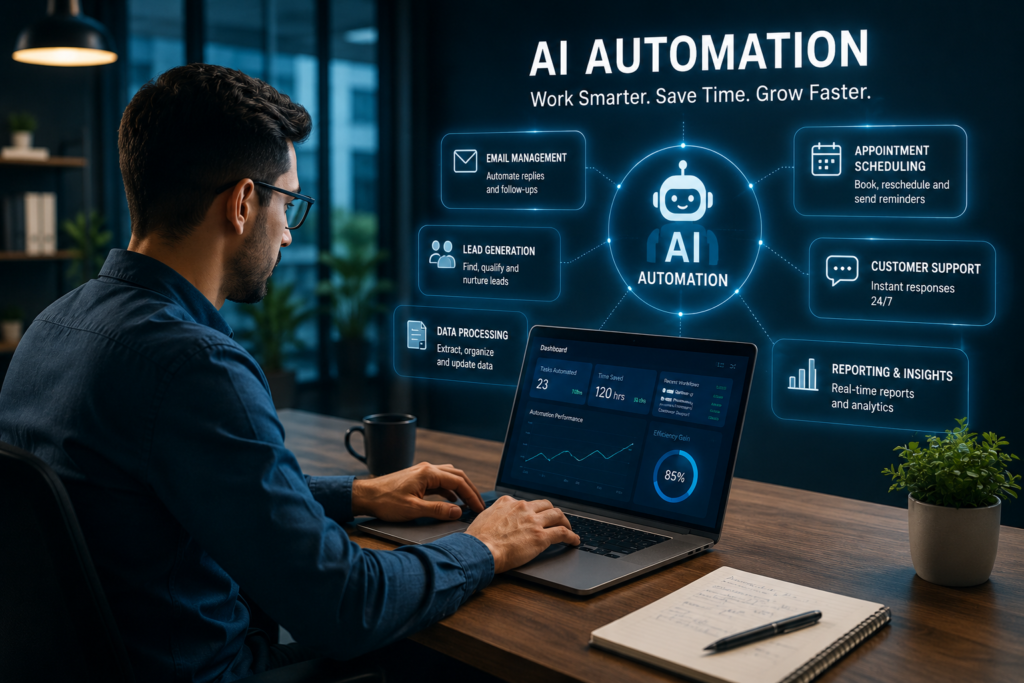
Consider a small dental clinic. Staff may spend hours answering routine questions, confirming appointments, sending reminders, following up with patients, and organizing information.
An AI-assisted workflow could handle some of those repetitive tasks while sending unusual or sensitive cases to a human employee.
The entrepreneur providing the service does not need to invent an AI model. The value lies in understanding the client’s business, identifying repetitive processes, and connecting the right technology to the right workflow.
A client is not really buying “AI.” They are buying fewer repetitive tasks, faster responses, better organization, or a process that no longer depends on someone performing the same manual work every afternoon. That distinction matters.
The market is already crowded with people selling generic “AI services.” A more defensible position is to become the person who can say:
“I understand this particular business problem, and I know how to improve it.”
McKinsey’s research supports the underlying opportunity. Although AI adoption is now widespread, most organizations have not yet embedded it deeply enough into their operations to capture material enterprise-level benefits. Its research suggests that organizations achieving more value are increasingly redesigning workflows rather than simply adding AI to individual tasks. (McKinsey & Company)
A specialist could therefore build automation systems for healthcare practices, hospitality businesses, recruitment agencies, professional firms, retailers or manufacturers. The opportunity is not really “selling AI.” It is selling a better way of doing something.
There is, however, a less comfortable side to this business. AI tools change quickly. Anyone entering this field will need to keep learning, testing, and replacing tools when better ones appear. Technical knowledge alone will not be enough; understanding the customer’s business may matter just as much.
2. Niche Digital Transformation Consulting
Many small and medium-sized businesses know they need to modernize.
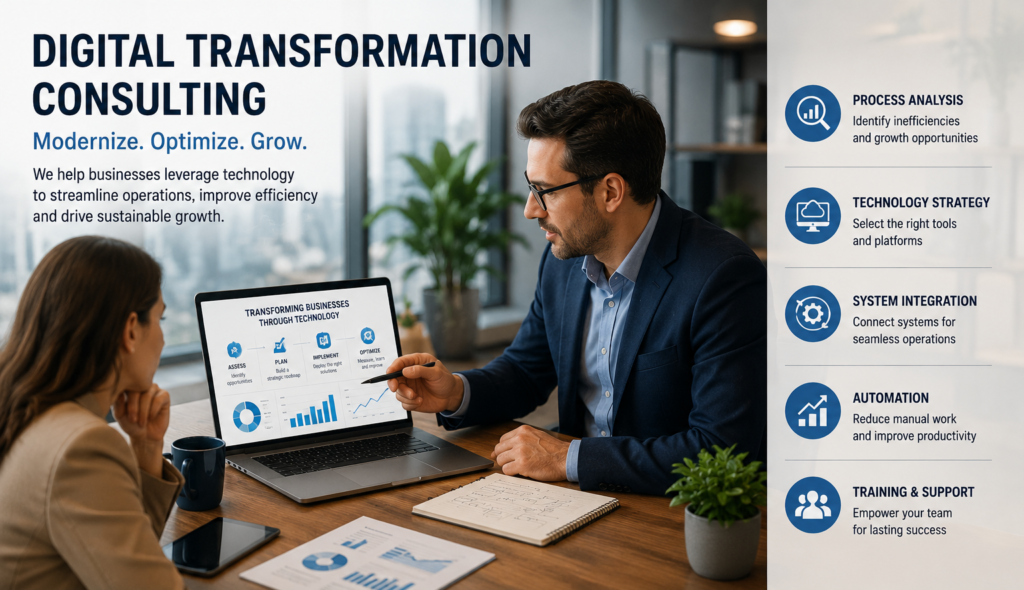
For many owners, the problem is not resistance to technology. They simply do not know which problem to tackle first. This is where online businesses to start in 2026 can find practical opportunities. A company may have a website but no effective customer relationship system. A hotel may have separate systems for reservations, customer communication, and marketing. A manufacturer may still rely heavily on spreadsheets for processes that could be automated. None of these problems sounds revolutionary. That is precisely why they can become business opportunities.
A niche digital transformation consultant can help a business identify inefficient processes, select appropriate software, improve data management, and introduce automation where it can produce a measurable benefit. The word niche is important. “I provide digital transformation consulting” is broad. “I help independent hotels connect their booking, customer communication, and marketing workflows” is much easier for a potential client to understand.
The broader market is moving in this direction. The World Economic Forum identifies technological change and digital access among the major forces reshaping businesses, while employers continue to report significant skills gaps as a barrier to transformation. (World Economic Forum)
That creates room for people who can act as translators between technology and ordinary business operations. The consultant does not necessarily have to be a programmer. They need to understand the business well enough to answer a more valuable question:
“What should we change, and why?”
That is considerably more useful than simply recommending the latest software.
3. Specialized Expert Services for Global Clients
Freelancing is not dead. But generic freelancing is becoming harder to defend. If a service can be produced cheaply by thousands of people and increasingly by AI, competing purely on price is a poor long-term strategy. Specialization changes the equation.
A cybersecurity professional could help small manufacturers improve their security practices. An experienced accountant could provide remote financial analysis for growing companies. A recruitment specialist could offer candidate sourcing and assessment for a particular profession. A supply-chain expert could help small businesses improve procurement and inventory planning.
The internet makes it possible to sell many professional services beyond your immediate geographic market. International work still comes with practical complications involving taxation, licensing, payments, privacy, and local regulations, but the potential customer base can be much larger than the market around you. The opportunity is therefore not simply to become a freelancer. It is to become the person who understands a particular problem unusually well.
That distinction also provides some protection against AI commoditization. A machine may produce a generic report, but a client can still value someone who understands the industry, checks the information, interprets the findings, and takes responsibility for the recommendation.
The World Economic Forum’s research points to a future in which technology skills become increasingly important while human capabilities such as creative thinking, resilience, flexibility, and leadership remain valuable. (World Economic Forum) The likely future of professional services is therefore not purely human or purely automated. It is often human expertise amplified by technology.
4. Digital Products Built Around Real Expertise
There is a difference between selling information and selling useful knowledge. The internet is overflowing with information. What people still pay for is information that is organized, relevant, and capable of helping them accomplish something. That creates opportunities for specialized digital products.
A teacher could create a structured exam-preparation toolkit. A financial professional could build a cash-flow planning model for small companies. A photographer could sell a workflow system for professional photo management. A restaurant consultant could create operational templates for independent restaurants. The product might be a template, spreadsheet, database, guide, research report, calculator, course, or specialized toolkit.
One attractive feature is scalability.
Suppose an expert spends several weeks developing a genuinely useful financial model. The model can potentially be sold hundreds or thousands of times without reproducing the original work for every customer. But there is a trap. AI has made digital products easier to create. It has also made mediocre digital products easier to create. So “I can produce an e-book quickly” is not a competitive advantage.
Useful expertise is.
The strongest digital products begin with a customer problem rather than a technology. Ask what people are struggling to do, what repeatedly wastes their time, or what decision they find difficult. Then build something that makes that task easier.
5. AI-Ready E-Commerce and Agentic Commerce
E-commerce is one of the oldest online business models in this article, but the customer journey is beginning to change.
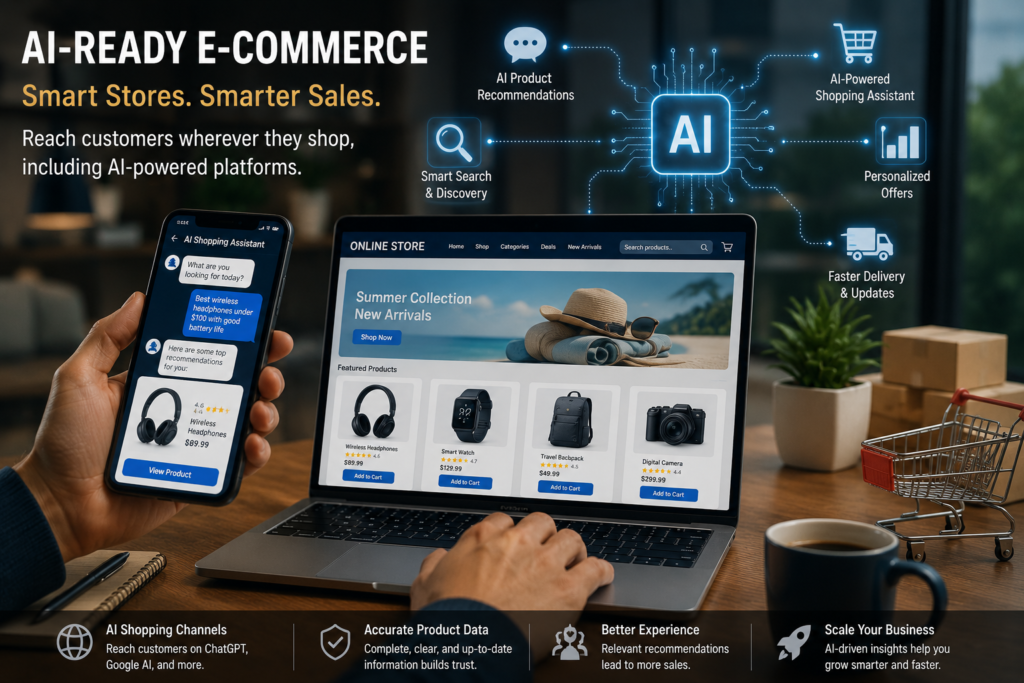
For years, the basic process was familiar: a consumer searched for a product, visited several websites, compared options, and eventually purchased one. Increasingly, AI can perform part of that research. A shopper can describe what they want in ordinary language and receive recommendations, comparisons, and product information through a conversational interface. This is not merely theoretical anymore.
Shopify has been building infrastructure that allows merchants to make products discoverable through AI shopping channels. In 2026, Shopify described agentic commerce as a model in which AI agents help shoppers discover, compare, and purchase products, including through channels such as ChatGPT, Google AI Mode, and Microsoft Copilot. (Shopify)
Shopify reported that AI-driven traffic to its stores grew eightfold year over year in the first quarter of 2026, while orders from AI-powered searches increased nearly thirteenfold. Those figures are Shopify’s own platform data, so they should be viewed as an indicator from its merchant ecosystem rather than a measurement of global e-commerce as a whole. (Shopify) Still, the direction is significant.
The online store of the future may need to be understood not only by human shoppers but also by AI systems helping those shoppers make decisions. That puts greater importance on accurate product information, specifications, availability, pricing, shipping details, and clear answers to customer questions. But entrepreneurs should not confuse technological change with easy money. E-commerce remains an operational business. Suppliers, inventory, logistics, returns, customer service, and margins still matter. A sophisticated sales channel cannot rescue a poor product or an unprofitable business model.
6. Audience Businesses: Newsletters, Research and Specialist Communities
Content creation is often described as if the content itself were the business. Usually, it is not. The more valuable asset is the audience.
A specialist newsletter can become a business. So can a research website, podcast, YouTube channel, professional community, or industry publication. Imagine a newsletter that helps small companies understand practical developments in artificial intelligence. At first, it may simply provide useful analysis. As the audience grows, the business could develop revenue through sponsorships, premium subscriptions, research products, consulting, events or partnerships.
The same model can work around healthcare, technology, careers, education, manufacturing, finance, hospitality, or other specialized subjects. There is a reason this model is becoming both harder and more interesting. AI can produce enormous quantities of average content. That makes average content cheaper.
What becomes more valuable is original research, first-hand experience, strong analysis, a recognizable voice, and trust. A small specialist publication does not have to compete with a giant media company on volume. It can compete on depth, relevance, and credibility. The objective should not be to publish more articles than everyone else. It should be to publish articles readers have a reason to remember.
7. Micro-SaaS and Small AI-Powered Software Businesses
Software used to require a substantial technical team, significant capital, and a long development cycle.
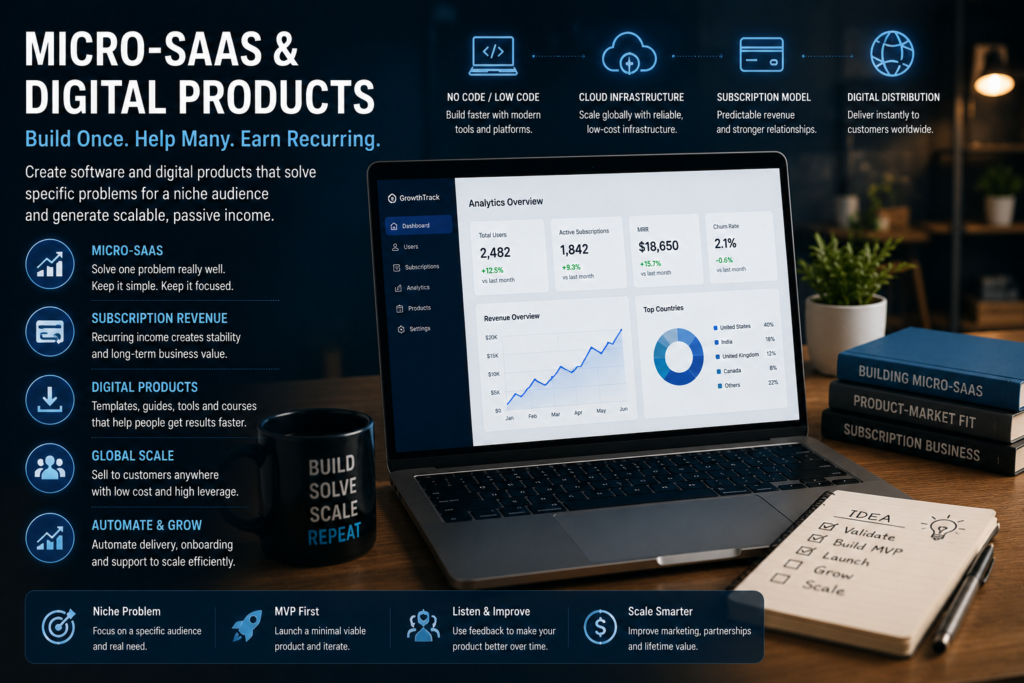
Those barriers have not disappeared, but they have changed.
Cloud infrastructure, no-code and low-code platforms, APIs, and increasingly capable AI development tools can make it easier for small teams to build and test software. This has helped create interest in Micro-SaaS, small software businesses built around a narrow customer problem. The best opportunities may not be glamorous.
A small software product could help a recruitment company organize candidate information. It could help a restaurant group monitor food costs across locations. It could help a training company manage course registrations and certificates. It could help a manufacturer track recurring maintenance tasks. The narrower the problem, the easier it can be to explain the value. But there is a lesson that aspiring founders often discover too late:
Building the software is not the same as building the business.
Customer acquisition, pricing, retention, security, support, and distribution can be harder than development itself. That is why entrepreneurs should test the problem before investing heavily in the solution. If five potential customers say, “I would pay for this,” that can be more valuable than months spent building a product nobody asked for.
An Opportunity Matrix: Online Businesses to Start in 2026
The seven models are not equally suitable for every entrepreneur. Their economics and skill requirements differ.
| Business model | Initial capital | Expertise required | Scalability | Where the advantage comes from |
| AI automation and AI agent services | Low to medium | High | High | Industry knowledge and implementation |
| Niche digital transformation consulting | Low | High | Medium to high | Business expertise and trust |
| Specialized expert services | Low | High | Medium | Specialized knowledge |
| Digital products | Low | Medium to high | Very high | Expertise packaged into a reusable asset |
| AI-ready e-commerce | Medium | Medium | High | Product selection, brand and distribution |
| Audience businesses | Low | Medium to high | High | Trust and a loyal audience |
| Micro-SaaS | Low to medium | High | Very high | Software, recurring revenue and specialization |
For entrepreneurs evaluating online businesses to start in 2026, the right choice depends less on following trends and more on identifying a problem they can solve well.
These are not predictions of profitability. They are simply different business structures with different characteristics. And there is an important distinction between low financial entry cost and low difficulty. A newsletter may cost little to launch but take years to build a meaningful audience. A Micro-SaaS product may be inexpensive to prototype but difficult to distribute. An AI consulting business may require little capital but considerable expertise. The cheapest business to start is therefore not necessarily the cheapest business to succeed in. Entrepreneurs interested in property can also explore our guide to 7 Real Estate Business Opportunities for a closer look at opportunities in the property sector.
What I Would Be Careful About in 2026
Not every popular online business deserves your attention.
I would be cautious about businesses built almost entirely around generic AI-generated content, undifferentiated dropshipping, mass-produced print-on-demand designs, low-value affiliate websites, and generic freelance services competing mainly on price. That does not mean these models can never work. It means their barriers to entry are so low that differentiation is becoming increasingly difficult. When everyone has access to roughly the same tools, the tool stops being the moat. The advantage has to come from something harder to copy. That might be specialized knowledge, customer relationships, proprietary data, original research, distribution, brand reputation, superior service, or a deep understanding of a particular market.
The Real Opportunity Is the Gap
There is a common mistake in thinking about the future of online business. People look at a new technology and ask: “What business can I build with this?” A better question is: “What problem has this technology made cheaper, faster, or easier to solve, and who needs that solution?” That change in perspective is important.
AI is a particularly clear example. Organizations are using it widely, but many are still struggling to move from experimentation to scaled business value. McKinsey’s latest survey found that approximately one-third of organizations had begun scaling AI programs across the enterprise, while the majority remained in experimentation or pilot phases. It also found that workflow redesign is strongly associated with greater AI impact. (McKinsey & Company)
That is a gap. And gaps are where businesses are often built. The same principle extends beyond AI. UN Trade and Development says digitalization is transforming how people work, consume, and do business, while its 2025 review highlighted the continuing need to improve digital readiness and close gaps between countries and businesses. (UNCTAD)
For entrepreneurs, that means opportunity can exist not only in inventing new technology but in helping people and businesses catch up with technology that already exists.
How to Choose Your Business
Before spending significant money, ask yourself five questions.
What problem am I solving?
If the answer is vague, the business probably needs more work.
Who will pay for the solution?
A large audience is not enough. You need customers with both a problem and a willingness to spend money solving it.
Why would they choose me?
If the answer is “because I use AI,” think again. Your competitors can use it too.
Can I test the idea cheaply?
Try to obtain a customer before building the perfect website, developing the complete software product, or purchasing large amounts of inventory.
What becomes stronger as the business grows?
The best businesses accumulate something valuable: reputation, customer relationships, proprietary data, audience, recurring revenue, intellectual property, or operational expertise. That is what can turn a small online activity into a real business.
Final Thoughts
The best online businesses to start in 2026 will not necessarily be the most fashionable ones, but those that solve clear problems and create lasting value for customers.
AI is reducing the cost of producing many things. That will create opportunities, but it will also eliminate some forms of scarcity. Generic content will become cheaper. Basic digital services will become easier to automate. Simple software will become faster to build. As that happens, the things that remain difficult to copy become more important.
Judgment. Expertise. Trust. Relationships. Distribution. Original thinking.
That is why the next generation of successful online businesses may not be built by people who chase every new technology. They may be built by people who understand a customer problem deeply and know how to use new technology to solve it better.
So do not begin with: “What online business should I start?” Instead, begin with: “What valuable problem is becoming more important, and how can I solve it better than the alternatives?”
Find the problem first. Talk to the people who actually have it. Test the smallest useful solution you can build, and, ideally, get someone to pay for it before you spend heavily. Then build.
The opportunity is not in chasing the next tool. It is in finding the problem that the next tool makes possible to solve.
Editorial Note
This article deliberately moves beyond the conventional list of online “side hustles.” The seven businesses discussed here were selected because they reflect broader changes taking place in artificial intelligence, digital commerce, professional services, software, and the creator economy. Some are established business models entering a new phase. Others are emerging opportunities whose commercial potential is still developing.
The purpose is not to suggest that any one model guarantees success. It is to identify where technology is creating meaningful gaps between capability and adoption, and where entrepreneurs may be able to build businesses by closing those gaps.
Our editorial position is straightforward: New technology does not automatically create a good business. A good business exists when technology helps solve a problem that customers genuinely value.
Author’s Note
This article is intended for general informational purposes and does not constitute financial, investment, or business advice. Startup costs, regulations, technology capabilities, customer demand, and market conditions vary by country and industry. Readers should conduct appropriate market research and professional due diligence before committing significant time or capital to any business.
Nick Gentle
Founder & Writer
BusiPulse
Sources and Further Reading
World Economic Forum, The Future of Jobs Report 2025. The report draws on employer perspectives across more than 1,000 companies and identifies AI and big data, networks and cybersecurity, and technological literacy among the fastest-growing skills. (World Economic Forum)
McKinsey & Company, The State of AI in 2025: Agents, Innovation, and Transformation. The survey covers 1,993 respondents in 105 countries and examines AI adoption, agentic AI, scaling, and the organizational practices associated with greater value. (McKinsey & Company)
McKinsey & Company, The State of AI: How Organizations Are Rewiring to Capture Value. This research examines workflow redesign and other organizational changes associated with capturing value from generative AI. (McKinsey & Company)
Shopify, Agentic Commerce on Shopify: How It Works. Shopify’s 2026 material describes the development of AI-assisted product discovery and purchasing and reports its own Q1 2026 platform data on AI-referred traffic and orders. (Shopify)
UN Trade and Development (UNCTAD), E-Commerce and Digital Economy Programme: Year in Review 2025. The report discusses digital transformation, country readiness, and efforts to improve measurement of e-commerce and the digital economy. (UNCTAD)
UN Trade and Development (UNCTAD), Stronger Statistics to Measure E-Commerce and the Digital Economy. The December 2025 update describes the launch of a global database on e-commerce value and the continuing need for better digital-economy data. (UNCTAD)

[…] Entrepreneurs interested in building online income streams can also explore our guide to 7 smart online businesses to start in 2026.7 smart online businesses to start in 2026 […]
[…] a single building. For entrepreneurs comparing different low-overhead business models, our guide to 7 Smart Online Businesses to Start in 2026 offers additional ideas beyond the property […]
[…] The safest strategy is not to build a business around a temporary trick in the interface. It is to build around a durable problem. Businesses looking to turn emerging AI capabilities into practical ventures can also explore our guide to 7 Smart Online Businesses to Start in 2026. […]
[…] Starting a business is relatively easy compared with building one that survives. So, rather than producing another long list of fashionable business ideas, this article focuses on nine practical opportunities selected for their recurring demand, potential for repeat revenue, accessibility to smaller operators, and relevance across different markets. Entrepreneurs specifically interested in digital-first opportunities can also explore our guide 7 Smart Online Businesses to Start in 2026. […]
[…] same principle applies to entrepreneurs. As we discussed in our analysis of online businesses and emerging digital opportunities, access to new technology does not automatically create a good business. The technology becomes […]