

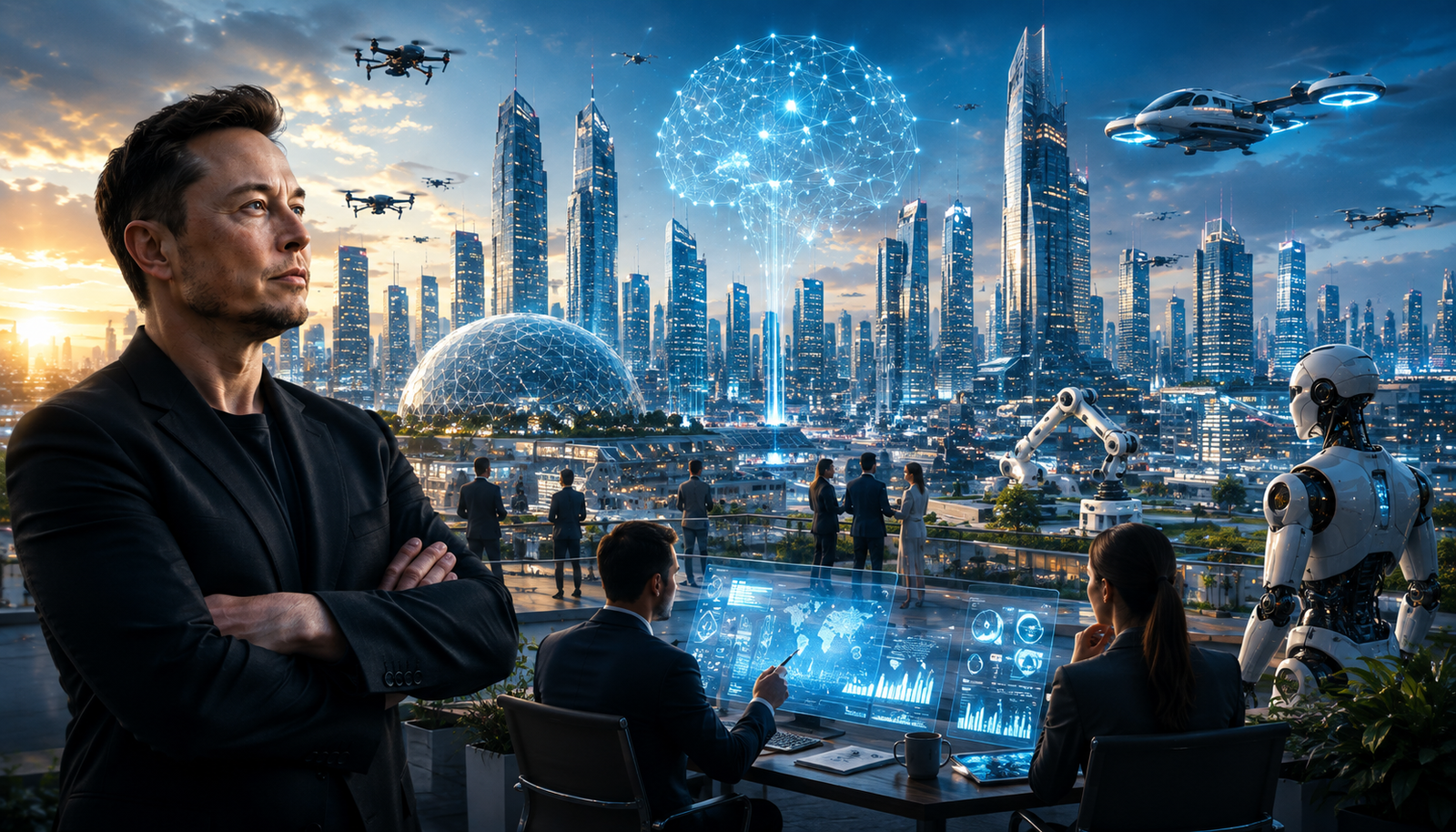
Money becoming irrelevant by 2036 sounds like science fiction today, but Elon Musk believes the rapid advancement of artificial intelligence and robotics could fundamentally change the role money plays in our lives within the next decade. His prediction raises a bigger question than whether cash or digital currency will disappear: if AI and robots can produce most goods and services with little human labor, could scarcity itself decline—and with it, the economic importance of money? For businesses, entrepreneurs, investors, and ordinary people, the implications could be profound.
During a July 2026 interview with The Economist, Musk described a future in which artificial intelligence and humanoid robots dramatically increase the world’s productive capacity. His prediction was not simply about smarter software or more capable machines. It was about a future where technology creates such extraordinary abundance that the traditional relationship between work, production, and even money begins to change. His most memorable observation captures that vision:
“The most likely outcome is an age of amazing abundance where anyone can have anything they can think of.” — Elon Musk, The Economist interview
It is an extraordinary claim.
It is also one that deserves careful examination rather than blind acceptance or immediate dismissal.
Some commentators focused on another headline from the interview—Musk’s remark that “Money won’t matter in 2036.” But what does he actually mean? Will money become irrelevant by 2036? Taken alone, the statement sounds radical. Viewed in context, however, it represents something far more nuanced. Musk argues that if artificial intelligence and robots eventually produce more goods and services than people could reasonably consume, the economic importance of money could gradually diminish because scarcity itself would become less significant.
Whether that vision materializes exactly as Musk predicts remains uncertain. What is beyond dispute is that artificial intelligence is already transforming businesses, reshaping industries, accelerating innovation, and changing how entrepreneurs compete. The real question for business leaders is no longer whether AI will influence the economy.
It is whether they are preparing quickly enough for the changes already underway.
This article examines Musk’s 2036 vision through a business lens, separating verified statements from informed analysis while exploring what AI-driven abundance could mean for companies, entrepreneurs, investors, and startups.
Why This Conversation Matters Today
Discussions about artificial intelligence often swing between two extremes. One predicts a technological utopia where machines solve humanity’s greatest challenges. The other warns of widespread unemployment, economic disruption, and existential risk. Reality is likely to fall somewhere between those extremes.
What makes Musk’s interview particularly significant is that he frames artificial intelligence primarily as an economic force rather than simply a technological breakthrough. His argument is not that AI will become impressive. It is that AI, combined with humanoid robotics, could fundamentally redefine how economies create value. For business leaders, this distinction is critical.
Throughout history, companies that recognized structural economic shifts before their competitors often emerged as industry leaders. Those that underestimated transformative technologies frequently struggled to remain relevant.
The internet did not merely change communication. It transformed retail, banking, education, entertainment, healthcare, advertising, and countless other industries. Artificial intelligence appears to be following a similar trajectory, but potentially at a much faster pace.
The potential economic impact is already enormous. McKinsey Global Institute estimated that generative AI could add the equivalent of $2.6 trillion to $4.4 trillion annually across the 63 use cases it analyzed. Meanwhile, the International Monetary Fund (IMF) estimates that almost 40 percent of global employment is exposed to AI, with the figure rising to about 60 percent in advanced economies. Exposure does not necessarily mean job loss; the IMF notes that AI can both complement human workers and substitute for some tasks.
These findings do not prove Musk’s prediction. They do, however, reinforce the broader direction he describes: artificial intelligence is becoming a defining economic force rather than simply another software innovation.
What Elon Musk Actually Predicted: Will Money Become Irrelevant by 2036?
Public discussions often reduce complex interviews to a single headline. That happened here as well. Many reports highlighted Musk’s statement that “Money won’t matter in 2036.” While attention-grabbing, that sentence represents only one part of a much broader argument. The central idea presented during the interview was the emergence of what Musk called an “age of amazing abundance.”
His reasoning follows a clear sequence. Artificial intelligence is advancing rapidly. Humanoid robots are becoming increasingly capable. Together, these technologies could dramatically expand the world’s ability to produce goods and deliver services.
If production becomes extraordinarily efficient, scarcity, the foundation of most economic systems, may gradually lose some of its importance. In that context, money becomes less significant because goods and services become more abundant. Understanding this sequence is essential.
Musk is not predicting that currencies will disappear overnight. Nor is he suggesting that governments will abolish money by 2036.
Instead, he is describing a possible long-term economic outcome if AI and robotics continue advancing at an exceptional pace. Whether that timeline proves accurate remains open to debate. The underlying economic question, however, is both legitimate and increasingly relevant:
What happens when intelligent machines can produce far more than humanity has historically been able to create?
Digital Intelligence Meets Physical Intelligence
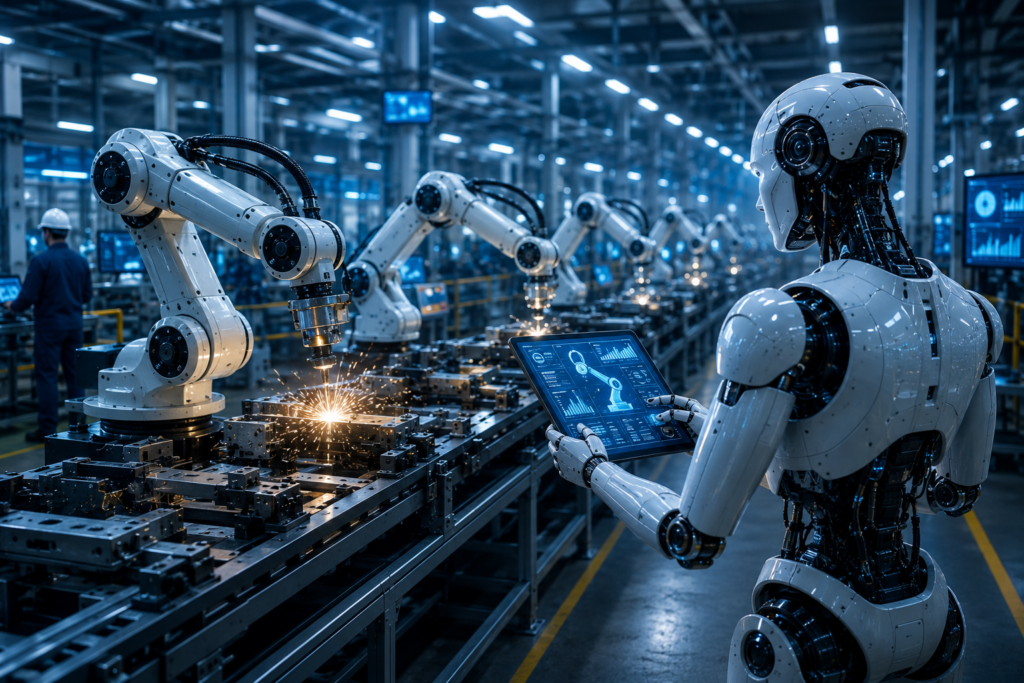
One of the most overlooked insights from Musk’s interview may also be its most important. He explained the future economy in remarkably simple terms:
“You can really think of the economy as digital and physical intelligence.”
This statement deserves careful attention because it helps explain why Musk believes the next decade could represent a turning point. Digital intelligence refers to artificial intelligence operating in the virtual world: large language models, software assistants, data analysis, scientific research, programming, financial modeling, and customer service. These technologies already influence how businesses operate.
Physical intelligence, by contrast, emerges when AI gains the ability to interact directly with the real world through machines. That is where humanoid robots enter the discussion. Factories, warehouses, construction sites, hospitals, hotels, agriculture, logistics, and retail could eventually benefit from intelligent robotic systems capable of learning, adapting, and operating with minimal human supervision.
According to Musk, combining advanced AI with capable humanoid robots allows intelligence not only to process information but also to produce tangible goods and deliver physical services. This combination forms the foundation of his vision for an AI-driven economy.
From Scarcity to Abundance
Economics has traditionally been built around one fundamental assumption: resources are limited. Businesses compete because labor, materials, expertise, time, and capital remain scarce. Prices exist because production has costs.
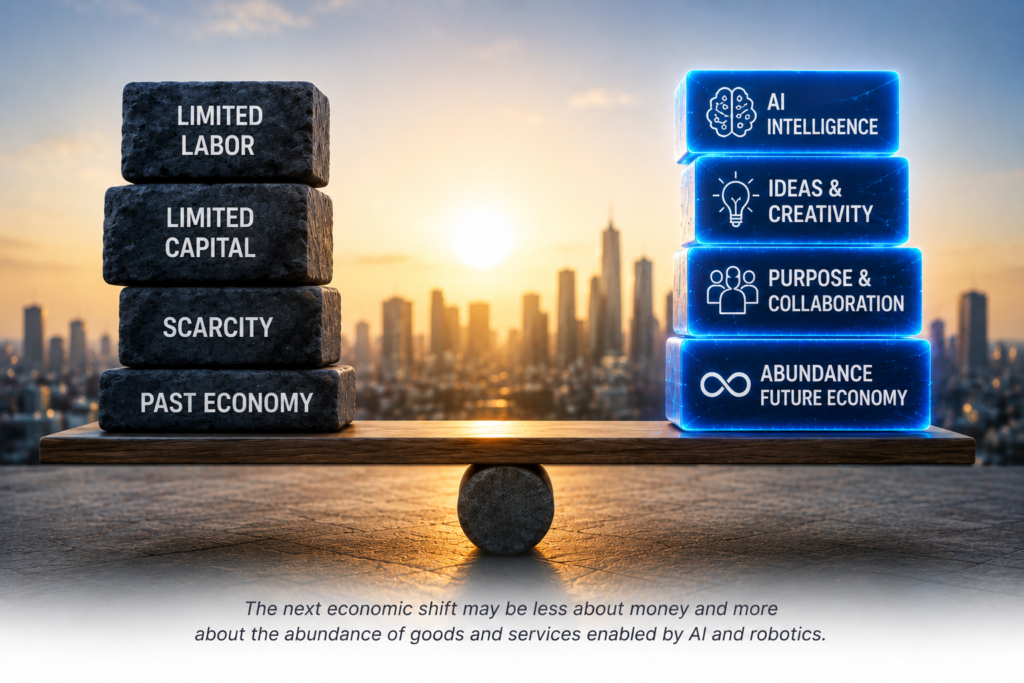
Artificial intelligence has the potential to change that equation. As AI improves productivity and robots automate increasingly complex tasks, the cost of producing many goods and services may continue to decline. This does not eliminate scarcity entirely. Natural resources, land, energy, and environmental constraints will still matter. However, the cost of creating value could decrease significantly across numerous industries. Musk summarized this possibility with another striking observation:
“If you have vast numbers of robots with vast amounts of digital intelligence, you have a sort of quasi-infinite economy.”
The phrase “quasi-infinite economy” should not be interpreted literally. No economy can become truly infinite. Rather, Musk is describing a future where productive capacity expands so dramatically that today’s economic assumptions begin to look fundamentally different. If that happens, competitive advantage may depend less on access to labor and more on access to intelligent systems, innovation, trusted brands, and strategic leadership. That possibility alone is enough to command the attention of every entrepreneur, investor, and business executive.
Why Business Leaders Cannot Ignore This Shift
Whether Elon Musk’s 2036 timeline proves accurate is, in many ways, a secondary question. The primary question is much simpler.
What if the transformation has already begun?
Artificial intelligence is no longer an experimental technology reserved for research laboratories. It is helping businesses improve productivity, automate workflows, enhance customer experiences, strengthen decision-making, and accelerate innovation across industries.
Companies do not need to believe every prediction surrounding AI. They do, however, need to recognize that competitive advantage is increasingly shaped by how effectively organizations integrate intelligent technologies into their operations.
History consistently rewards businesses that prepare for structural change before it becomes obvious.
Those waiting for absolute certainty often discover that markets have already moved ahead. Artificial intelligence may ultimately follow the same pattern. As businesses increasingly use automation and AI to reduce routine human involvement, entrepreneurs are already exploring business models designed to generate recurring revenue with less day-to-day intervention. Our guide to 9 profitable businesses that make money while you sleep in 2026 examines several of these models.
What AI Abundance Could Mean for Business
Every major technological revolution changes the rules of competition. The Industrial Revolution rewarded companies that mastered mechanization. The internet rewarded businesses that embraced digital transformation. Cloud computing favored organizations that could scale quickly and operate efficiently. Artificial intelligence may become the next defining competitive advantage.
If Musk’s vision of AI-driven abundance moves even partially toward reality, businesses will no longer compete solely through capital, workforce size, or production capacity. Increasingly, they will compete through intelligence: how effectively they use AI to make decisions, optimize operations, and create value for customers.
This shift has already begun. Across industries, AI is helping organizations forecast demand, improve supply chains, automate customer service, detect fraud, accelerate product development, and personalize customer experiences. The businesses that thrive over the next decade are unlikely to be those that simply purchase AI software. They will be the ones that redesign how they work. Technology alone rarely transforms a business. Leadership does.
A New Competitive Advantage: Intelligence at Scale
Traditionally, growth required hiring more employees, opening more offices, or expanding manufacturing capacity. Artificial intelligence changes that equation.
A small company with the right AI tools can now perform work that previously required much larger teams. Research that once took days may take hours. Marketing campaigns can be developed and tested more efficiently. Customer support can operate around the clock across multiple languages. Business data can be analyzed almost instantly. This does not eliminate the need for skilled professionals. Instead, it allows people to focus more on creativity, strategic thinking, relationship building, and innovation while AI handles repetitive and data-intensive tasks.
Companies that combine human judgment with machine intelligence are likely to outperform organizations that rely exclusively on either.
Entrepreneurs May Have Their Greatest Opportunity Yet
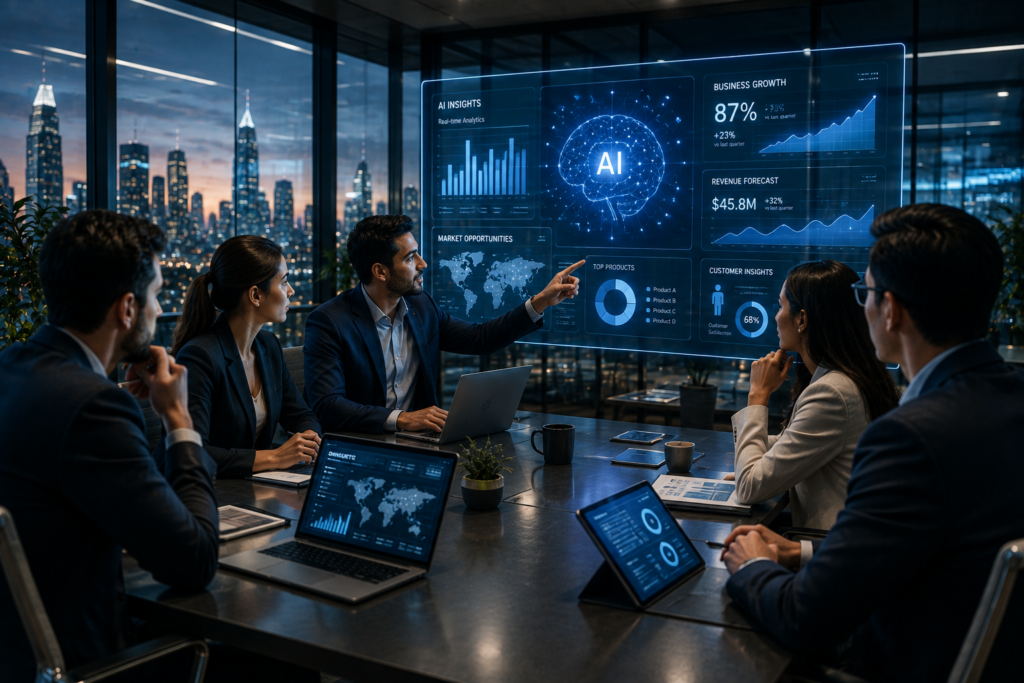
Every generation of entrepreneurs benefits from a technological breakthrough that lowers the cost of building a business. For previous generations, it was the internet. For today’s founders, it may be artificial intelligence.
A single entrepreneur can now draft business plans, build websites, analyze competitors, create marketing campaigns, write software, translate content, generate product ideas, and automate administrative work using AI-powered tools. This dramatically reduces the barriers that once prevented many people from starting a business. However, lower barriers also mean greater competition.
When everyone has access to similar technology, success depends less on the tools themselves and more on how effectively they are used. Entrepreneurs who understand customer needs, solve meaningful problems, and build trust will continue to stand out. AI can accelerate execution. It cannot replace vision, integrity, or long-term thinking.
Why Startups Could Benefit the Most
Large corporations often have greater financial resources, but they also face greater organizational complexity. Startups possess a different advantage: they can adapt quickly. Without legacy systems or lengthy approval processes, startup founders can integrate AI into their products, operations, and customer experiences from the very beginning. This flexibility allows small companies to compete in ways that were previously unimaginable. A lean team supported by intelligent automation can often deliver results comparable to much larger organizations. At the same time, AI raises expectations.
If automation becomes widely available, it will no longer be a meaningful competitive advantage on its own. Customers will continue choosing businesses that offer genuine value, exceptional service, and differentiated products. Technology opens the door. Execution determines who succeeds.
Investment Opportunities in the Age of AI
Periods of technological transformation often create extraordinary opportunities for investors. They also create speculative bubbles. The challenge is distinguishing sustainable trends from temporary excitement. If AI continues to advance, several industries appear well-positioned for long-term growth. Artificial intelligence software will remain central to digital transformation. Semiconductor manufacturers are likely to benefit from growing demand for advanced computing infrastructure. Cloud service providers will continue supporting increasingly powerful AI models.
Cybersecurity companies may experience greater demand as organizations protect AI-driven systems and sensitive data. Robotics manufacturers could play a critical role as intelligent machines move beyond factories into healthcare, logistics, retail, agriculture, and construction.
Renewable energy and electricity infrastructure may also become increasingly important because AI systems and data centers require enormous amounts of reliable power. The lesson for investors is straightforward. Invest in businesses with durable competitive advantages rather than chasing short-term headlines. Technological revolutions reward patience more often than speculation.
How AI Is Transforming Real Estate and Construction

Artificial intelligence is usually associated with software development or technology companies. Its influence on real estate, however, could prove equally significant. Real estate has always depended on informed decision-making. Developers evaluate land values, infrastructure, demographic trends, transportation networks, zoning regulations, and future demand before committing capital.
AI enables professionals to process these variables more efficiently and identify patterns that might otherwise remain hidden. Smart buildings are becoming more intelligent through automated energy management, predictive maintenance, occupancy analysis, and security systems.
Construction firms are exploring robotics to improve safety, precision, and productivity. Artificial intelligence is also expected to accelerate the adoption of advanced construction technologies such as large-scale 3D printing. AI can help optimize building designs, reduce material waste, improve structural accuracy, and automate quality control throughout the construction process.
In the longer term, the combination of AI, robotic construction, and 3D printing could potentially shorten project timelines. Property managers increasingly rely on AI to anticipate maintenance needs, improve tenant services, and optimize operating costs. Investors can use AI-assisted market analysis to evaluate opportunities more quickly while reducing certain forms of human bias in decision-making. Artificial intelligence will not replace experienced real estate professionals. It will provide them with more powerful tools. Those who embrace these tools are likely to make faster, more informed decisions in an increasingly competitive market.
The Challenges Behind the Optimism
Musk’s vision is optimistic, but it is not without obstacles. Artificial intelligence still faces significant technical, economic, and societal challenges. Current AI systems can generate inaccurate information, misunderstand context, and require substantial human oversight. Humanoid robots remain expensive and technically complex. Many industries lack the infrastructure needed for large-scale robotic deployment.
Energy demand presents another challenge. Advanced AI models require massive computing resources, placing increasing pressure on electricity generation and data center capacity.
Regulation will also shape the pace of adoption. Governments worldwide continue developing policies related to AI safety, privacy, intellectual property, cybersecurity, and accountability.
These issues are unlikely to disappear simply because technology advances. Business leaders should therefore prepare for progress while recognizing that adoption may occur unevenly across industries and regions.
Ethics May Become a Business Advantage
One of the most thoughtful moments in Musk’s interview came when he discussed AI safety. Rather than focusing solely on technological capability, he emphasized the importance of developing AI that seeks truth and contributes positively to humanity. Regardless of whether every reader agrees with that philosophy, the broader message deserves attention. Responsible AI is becoming a strategic issue.
Customers increasingly expect organizations to use technology ethically. Employees want transparency. Investors evaluate governance alongside financial performance. Regulators are demanding greater accountability.
In the years ahead, trust may become one of the most valuable assets a business can possess. Companies that combine technological innovation with ethical leadership are likely to build stronger and more enduring relationships with customers and stakeholders.
What If Elon Musk Is Wrong?
Every transformative prediction deserves careful scrutiny. History is filled with bold forecasts that proved remarkably accurate. It also contains many that did not. Musk’s timeline could ultimately prove too optimistic. Artificial intelligence may develop more slowly because of technical limitations, regulatory constraints, geopolitical tensions, economic disruptions, or slower adoption by businesses. Even Musk acknowledged during the interview that unforeseen events could alter the trajectory of technological progress.
Yet focusing exclusively on whether his prediction comes true by 2036 risks missing the larger point. The direction of change already appears evident. Artificial intelligence is becoming more capable. Robotics continues advancing. Businesses are integrating intelligent systems into everyday operations.
The more relevant question is not whether every aspect of Musk’s vision becomes reality within a decade. It is whether organizations are preparing for a future in which AI plays a far greater role than it does today. History suggests that preparing for meaningful technological change is rarely a mistake. Ignoring it often is.
How Business Leaders Should Prepare for an AI-Driven Future
Whether Elon Musk’s vision unfolds exactly as he predicts or takes a different path, one conclusion is becoming increasingly difficult to ignore. Artificial intelligence is no longer an experimental technology confined to research laboratories. It is rapidly becoming part of everyday business operations, influencing how organizations make decisions, serve customers, develop products, and compete in global markets.
For business leaders, the objective should not be to predict the future perfectly. It should be to prepare for it intelligently. The first step is developing AI literacy across the organization. Executives no longer need to become programmers, but they do need to understand AI’s capabilities, limitations, risks, and commercial applications. Leaders who understand these technologies will be better positioned to make informed strategic decisions.
The second priority is identifying opportunities where AI can enhance productivity without compromising quality or trust. Automating repetitive tasks allows employees to devote more time to creativity, problem-solving, relationship building, and innovation—areas where human judgment remains indispensable.
Third, businesses should invest in continuous learning. The pace of technological change means that today’s competitive advantage may become tomorrow’s standard practice. Organizations that encourage curiosity, experimentation, and adaptability are more likely to remain resilient as AI evolves.
Finally, responsible adoption should become a core business principle. Transparency, data privacy, ethical governance, and accountability are not obstacles to innovation. They are increasingly essential components of long-term success.
Artificial intelligence may reshape business models. Trust will continue to shape reputations.
Key Takeaways
- Elon Musk’s central prediction is not simply that money will matter less by 2036. His broader vision is that artificial intelligence and humanoid robotics could create an “age of amazing abundance” by dramatically expanding humanity’s productive capacity.
- According to Musk, the combination of digital intelligence and physical intelligence could fundamentally transform how economies produce goods and services.
- The statement “Money won’t matter in 2036” should be understood within that broader context. It reflects a hypothetical future where abundance significantly reduces economic scarcity, rather than a prediction that currencies will disappear.
- Artificial intelligence is already reshaping industries through automation, data analysis, software development, customer service, scientific research, and operational efficiency.
- Entrepreneurs and startups have an unprecedented opportunity to build businesses faster and at lower cost, but long-term success will continue to depend on innovation, execution, and customer trust.
- Investors should focus on long-term structural trends rather than short-term excitement surrounding AI-related companies.
- Businesses across industries can benefit from AI through smarter analysis, predictive maintenance, intelligent systems, automation, and improved operational efficiency.
- Responsible AI development, ethical governance, and continuous learning are likely to become defining competitive advantages over the coming decade.
Final Thoughts
Every generation encounters technologies that redefine what seemed possible. The steam engine accelerated industrial production. Electricity transformed manufacturing and daily life. The internet connected billions of people and reshaped global commerce. Artificial intelligence may represent the next chapter in that story.
Whether Elon Musk’s 2036 timeline proves accurate remains uncertain. History reminds us that forecasting technological change is remarkably difficult. Some innovations arrive sooner than expected. Others require decades to mature. Progress is rarely linear. Yet uncertainty should not become an excuse for inaction.
The businesses most likely to succeed in the coming decade will not necessarily be those that predict every technological breakthrough correctly. They will be the organizations that remain adaptable, invest in knowledge, embrace responsible innovation, and respond confidently as change unfolds. Perhaps the greatest lesson from Musk’s interview is not about money.
It is about abundance.
It is about reimagining what becomes possible when intelligence is no longer limited by human effort alone.
Whether that future arrives by 2036 or much later, the strategic decisions made today will influence who benefits from tomorrow’s opportunities. The future has always rewarded those willing to prepare before change becomes obvious. Artificial intelligence appears to offer another opportunity to do exactly that. The question is no longer whether AI will reshape business. The question is whether today’s leaders are prepared to reshape their businesses alongside it.
Author’s Note
This article is based on Elon Musk’s interview with The Economist, supported by publicly available research from respected institutions, including the International Monetary Fund (IMF) and the McKinsey Global Institute. Wherever possible, verified facts have been distinguished from analysis and forward-looking interpretation. Predictions about artificial intelligence, robotics, and future economic systems remain inherently uncertain. The purpose of this article is to encourage thoughtful discussion and informed decision-making rather than to present speculative outcomes as established fact.
Nick Gentle
Founder & Writer
BusiPulse
Editorial Note
The opinions expressed in this article reflect the author’s independent analysis of publicly available information. The discussion of Elon Musk’s 2036 vision includes both statements attributed to Musk and the author’s analysis of their potential implications for business, technology, and the economy. Future outcomes cannot be predicted with certainty, and readers should not interpret this article as financial or investment advice. Readers are encouraged to conduct their own research and exercise independent judgment. Healthy debate, evidence-based discussion, and critical thinking are essential when evaluating technologies that are evolving as rapidly as artificial intelligence.