



Businesses that make money while you sleep sound like the ultimate entrepreneurial dream. But in the real world, there is an important distinction between passive income and a business designed to operate without the owner being involved every minute.
A business can continue generating revenue while its owner is asleep when it has recurring customers, automated transactions, income-producing assets, subscription payments, or employees and systems handling routine operations.
That is why some of the most attractive profitable businesses in 2026 are not necessarily glamorous. They are businesses built around repeat demand, predictable revenue, and operating systems.
The goal is not to find a business that requires no work. The goal is to build one where your personal involvement becomes less necessary over time.
The Best Profitable Businesses That Make Money While You Sleep in 2026
1. SaaS and Subscription Software
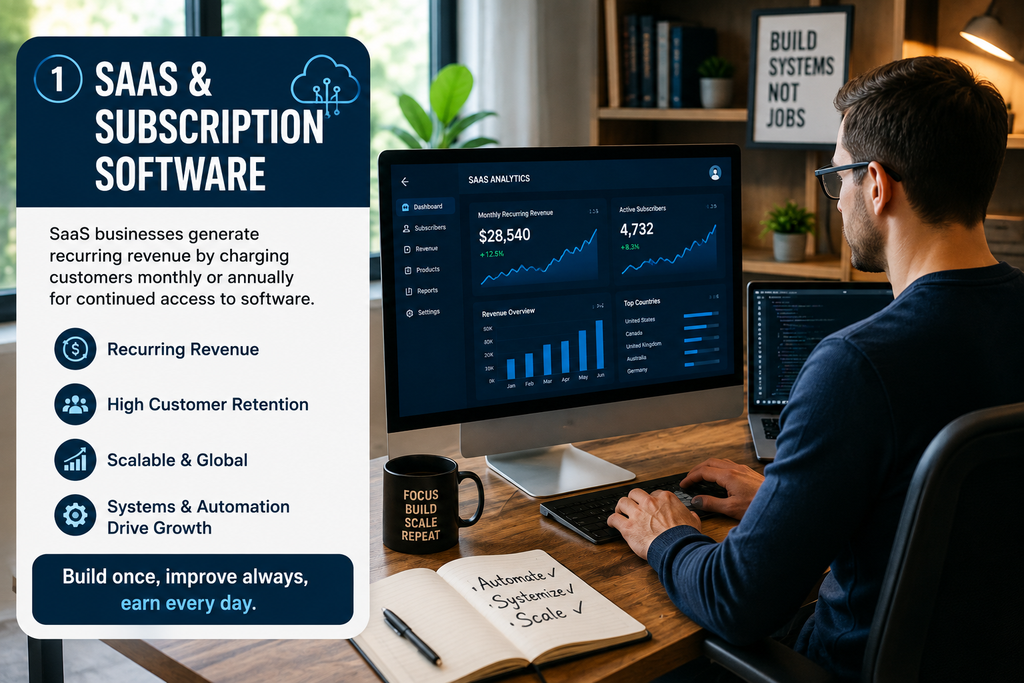
Software-as-a-Service (SaaS) is one of the clearest examples of a business capable of generating revenue around the clock. Instead of selling software once, a SaaS company charges customers monthly or annually for continued access. Once the product is built and billing, onboarding, and support systems are established, customers can subscribe without the founder personally making every sale.
The model also has an important financial advantage: recurring revenue can make business planning more predictable. Metrics such as monthly recurring revenue, customer retention, and customer lifetime value help SaaS companies understand the health of their subscription base.
However, SaaS is not passive at the beginning. Product development, customer acquisition, cybersecurity, technical maintenance, and customer support require serious work. The opportunity comes when those activities become systemized. A well-designed SaaS operation can serve a growing customer base without requiring the founder to personally handle every transaction.
For entrepreneurs who can build strong products and recurring customer relationships, SaaS can be one of the most scalable, profitable businesses to operate.
2. Digital Products and Memberships
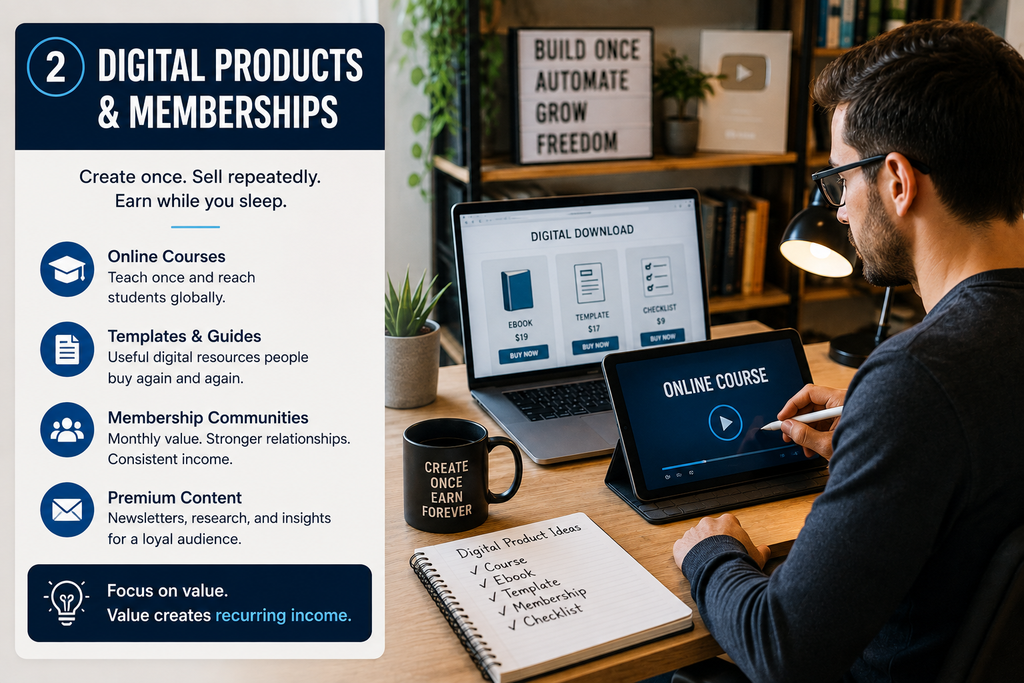
Online courses, templates, professional guides, premium newsletters, research databases, and membership communities can all be delivered digitally. Unlike physical products, digital products do not need to be manufactured and shipped every time someone makes a purchase. A well-designed product can therefore be sold repeatedly with relatively little additional delivery cost.
Memberships take the model further by charging customers monthly or annually for continuing access to content, tools, research, or a community. The major challenge is creating something valuable enough that customers are willing to buy it and, in the case of memberships, continue paying for it.
A digital product may be inexpensive to deliver, but attracting customers, updating the product, and maintaining engagement still require ongoing attention.
3. Self-Storage
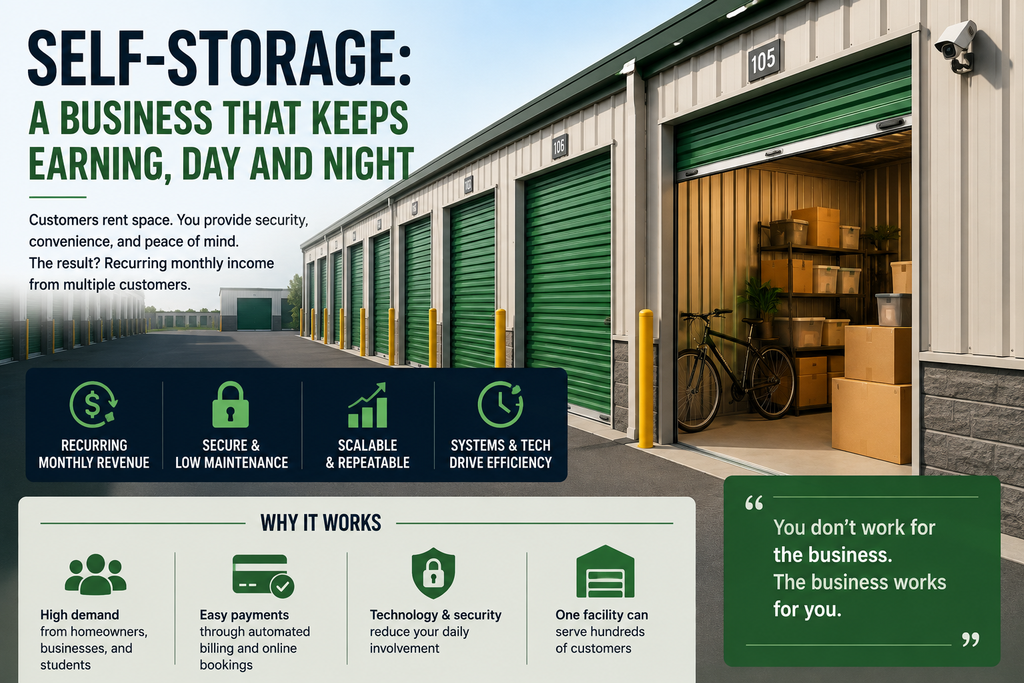
Self-storage is a classic example of an asset-based business with recurring revenue. Customers rent storage units monthly, while access, payments, security, and administrative tasks can increasingly be handled through digital systems and outsourced services.
The U.S. Census Bureau classifies self-storage as a distinct rental industry, with more than 18,500 employer establishments recorded in its 2023 business-pattern data. The attraction is not that the owner does nothing. Rather, one property can serve many customers simultaneously, creating multiple recurring revenue streams from the same underlying asset.
The major barrier is capital. Acquiring land, constructing facilities, or purchasing an existing operation can require substantial investment. Location, occupancy, security, maintenance, and operating costs can also have a major influence on profitability. For investors with sufficient capital and the right location, self-storage can become one of the more predictable profitable businesses based on recurring rental demand.
4. Vending Machine Businesses
Vending is a simpler example of automation. Machines can sell snacks, drinks, coffee, or other products throughout the day without requiring an employee to stand beside every transaction. The business is not completely passive. Machines need replenishment, maintenance, payment processing, and location management. But once a strong route has been established, an owner can potentially manage multiple machines far more efficiently than a conventional retail shop.
The key question is not simply:
How much does one machine make?
It is:
Can I build a network of profitable locations?
A poor location can turn an apparently automated business into an expensive machine collecting dust. A strong location, on the other hand, can produce repeat sales with relatively little day-to-day involvement.
5. Laundromats
Laundromats combine equipment, recurring consumer demand, and relatively low staffing requirements. Washing and drying machines generate revenue while customers use them, meaning the owner does not have to exchange every hour of personal labor for income.
But laundromats are often presented as more passive than they really are. Equipment breaks. Utilities can be expensive. Locations matter. Cleaning and customer service still need to be managed.
The opportunity lies in turning these recurring activities into systems. Automated payment systems, remote monitoring, scheduled maintenance, cleaning arrangements, and reliable operating procedures can reduce the amount of direct owner involvement.
The broader lesson is important: boring businesses can become attractive when repetitive work is converted into a system.
6. Equipment Rental
Why sell an expensive piece of equipment once when you may be able to rent it repeatedly? Construction equipment, party equipment, tools, cameras, trailers, and specialist machinery can all support rental businesses. The underlying economics are straightforward: an asset can potentially produce revenue multiple times during its useful life.
Technology can make booking, payment, and scheduling increasingly automated, while maintenance and delivery can be handled by employees or contractors.
However, depreciation, theft, damage, insurance, maintenance, and utilization rates can determine whether the business succeeds. An expensive machine sitting unused is not producing income. Therefore, keeping assets rented is just as important as owning them.
7. Subscription E-Commerce
Traditional ecommerce often starts from zero each month: acquire customers, sell products, and repeat. Subscription ecommerce attempts to change that equation by encouraging customers to reorder automatically. Products that customers naturally consume or replace, such as household goods, pet supplies, personal-care products, or specialty foods, can be particularly suitable.
The attraction is recurring revenue rather than constant dependence on one-time transactions. But subscriptions create their own challenges. Fulfillment costs, cancellations, inventory management, customer acquisition, and retention can quickly destroy margins.
The model works best when customers have a genuine reason to keep receiving the product rather than simply being persuaded into another recurring payment.
8. Property Rentals and REITs
Real estate has been generating income for property owners for centuries, but modern structures can make the concept more accessible. A rental property can produce recurring rent while a property manager handles leasing, maintenance, tenant communication, and other routine responsibilities.
For people who do not want to own property directly, Real Estate Investment Trusts (REITs) provide another route. The U.S. Securities and Exchange Commission explains that REITs allow individuals to participate in income-producing real estate without directly purchasing commercial property.
But neither option represents guaranteed income. Vacancies, maintenance expenses, financing costs, interest rates, property values, and market conditions can all affect returns. The real advantage is the potential to own or participate in income-producing assets, not the promise of effortless money.
9. Automated Service Businesses
The final category may be one of the most interesting because it does not necessarily require a physical asset or software product. Consider businesses such as commercial cleaning, bookkeeping, maintenance, digital marketing, IT support, or specialized B2B services.
At first, the owner may perform much of the work. But the business can eventually be systemized by hiring employees, standardizing processes, using software for scheduling and billing, and building recurring customer contracts. That transformation is crucial.
The owner stops being the product.
Instead, the system becomes the business. Recurring service contracts can create ongoing customer relationships rather than forcing the company to find a completely new customer for every transaction. The real opportunity is to turn a service that initially depends heavily on the founder into a repeatable operation that can be delivered consistently by a trained team.
Entrepreneurs interested in building online income streams can also explore our guide to 7 smart online businesses to start in 2026.7 smart online businesses to start in 2026
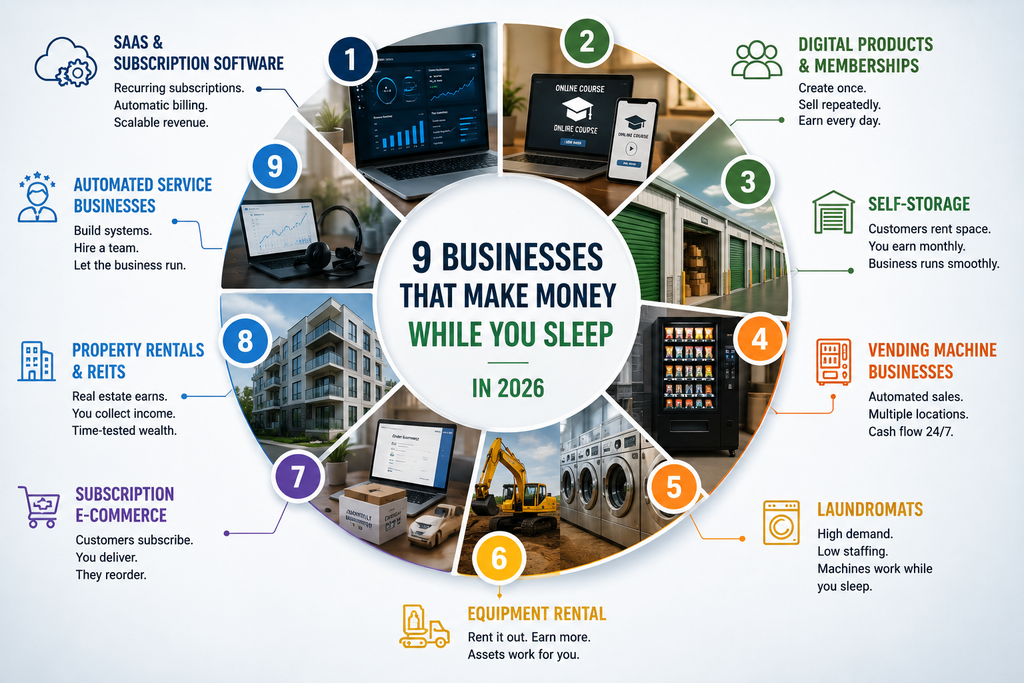
The Real Secret: Build a Business That Does Not Need You Every Hour
There is no magic business that simply deposits money into your account while you sleep. Even the most automated business requires work somewhere from the owner, employees, contractors, technology, or invested capital. The smarter objective is to build operating leverage.
Operating leverage means creating a business where one system, employee, machine, property, or digital product can serve many customers without requiring an equal increase in the owner’s working hours.
Before starting one of these profitable businesses, ask five questions:
- Is the demand recurring?
- Can customers buy without talking to me?
- Can routine work be automated or delegated?
- Can the business serve more customers without my hours increasing proportionally?
- Can the business eventually operate successfully without me?
If the answer to most of these questions is yes, you may be looking at a business with genuine scalability.
Final Thoughts
The most successful profitable businesses are not necessarily the ones that require the least work; they are the ones that gradually reduce the owner’s need to be involved in every transaction.
The phrase “make money while you sleep” is attractive because it promises freedom. But freedom is not created by finding a magical passive-income idea. It is created by building a business in which revenue is less dependent on the owner’s personal time.
SaaS does it through subscriptions. Self-storage does it through rented space. Vending does it through automated transactions. Rental businesses do it through assets. Service companies can do it through employees and recurring contracts. The common thread is not the industry. It is the business model. In 2026, entrepreneurs should therefore ask a better question than:
“What business can make me money while I sleep?”
Ask instead:
“What business can I build today that can keep creating value and revenue without requiring me to be present for every transaction?”
That is a much more realistic path toward business freedom.
Disclaimer
This article is for general informational and educational purposes only. It does not constitute financial, investment, legal, tax, or business advice. Business performance varies according to location, capital, competition, management, market conditions, and other factors. Readers should conduct their own research and seek appropriate professional advice before making business or investment decisions.

[…] exploring business models designed to generate recurring revenue with less day-to-day intervention. Our guide to 9 profitable businesses that make money while you sleep in 2026 examines several of these […]