

The business world has a fascination with excitement.
Artificial intelligence startups, fintech platforms, e-commerce brands, and social-media businesses attract attention because they promise rapid growth and dramatic disruption. Entrepreneurs are constantly encouraged to find the next big trend, launch something innovative, and scale it as quickly as possible. But there is another side of entrepreneurship that receives much less attention.
Boring businesses.
They clean buildings. Maintain properties. Remove waste. Control pests. Repair equipment. Manage accounts. Maintain lawns. Rent useful assets. None sounds particularly glamorous. Yet many of these businesses address problems that customers face repeatedly. That distinction matters.
A business does not have to be fashionable to be valuable. It has to solve a problem that customers are willing to pay to have solved and ideally do so in a way that produces enough margin and cash to support the operation. Recent business coverage continues to identify cleaning, bookkeeping, equipment rental, landscaping, junk removal, and similar services among the less glamorous businesses that can create repeat demand or opportunities for expansion.
That does not mean every boring business is profitable. Competition, labor costs, pricing, regulation, customer acquisition, and management can destroy an otherwise attractive business model. The real lesson is different:
Entrepreneurs can sometimes find better opportunities by looking for persistent problems instead of fashionable ideas.
Here are seven boring businesses worth examining.
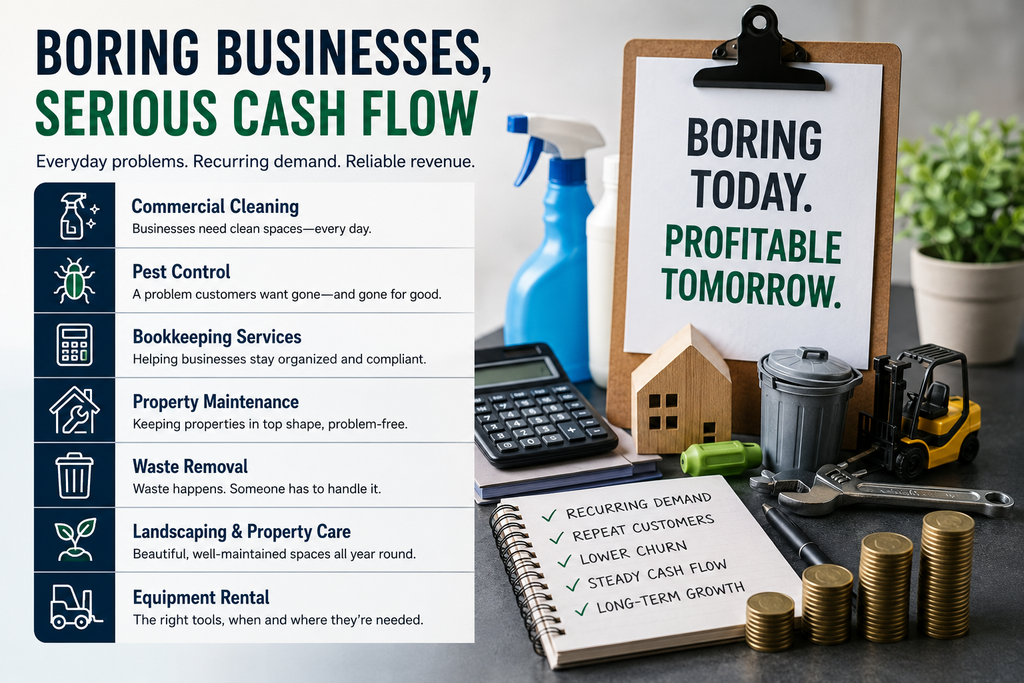
1. Commercial Cleaning: Simple Service, Recurring Need
Cleaning may be one of the most obvious examples of a boring business that looks ordinary but can become commercially sophisticated. Offices, restaurants, retail stores, schools, medical facilities, warehouses, and other commercial properties need to be cleaned repeatedly. Unlike many consumer purchases, cleaning is often a recurring requirement rather than a one-time transaction. That creates an important characteristic: repeat demand.
The commercial cleaning industry itself is broader than simply sending workers into offices with cleaning supplies. It includes interior cleaning, exterior and window cleaning, floor care, restoration, and other specialized services. This gives entrepreneurs several ways to specialize.
A company might focus on medical facilities, industrial sites, high-end offices, post-construction cleaning, or specialized floor maintenance. Specialization can make it easier to develop expertise, establish processes, and target a specific customer group. The growth potential comes from systems.
A small operator may initially perform the work personally. A larger company can employ teams, introduce supervisors, standardize procedures, use scheduling software, and pursue recurring commercial contracts. The service remains boring. The business operation doesn’t have to be. The lesson: a recurring service can be more commercially valuable than an exciting product that customers buy only once.
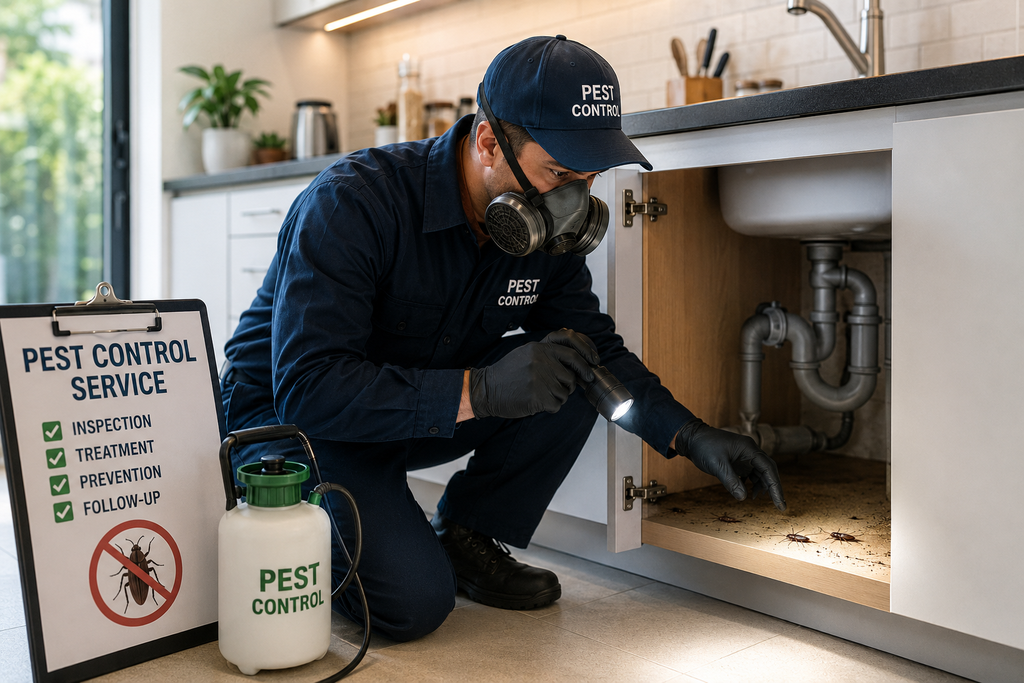
2. Pest Control: A Problem Customers Want Gone
Few people become enthusiastic about discovering termites, rodents, cockroaches, or other pests. That is precisely what makes pest control interesting from a business perspective. The customer is not usually buying the service because it is entertaining. They are buying because they have a problem they want removed and, in many cases, prevented from returning. This creates potential for recurring service agreements. Instead of relying entirely on one-off emergency calls, a pest-control company can offer scheduled inspections and treatments where regulations and customer needs allow.
The business can also develop specialized services for residential customers, commercial properties, hospitality businesses, warehouses and other facilities. Recent industry commentary highlights recurring contracts and route density as important characteristics of well-run pest-control businesses.
But there is an important caveat: pest control is a regulated activity in many jurisdictions. Licensing, technician training, chemical handling, insurance, and environmental requirements all need to be understood before entering the sector. So the opportunity is not simply: “Buy equipment and start spraying.” It is to build a compliant service operation around a problem that customers have a strong incentive to solve.
3. Specialized Bookkeeping: Turning Financial Complexity Into a Service
Bookkeeping may seem increasingly vulnerable to software and artificial intelligence. There is some truth to that. Modern accounting platforms can automate many routine activities that once required manual work. But automation does not eliminate every financial problem faced by small businesses. Owners still need organized records, reconciliations, reporting, accounts receivable and accounts payable management, payroll coordination, and a clear understanding of their financial position.
The U.S. Small Business Administration specifically identifies bookkeeping, accounts receivable, accounts payable, available cash, and bank reconciliation among areas businesses need to manage properly. That creates room for specialized bookkeeping services.
Instead of serving every business, a provider might specialize in restaurants, construction companies, property businesses, e-commerce sellers, or professional services. The advantage of specialization is familiarity. Once a bookkeeper understands an industry’s common transactions, reporting requirements, and financial problems, the service can become more valuable than generic data entry.
Technology may actually strengthen this model by reducing routine work and allowing the service provider to concentrate more on reporting, interpretation, and financial organization. The opportunity is therefore not necessarily to compete with software. It may be to become the person who helps business owners use the software correctly.
4. Property Maintenance: Making Money Around Real Estate
Buying property is not the only way to participate in the real-estate economy. Every building creates operational needs. Properties require cleaning, repairs, landscaping, painting, plumbing, electrical work, air-conditioning maintenance, and other services. Landlords and property investors also need people to coordinate maintenance requests, inspect properties, and deal with tenants and contractors. That creates an entire ecosystem of businesses around property ownership.
A small entrepreneur might specialize in one service. Another might build a broader property-maintenance company capable of coordinating multiple trades. The opportunity becomes particularly interesting when the customer owns multiple properties. A landlord with ten properties may prefer a reliable maintenance provider over finding a different contractor every time a problem appears. That relationship can potentially produce repeat business and referrals.
Property management can take the concept further by handling tenant communication, maintenance coordination, rent administration, and other operational tasks. This is an important distinction for aspiring real-estate entrepreneurs:
You do not necessarily need to own the asset to build a business around it.
Sometimes the better opportunity is serving the people who own and operate the asset.
5. Waste Removal and Specialized Disposal
Waste is one of those problems that businesses and households cannot simply ignore. Homes produce unwanted items. Construction sites produce debris. Restaurants generate waste. Businesses need materials collected and disposed of properly. That creates opportunities in junk removal, recycling, commercial waste services, and specialized disposal. A small junk-removal company might begin with one vehicle and a limited service area. Over time, it could add employees, vehicles, commercial accounts, and specialized services.
Although waste removal may seem like one of the more boring businesses, entrepreneurs need to look beyond the simple idea. Waste handling can involve environmental rules, disposal requirements, transportation regulations, and licensing depending on the material and jurisdiction. That means the business model should be built around compliance as well as convenience.
The opportunity exists because customers often face a problem they do not want to handle themselves. And that is one of the strongest foundations for a service business:
The more inconvenient the problem, the more valuable a reliable solution can become.
6. Route-Based Property Care and Landscaping
Landscaping is another business that can look small from the outside but become more sophisticated as it grows. A homeowner may need occasional lawn maintenance. A commercial property, apartment complex, or housing development may need scheduled service throughout the year. That recurring requirement can create a route-based business.
The economics become more interesting when several customers are located close together. If one team can serve many nearby properties efficiently, travel time falls, and employee productivity can improve. This is known as route density, and it can matter enormously in service businesses.
A landscaping company can also expand beyond basic lawn care into seasonal cleanup, irrigation support, tree services, commercial property maintenance, and other related activities, depending on local expertise and regulation. The lesson is important because many entrepreneurs misunderstand what “scaling” means. Scaling does not always require opening offices in ten countries. Sometimes it means:
- serving more customers per employee,
- reducing unnecessary travel,
- improving scheduling,
- increasing contract retention,
- using equipment more efficiently,
- and expanding into related services.
A local business can become a serious company through operational improvement.
7. Equipment Rental: Earning From Assets More Than Once
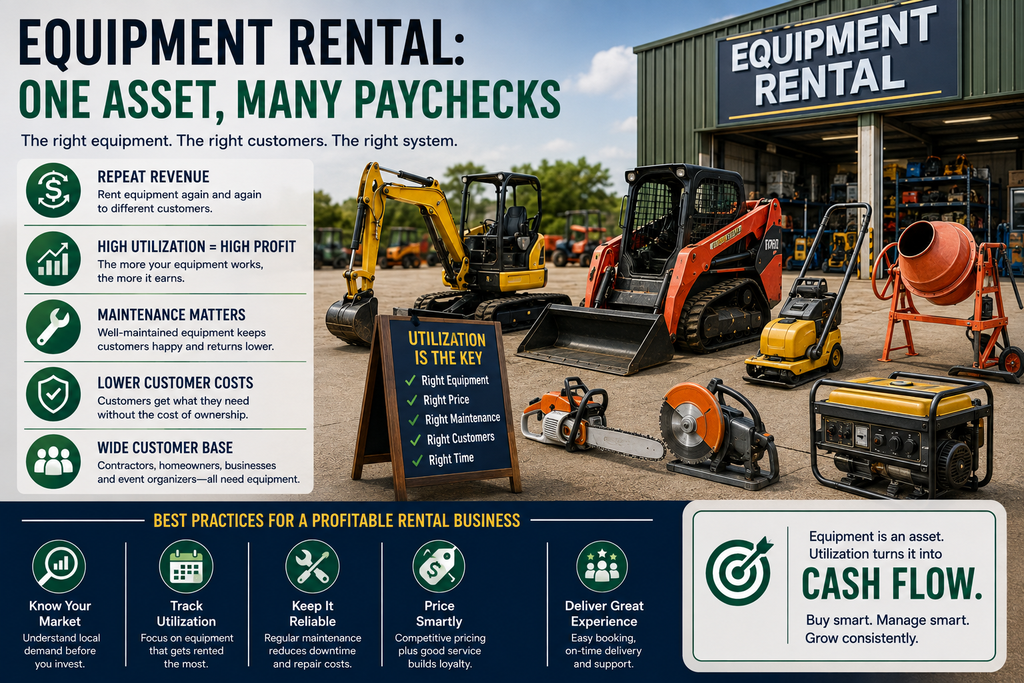
Equipment rental is different from the service businesses above because the core asset can generate revenue repeatedly. Construction companies, contractors, event organizers, property owners, and consumers sometimes need equipment for a limited period. Purchasing the equipment themselves may not make economic sense. Rental businesses solve that problem.
Depending on the local market, an operator might rent tools, construction equipment, landscaping machinery, event equipment, generators, or specialized assets. The attraction is straightforward:
One asset can potentially produce revenue many times.
But this model has a major weakness: equipment costs money even when it is sitting idle. Purchase price, maintenance, storage, insurance, transportation, depreciation, and damage all affect the economics. That makes utilization one of the most important measurements in the business. An expensive machine that is rented frequently can be productive. The same machine sitting unused for months can become an expensive liability. So the real business is not simply equipment ownership.
It is efficiently matching useful assets with customers who need them.
What These Boring Businesses Have in Common
Commercial cleaning, pest control, bookkeeping, property maintenance, waste removal, landscaping, and equipment rental appear unrelated. But underneath, several common characteristics emerge.
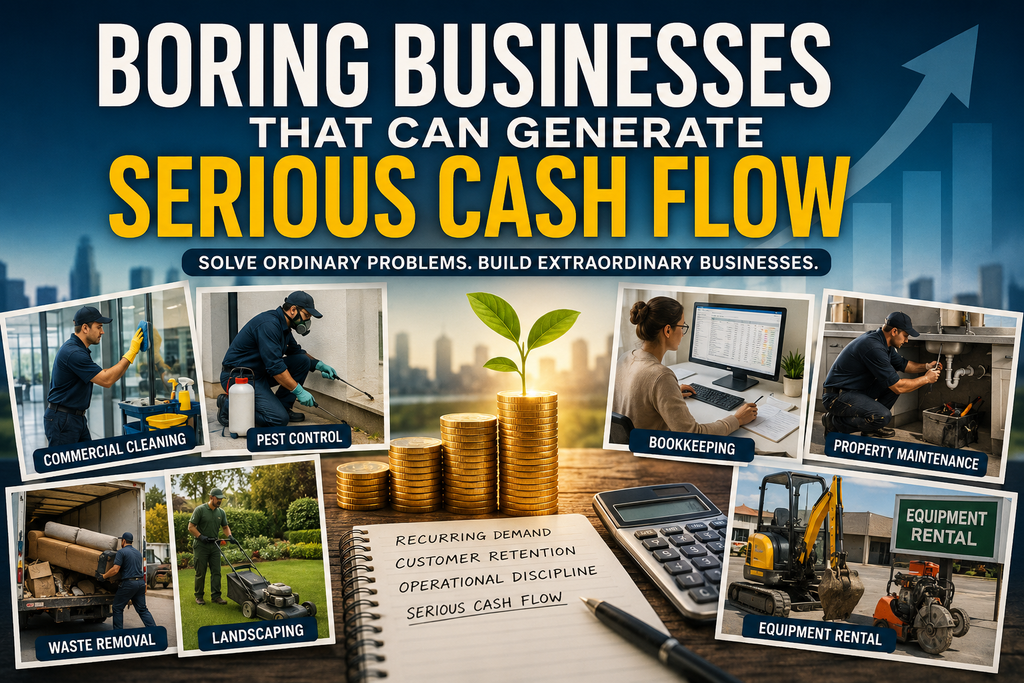
Recurring or repeat demand
Customers often need these services more than once.
Clear customer problems
The value proposition is usually easy to understand. A building needs cleaning. A pest problem needs treatment. A property needs maintenance.
Operational discipline
Success depends heavily on scheduling, staffing, pricing, quality control, and cost management.
Potential for customer retention
A satisfied customer may continue using the same provider rather than repeatedly searching for a replacement.
Room for specialization
A company can focus on a particular industry, property type, customer group, or service.
Potential to scale
Growth can come through employees, contracts, routes, vehicles, equipment, geographic expansion, or additional services. This is why calling them “boring” can be misleading. The service may be ordinary. The economics and operations can be anything but ordinary.
Don’t Confuse Revenue With Cash Flow
There is one important problem with the phrase “serious cash flow.” Revenue, profit, and cash flow are not interchangeable.
A company can have strong sales and still experience cash shortages. It may have customers who pay late, suppliers who require early payment, high inventory costs, equipment purchases, or large payroll obligations.
The SBA emphasizes the importance of tracking money coming into and leaving a business and separating recurring from nonrecurring costs. It also recommends cash-flow projections as part of financial planning. This distinction is particularly important in service businesses.
Imagine a company wins a large commercial contract. Revenue increases sharply, but the company must immediately hire workers, buy supplies, and cover transportation costs while waiting weeks for the customer to pay. The business may be profitable on paper while still feeling financially strained. That is why entrepreneurs should ask more than:
“How much can this business make?”
They should ask:
- How quickly do customers pay?
- How often do they buy?
- What does it cost to serve them?
- How much working capital is required?
- How dependent is the business on the owner?
- What happens when demand falls?
- How easily can labor and other costs be adjusted?
Those questions reveal the actual quality of the business model.
How a Boring Business Becomes a Serious Business
The most interesting transformation happens when an entrepreneur stops thinking in terms of individual jobs and starts thinking in terms of systems.
A cleaner can move from one-off jobs to commercial contracts.
A pest-control company can build recurring service plans.
A landscaper can develop dense maintenance routes.
A bookkeeping provider can specialize in a profitable customer segment.
A property-maintenance company can coordinate multiple services.
A waste-removal company can add commercial accounts.
An equipment-rental company can expand its inventory based on actual utilization.
The business gradually becomes less dependent on the founder personally performing every task. That is a critical step. If the owner must personally do every job, answer every phone call, schedule every employee, and solve every customer problem, the business may simply be buying the owner a job.
If documented processes, trained employees, reliable systems, and repeat customers allow the company to operate without constant owner intervention, it starts becoming a more scalable enterprise.
What Entrepreneurs Should Learn
The biggest lesson from boring businesses is not that everyone should start a cleaning company or buy a fleet of rental equipment. It is that opportunity often hides inside recurring inconvenience. Entrepreneurs frequently ask:
What business is trending right now?
A more useful question may be:
What problem keeps happening, and who is willing to pay for a reliable solution?
That question can lead to very different opportunities. Technology can then become an advantage rather than the entire business. Scheduling software can improve routes. Automation can reduce administration. Digital marketing can lower customer-acquisition friction. Data can improve pricing. AI can assist with customer communication, documentation, and internal operations. The underlying business can remain completely ordinary. Its execution can become increasingly sophisticated.
Final Thoughts
The next successful business does not necessarily have to be revolutionary. It may clean buildings, remove waste, maintain properties, control pests, organize financial records, care for landscapes, or rent equipment.
Those businesses may never become fashionable on social media. They don’t need to. A business ultimately creates value by solving problems that customers are willing to pay to solve.
The most attractive boring businesses are therefore not simply those with low startup costs. They are businesses where recurring demand, sensible pricing, customer retention, efficient operations, and disciplined financial management can work together. For entrepreneurs, that suggests a useful change in perspective. Instead of asking only:
“What is the next big thing?”
ask:
“What ordinary problem happens again and again, and how can I solve it better?”
Sometimes the answer will be an AI company. Sometimes it will be a real estate business. And sometimes it will be something far less glamorous.
That may be precisely where the opportunity lies.