



If a business earns unusually attractive profits, competitors have an incentive to enter its market and take some of those profits for themselves. They can lower prices, copy features, hire experienced employees, improve distribution, or introduce alternatives. Competition should therefore make exceptional business performance difficult to sustain. Yet some companies remain highly competitive for years even when rivals understand their products and actively try to challenge them.
The explanation often lies beneath the product itself. Certain businesses develop structural advantages that protect customer relationships, pricing power, market share, or profitability from competitive pressure. Investors and strategists commonly describe such protection as an economic moat, borrowing the image of a moat surrounding a fortress. A wider moat does not eliminate competition; it makes a successful attack more difficult or expensive.
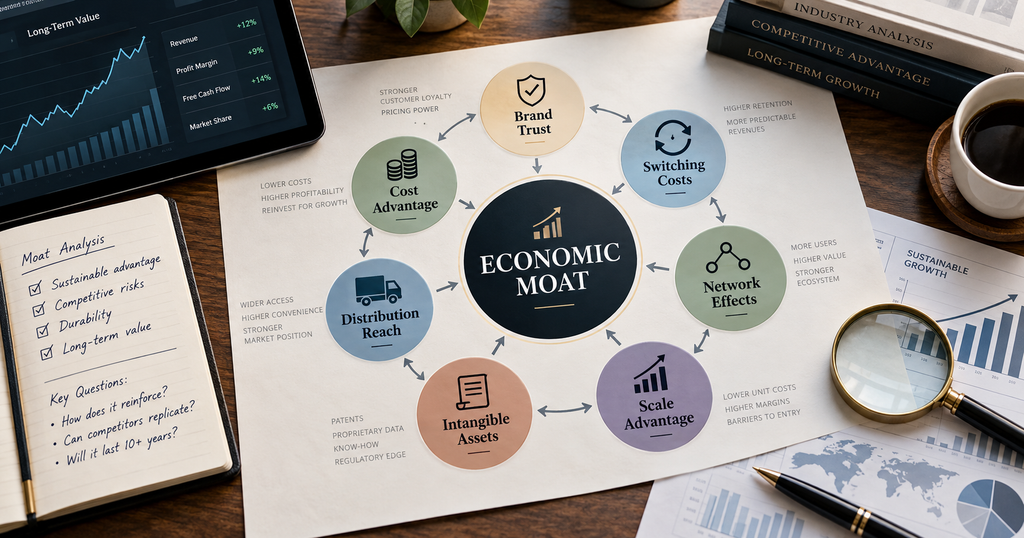
A growing company is not automatically a company with an economic moat. Neither are high profits, talented management, a fashionable product, or temporary market leadership sufficient evidence on their own. The stronger test is whether competitors can realistically reproduce the economics supporting that success. Seven types of advantage help explain why the answer can sometimes be no.
1. Powerful Brands Can Create Pricing Power
A brand becomes economically important when it changes customer behaviour. Recognition alone is insufficient. The strategic value appears when customers trust the name, actively seek it out, accept a higher price, or perceive greater risk in choosing an unfamiliar alternative. In that situation, years of accumulated reputation can influence purchasing decisions even when competitors offer technically similar products.
Luxury goods provide an obvious example, but brand economics extend much further. Financial services depend heavily on trust, while consumer products can benefit from familiarity when customers have little time to compare alternatives. In enterprise markets, reputation can also reduce perceived purchasing risk because decision-makers may prefer a proven supplier when failure would be expensive. The resulting advantage can support pricing power, customer retention, and more efficient marketing.

Brand strength nevertheless remains vulnerable. Quality failures, reputational damage, changing consumer tastes, or a new generation of customers with weaker attachment to the established name can erode it. The moat is therefore not the logo or advertising budget; it is the accumulated confidence that influences what customers are willing to buy and pay for.
2. Switching Costs Can Protect Customer Relationships
Customers sometimes remain with a supplier even when alternatives are available because changing providers carries financial cost, inconvenience, operational risk, or lost time. These switching costs can be particularly powerful in enterprise software, banking, cloud services, accounting systems, payment infrastructure, and other products embedded deeply into daily operations.
Consider a company using an enterprise CRM platform across sales, marketing, customer support, reporting, and automation. Moving to another provider may involve transferring years of data, rebuilding integrations, retraining employees, redesigning workflows, testing security controls, and accepting the possibility of disruption. A competitor offering a slightly cheaper or technically better product may therefore discover that product superiority alone is insufficient to persuade customers to move.

The distinction between retention and entrapment matters. Contractual obstacles or deliberately difficult cancellation processes may keep customers temporarily while damaging trust. Durable switching costs are stronger when customers stay voluntarily because replacing a useful, integrated product would impose genuine economic costs. Technology can also weaken this moat: better data portability, common standards, migration tools, or simpler integrations can make switching easier than it once was.
3. Network Effects Can Make Participation More Valuable
Some businesses become more useful as participation increases. This network effect can create a powerful competitive advantage because a new entrant may need to reproduce not only the product but also the community or commercial ecosystem surrounding it.
Payment networks illustrate the mechanism. Consumers benefit when their preferred payment method is accepted by many merchants, while merchants value a network used by many consumers. Marketplaces can display similar economics: more sellers increase selection for buyers, and more buyers create greater selling opportunities. A new marketplace may therefore have excellent technology but still struggle with the classic problem of attracting each side before the other has arrived.
However, growth and network effects should not be confused. A manufacturer selling twice as many units does not necessarily make each product twice as useful. Even genuine network effects can weaken when customers use several networks simultaneously, interoperability improves, or participants can move without losing important relationships. The moat comes from additional value created by participation, not from user numbers displayed on a presentation slide.
4. Economies of Scale Can Improve Unit Economics
Size becomes a competitive advantage when greater volume changes the underlying cost of doing business. Through economies of scale, companies may negotiate better purchasing terms, spread fixed costs across more customers, use infrastructure more efficiently, or justify investments that smaller competitors cannot support economically.
A large retailer, for example, may negotiate supplier terms unavailable to an independent store. A global software provider can spread research, security, and infrastructure spending across millions of users, while a logistics company with dense delivery routes may achieve better utilization of vehicles, warehouses, and employees. These savings can support lower prices, higher margins, or greater reinvestment, creating difficult choices for smaller competitors.
Scale matters only while it improves economics. Large organizations can accumulate bureaucracy, slow decision-making, redundant management, and legacy systems that smaller competitors avoid. These diseconomies of scale explain why size should never be treated as a moat by itself. The relevant measure is not how large the company has become, but whether its scale allows it to serve customers more efficiently than credible rivals. When that advantage remains difficult for smaller rivals to reproduce, scale can contribute to a durable economic moat.
5. Intangible Assets Can Restrict Imitation
Many visible products can eventually be copied. Less visible assets can be much harder to reproduce. Patents, regulatory licences, proprietary technology, specialized expertise, trusted brands, unique datasets, intellectual property, and accumulated research can restrict competition when they give their owner capabilities or permissions that newcomers cannot acquire quickly.
Pharmaceutical markets provide a clear illustration of the principle. Developing a medicine can require substantial research, clinical testing, regulatory review, and intellectual-property protection before commercial sale. In other industries, regulatory licences or specialized certifications may similarly limit immediate entry. Technology companies may build proprietary systems or datasets over years that cannot simply be purchased by a new competitor on launch day.
Not every intangible asset deserves to be called an economic moat. A patent covering obsolete technology has little strategic value, while a large dataset is unimportant if equivalent information is easily available elsewhere. Patents also expire, regulations change, and technological breakthroughs can bypass previously valuable intellectual property. The asset matters only when it continues contributing to customer value or materially limits profitable imitation.
6. Distribution Can Determine Who Reaches the Customer
A superior product has limited commercial value if customers rarely encounter it. Distribution strategy can therefore become a competitive advantage when a company develops efficient access to buyers that competitors would need substantial time or money to reproduce.
Traditional distribution advantages include retail shelf space, wholesaler relationships, sales forces, warehouses, logistics networks, and corporate procurement relationships. Digital businesses have created their own equivalents through search visibility, direct customer relationships, developer ecosystems, app integrations, marketplaces, and established online audiences. A company already connected to millions of relevant customers can often introduce an additional product more efficiently than an unknown entrant starting without distribution.
This moat is particularly exposed to changes in technology. E-commerce weakened some traditional retail advantages by allowing brands to reach customers directly, while digital marketplaces created powerful new intermediaries of their own. Distribution therefore demonstrates an important characteristic of competitive advantage: a moat can remain valuable for decades and then narrow rapidly when the way customers discover or purchase products changes.
7. Structural Cost Advantages Can Change the Rules of Competition
A company that can sustainably operate at lower cost has choices unavailable to higher-cost rivals. It can charge comparable prices and earn stronger margins, reduce prices to gain customers, invest more heavily in business technology, or remain profitable during periods when weaker demand places competitors under pressure.
Structural cost advantages can originate from automation, superior processes, favourable access to resources, efficient logistics, lower customer-acquisition costs, better technology, scale, or a fundamentally different business model. Southwest Airlines, for example, became widely studied for an operating model built around elements such as a simplified fleet and high aircraft utilization rather than merely offering temporary discounts. The broader lesson is that durable low-cost competition usually depends on a system, not a promotional price.
This distinction is critical because selling cheaply does not prove that a business has a cost moat. A company can subsidize customers with investor capital or sacrifice margins temporarily, but competitors need not fear low prices that cannot be sustained. The stronger question is whether the company can remain profitable at economics its rivals would struggle to match.
A Successful Business Does Not Automatically Have a Moat
The seven advantages rarely operate in perfect isolation. A trusted brand may improve distribution, broader distribution may increase scale, greater scale may lower costs, and lower costs may provide more capital for product development. Similarly, a widely adopted software platform can combine switching costs with network effects and accumulated customer data. An economic moat can become especially powerful when several competitive advantages reinforce one another. These reinforcing competitive advantages are central to the broader economic-moat framework.
That also explains why current success is an unreliable shortcut for identifying a moat. Rapid revenue growth may result from temporary demand, a technological trend, unusually favourable pricing, or weak competition. High margins can attract new entrants, and market leadership can disappear if customers discover an easier alternative. Emerging competitors can also become important when established companies underestimate markets that initially appear too small. A genuine economic moat should help explain why competitors have difficulty taking customers or compressing profitability even after the opportunity becomes obvious.

The direction of the moat matters as much as its present width. Switching costs can fall, patents expire, brands lose relevance, regulations change, distribution channels move online, and new technology can destroy an old cost advantage. Managers and investors should therefore ask not merely whether a moat exists, but whether it is widening, stable, or eroding.
Final Thought
The businesses that are hardest to compete with are rarely protected by a single impressive product. Their deeper strength often comes from systems built around the product: customer trust, difficult-to-replace workflows, valuable networks, efficient scale, protected assets, distribution reach, or structural cost advantages. Competitors may be able to copy what customers see while struggling to reproduce the economics operating underneath.
For business owners, this changes the strategic objective. The goal is not to construct artificial barriers that prevent customers from leaving, nor to assume that today’s success will defend itself. Stronger businesses build advantages that can compound with time: customer relationships improve retention, scale can lower costs, accumulated knowledge can improve products, and efficient distribution can make future growth less expensive.
For investors and observers, an economic moat provides a useful way to look beyond headline growth. Growth shows that a company is expanding today; a moat helps explain why competitors may struggle to take those customers, margins, or opportunities away tomorrow. No moat is permanent, but understanding what protects a business and what could eventually weaken that protection provides a more complete picture of long-term competitive strength.
Author’s Note
This article is intended for general educational and informational purposes and does not constitute business, investment, financial, legal, or professional advice. Competitive advantages, company performance, industry structures, technologies, regulations, and market conditions vary considerably across businesses, industries, and countries. Readers should conduct their own research and, where appropriate, seek qualified professional advice before making business or investment decisions. Readers are not required to agree with the author’s interpretations or conclusions.
The concept of an economic moat is widely associated with investment analysis and has been developed through extensive work on competitive advantage, including frameworks used by investors, academics, and business strategists. This BusiPulse article uses those established ideas as intellectual context while independently developing its explanations, examples, interpretations, and conclusions for general readers.

[…] core and exploring the future are not mutually exclusive. Some of that protection may come from an economic moat durable advantages that make the core business harder for competitors to […]
[…] produce attractive overall economics. In those cases, a lower relative price can become part of a genuine competitive advantage when the business can still provide acceptable value and […]
[…] This may be the most important lesson for small businesses. If your competitor can subscribe to the same AI service tomorrow, access to the tool is not much of a moat. […]
[…] thinking + workflow design + judgment. For businesses, the same principle also applies to competitive advantage: widely available AI tools are easier to copy than the systems, expertise, customer relationships, […]