



A customer can want a product, accept the price, and trust the company, yet still leave without buying. The reason may have little to do with the product itself. A confusing website, an unexpected fee, a compulsory account, a failed payment, or a frustrating support process can be enough to interrupt a purchase that was otherwise close to completion.
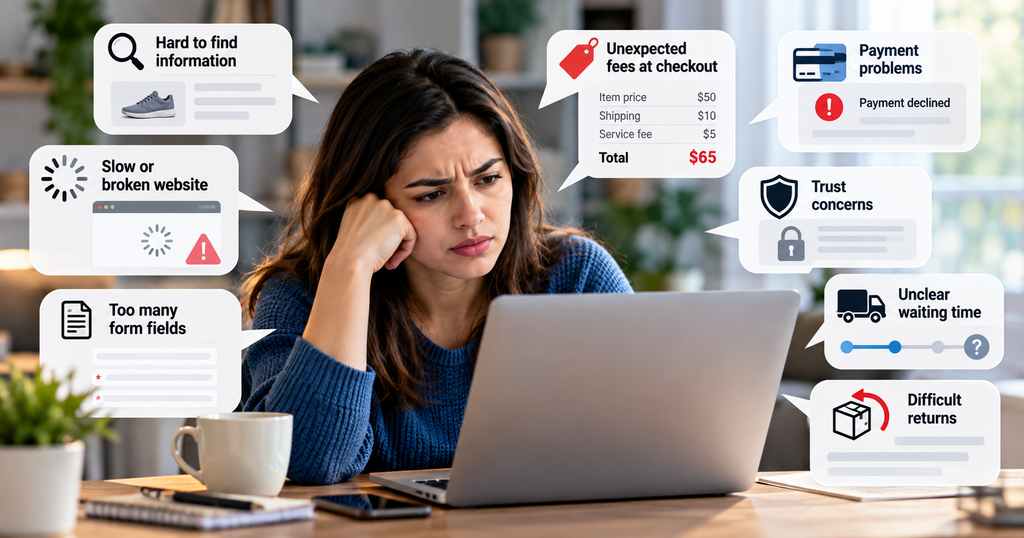
These obstacles are examples of customer friction: unnecessary effort, delay, uncertainty, or inconvenience that makes it harder for customers to complete an action. The problem is easy to underestimate because each obstacle may appear small when viewed separately. Across thousands of customers, however, small difficulties can become abandoned purchases, incomplete applications, cancelled subscriptions, repeated support contacts, and lost revenue.
Businesses often respond to weak sales by trying to attract more people. They spend more on advertising, launch promotions, offer discounts, or add new products. Those strategies may help, but bringing more prospects into a difficult customer journey can simply expose more people to the same obstacles. Sometimes the more useful question is not, “How do we attract more customers?” but, “How difficult are we making it for customers who are already interested?”
What Is Customer Friction?
Customer friction can occur at almost any stage of the relationship between a customer and a business. It may appear while someone is searching for information, comparing products, creating an account, requesting a quotation, completing payment, waiting for delivery, seeking support, returning an item, or cancelling a service. A slow checkout page is friction, but so is standing in a poorly managed queue or being transferred between several employees while explaining the same problem repeatedly.
Customer friction should not be confused with the underlying problem a customer wants solved. Someone may dislike spending time shopping for groceries, for example, and a delivery service can solve that problem. If the delivery company then hides its charges until the final screen or requires an unnecessarily complicated registration process, it has created new friction of its own.
The financial effect is often indirect. A business rarely sees an expense labelled “customer friction.” Instead, it appears in lower conversion rates, unfinished transactions, complaints, refunds, additional support work, and customers who disappear without explaining why. That is why apparently minor obstacles deserve more attention than their size might suggest.
1. Customers Cannot Find What They Need
Customer friction can begin before the customer reaches a checkout page. A potential buyer may first need to understand what a business sells, whether a product suits them, how much it costs, what is included or whether the service is available in their location. When that information is scattered, vague or difficult to find, the customer has to work harder than necessary.
This happens online when websites have confusing navigation, incomplete product descriptions, missing specifications, or service packages that are difficult to compare. It also happens offline when products are poorly labelled, prices are missing, or staff members cannot quickly direct customers to what they need. The company may have exactly the right product, but the buying process itself becomes an obstacle.

The solution is not to place every possible detail in front of the customer at once. Too much information can create another form of confusion. The objective is to make the right information easy to find at the point where the customer needs it.
2. The Website or App Creates Unnecessary Difficulty
A customer who has already decided what to buy can still be lost because the technology does not work smoothly. Slow pages, broken buttons, forms that reset, unclear error messages, and repeated login requests can turn a simple action into a frustrating process.
Mobile users can experience these problems even more strongly. A checkout that looks straightforward on a large monitor may be difficult on a small screen if customers must repeatedly zoom, enter long pieces of information, or move between applications to retrieve details.
Businesses sometimes judge their own systems from the perspective of employees who already know how everything works. Customers do not have that familiarity. A website does not need to be visually impressive to provide a good experience, but it does need to make important tasks reliable, understandable, and reasonably easy to complete.
3. The Real Price Appears Too Late
Few things create hesitation as quickly as discovering that the apparent price is not the final price. A customer may accept the advertised cost and then encounter delivery charges, service fees, mandatory extras, or other expenses near the end of the process.

Not every additional charge is unreasonable. Shipping costs money, taxes may be compulsory, and some services genuinely involve extra expenses. Customer friction arises when the customer forms one expectation and then discovers a different total after time has already been invested. Research from Baymard Institute has repeatedly identified unexpected costs, forced account creation and unnecessarily complicated checkout processes among the reasons customers abandon online purchases.
Transparent pricing may cause some customers to decide earlier that a product is too expensive, but that is not necessarily a bad outcome. A customer who understands the total cost from the beginning can make a proper decision. A customer who discovers important charges at the final stage may feel that the process has been unnecessarily difficult or misleading.
4. The Business Asks for More Information Than It Needs
Businesses naturally want to understand their customers, but the customer usually wants to complete one immediate task. Problems arise when the company’s desire for information becomes more important than the transaction the customer is trying to complete.
A simple purchase may become frustrating when the buyer is required to create an account, invent a password, provide unnecessary personal details and answer several questions before being allowed to pay. Every additional field creates another point at which the customer can stop.
There are situations where detailed information is essential. Banks, insurers and professional-service firms may need substantial information for legal, security or pricing reasons. The important question is whether each piece of information is genuinely needed at that stage. If it can reasonably be collected later, forcing the customer to provide it before completing the main task may create avoidable friction.
5. Paying Becomes Harder Than Deciding to Buy
Payment is one of the worst places to lose a customer because most of the work has already been done. The customer has discovered the business, evaluated the product and decided that the price is acceptable. If the payment process then becomes difficult, the company can lose a sale at the moment when it was closest to completion. At this stage, customer friction can turn an almost-completed purchase into a lost sale.
Problems may include too many checkout stages, declined payments without clear explanations, mobile pages that do not work properly, or payment methods that customers do not commonly use. International businesses face an additional challenge because payment habits differ between countries and markets.
The objective is not to offer every possible payment method. Too many options can also create confusion. The better approach is to understand how the target customers normally pay and make those methods secure, familiar, and easy to use. Once a customer has decided to buy, paying should not feel like starting a completely new process.
6. Customers Do Not Feel Confident Enough to Continue
Some friction is technical, but some is psychological. Customers hesitate when they are uncertain whether a business, payment process, or promise can be trusted. An unfamiliar website with inconsistent information, unclear policies, exaggerated claims, or weak contact details can create uncertainty even when the product itself is legitimate.
Trust becomes particularly important when customers are being asked to accept greater risk. Purchasing from an unfamiliar retailer, paying a large deposit, sharing personal information or joining a recurring subscription all require confidence that the company will behave as expected. PwC’s 2025 Customer Experience Survey found that poor customer experience can be serious enough for some consumers to stop buying from or using a brand.
Businesses cannot manufacture trust simply by adding impressive language to a website. Clear policies, realistic promises, accurate contact information, secure payment processes, and reliable communication are more persuasive. Customers are usually more comfortable when the experience behaves consistently with what the company claims.
7. Waiting Becomes More Frustrating Because Nothing Is Clear
Waiting is not always avoidable. Products take time to prepare, appointments run to schedules, banks conduct checks, and service businesses operate with limited capacity. What often creates the greatest frustration is not the delay itself, but uncertainty about how long it will last and what is happening.
A customer who knows that an order should arrive within four days can plan around that expectation. A customer who receives no useful estimate may repeatedly check the website, contact support, or begin to wonder whether something has gone wrong.

Clear communication can therefore reduce friction even when the underlying wait cannot be shortened. Delivery estimates, appointment windows, progress updates and order tracking give customers a better understanding of what will happen next. Convenience is not always about making everything instant; sometimes it is about making the process predictable.
8. Getting Help Requires Too Much Effort
Customer service should remove problems, but poorly designed support can create another problem of its own. A customer may search a help page, speak to a chatbot, send an email, and finally telephone the company, only to explain the same situation again at each stage.
From the company’s perspective, these may appear to be separate contacts. From the customer’s perspective, they are all part of one unresolved issue. The more effort required to reach someone capable of solving the problem, the more frustrating the experience becomes.
Automation can be useful when it answers routine questions quickly, but it should not become a wall between customers and genuine help. A fast automated response has limited value when the customer still needs several additional contacts before the problem is resolved.
9. The Business Makes Leaving or Correcting a Problem Unnecessarily Difficult
Customer friction does not disappear after the sale. Complicated returns, unclear refund procedures, difficult warranty claims, and hidden cancellation processes can damage the relationship after money has already changed hands.
Businesses may sometimes believe that making cancellation or returns difficult protects revenue. In the short term, it might prevent a few customers from leaving. In the longer term, however, customers who feel trapped or obstructed may respond through complaints, disputes, negative reviews or a decision never to buy from the company again.
Reasonable rules are still necessary. A business does not have to accept every return, cancel every contract immediately or ignore legitimate security requirements. The important point is that valid customer actions should not be made difficult simply because the business benefits when customers give up. If joining a service takes only a few minutes online, for example, requiring an unnecessarily complicated process to leave deserves careful examination.
Final Thoughts
Customer friction is easy to underestimate because the individual obstacles often look insignificant from inside a business. One extra field, one unclear fee, one unnecessary transfer or one confusing page may not appear serious on its own. Customers, however, experience the entire journey rather than each problem in isolation.
A business may have a strong product, competitive pricing, and effective marketing, yet still lose customers because dealing with the company requires more effort than it should. In that situation, spending more money to attract new prospects may not solve the underlying problem.
Reducing customer friction does not mean removing every safeguard, making every interaction instant, or agreeing to every customer request. Some steps are necessary for security, accuracy, legal compliance, or responsible decision-making. The real objective is to remove effort that serves no useful purpose. Sometimes growth comes from attracting more customers; sometimes it comes from making it easier for the customers who have already arrived to complete what they came to do.
Author’s Note
This article is intended for general educational and informational purposes and does not constitute business, financial, legal, marketing, technology, data-protection or professional advice. Customer journeys, payment systems, consumer-protection requirements and commercial practices differ across industries, markets and countries. Businesses should therefore consider their own circumstances and seek qualified professional advice where appropriate.
Examples in this article are intended to explain general business principles and should not be interpreted as guaranteed commercial results. Readers are not required to agree with the author’s conclusions. BusiPulse examines business, economics, markets, consumer behaviour and the financial forces behind everyday commercial decisions, with an emphasis on explaining complex ideas in practical and accessible language.

[…] systems can create frustration when access is interrupted. As BusiPulse explored in its article on customer friction, even small obstacles can affect how people interact with digital services. Passkeys can reduce […]
[…] even when the original price appeared attractive. BusiPulse examined this problem in its article on customer friction, explaining how unclear pricing and unnecessary purchasing obstacles can discourage otherwise […]