

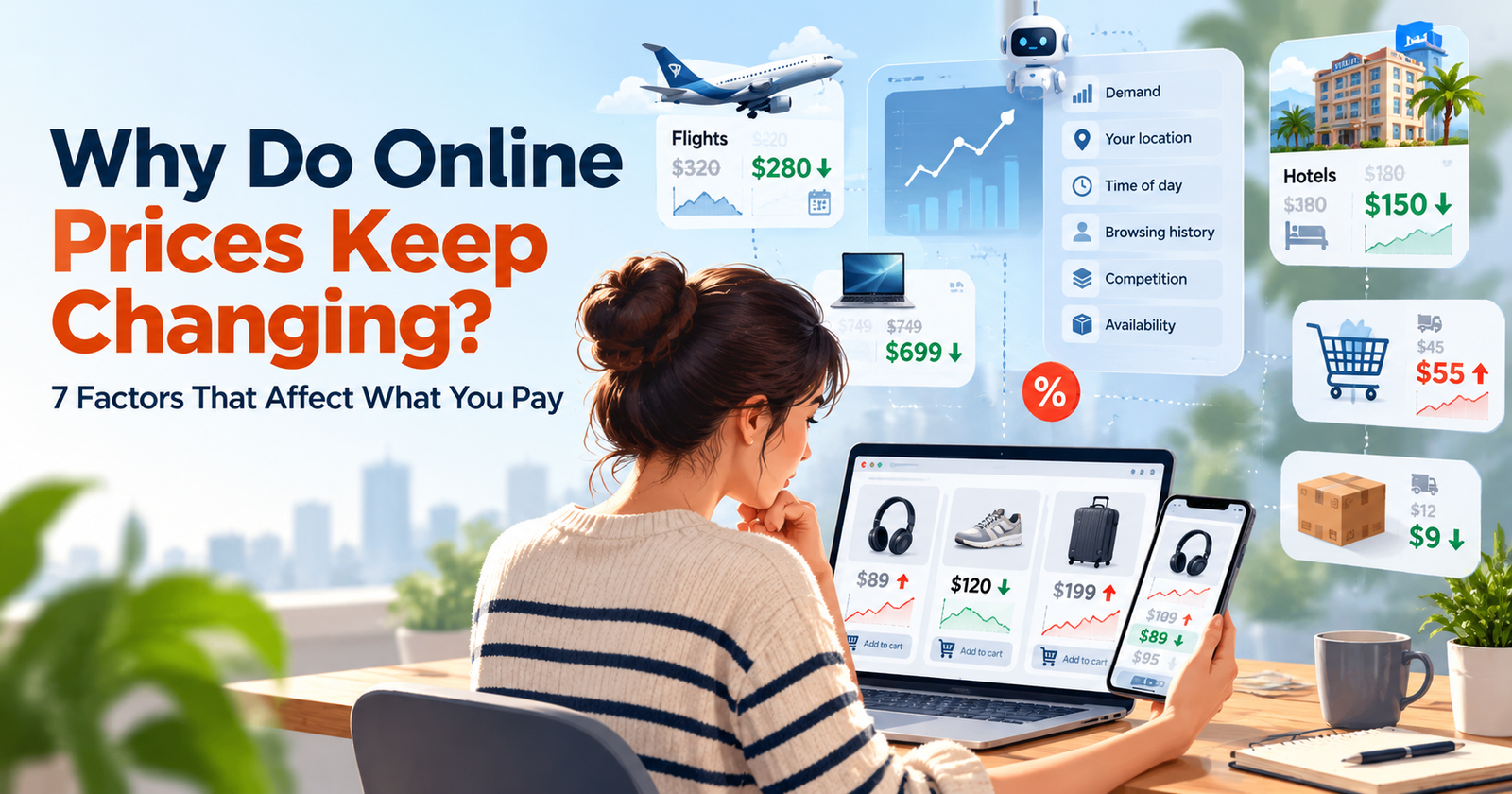
A flight costs $240 in the morning and $295 that evening. The destination, aircraft, and journey remain unchanged, yet the price has increased by almost 23%. Did other travelers book the cheaper seats? Did an algorithm adjust the fare? Or did the booking website somehow recognize your interest and decide you might pay more?
These questions reflect a growing frustration with digital shopping: consumers can see prices changing without knowing what caused the difference. An online price may respond to customer demand, remaining inventory, operating costs, or competition. Sometimes the offer itself has changed, while in other situations the customer receiving it may influence the price displayed.
Why do online prices keep changing? The answer is more complicated than a single pricing algorithm. Understanding how businesses set prices, why different customers may encounter different offers, and when waiting or buying makes financial sense can help consumers recognize questionable practices and make more informed purchasing decisions.
Why Do Online Prices Keep Changing? Understanding Dynamic Pricing
Dynamic pricing allows businesses to adjust prices as market conditions change instead of maintaining one fixed rate. Airlines, hotels, ride-hailing services, and online retailers have different reasons for using it, but they share an ability to respond to changing commercial circumstances.
The Bank of England’s April 2026 analysis explains how digital technology and artificial intelligence are making prices more flexible. A survey of more than 1,600 firms conducted over the three months to January 2026 found that 21% were using market-responsive pricing tools, with 31% expecting to do so within the following year. These figures reflect the surveyed businesses rather than global adoption.
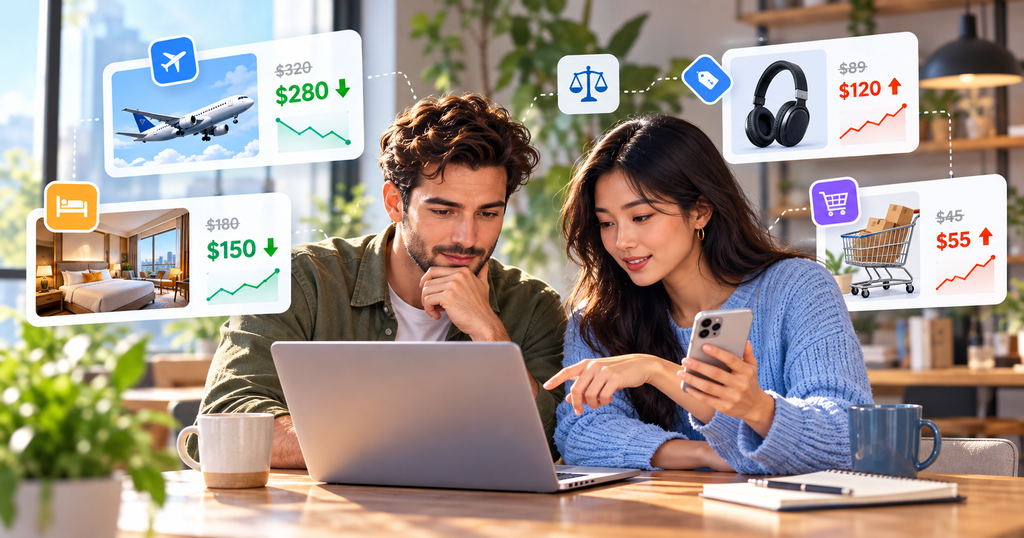
The transformation is particularly visible in hospitality, where online prices keep changing as hotels respond to occupancy forecasts, seasonal demand, and booking patterns. According to the Bank of England’s analysis of UK price observations, the share of hotel rates changing from one month to the next increased from approximately 15% in 2005 to around 80% in the more recent data. This indicates that prices are adjusted more frequently, not necessarily that hotels have become systematically more expensive.
For shoppers asking why online prices keep changing, the important distinction is whether prices are responding to market conditions or being adjusted according to information about individual customers. Dynamic pricing generally responds to factors such as demand and availability, while personalized pricing may influence the offers presented to different buyers. The two practices can overlap, but understanding their differences helps consumers evaluate price changes more accurately.
1. Sudden Demand Can Push Prices Higher
When more customers request a service than businesses can immediately provide, prices may rise. This is particularly noticeable in markets where supply cannot expand quickly.
Ride-hailing provides a practical example. Uber explains that its surge pricing responds to differences between local ride requests and available drivers. Higher fares may encourage additional drivers to serve busy areas while prompting some passengers to delay non-essential journeys.
The distinctive feature is the unexpected demand surge. Heavy rainfall, a concert ending, or a sudden transport disruption can create a temporary shortage of available vehicles. The price may fall when demand eases, or more drivers become available, although this is not guaranteed.
For customers, temporary demand-based increases are most relevant when timing is flexible. Someone returning from an ordinary shopping trip may be able to compare alternatives, while a traveler facing an urgent or unsafe situation may have little practical freedom to wait.
2. Limited Capacity Can Make Cheaper Offers Disappear
Airlines and hotels face a different problem: their available capacity expires. An empty airline seat cannot be sold once the flight departs, and an unoccupied hotel room cannot generate revenue for a night that has already passed.
Airlines use revenue-management systems that can make different fare categories available at different prices. As cheaper categories sell out or are withdrawn from sale, the lowest remaining fare may rise even though the aircraft and journey remain unchanged. Hotel operators make similar decisions using reservations, remaining rooms, and expected occupancy.
This is why the original $240 flight might later cost $295. The increase could reflect the disappearance of a cheaper fare category rather than an airline identifying a particular shopper and raising the price specifically for them.
For fixed-date travel, waiting carries a genuine opportunity cost. A consumer hoping to save another $20 could instead lose access to the available fare and face a considerably more expensive alternative.
3. Seasonal Patterns Influence Prices Before Demand Arrives
Not all pricing changes are reactions to unexpected events. Businesses can anticipate recurring periods of higher demand and adjust prices well before customers begin purchasing.
School holidays, major sporting events, festivals, and tourism seasons create reasonably predictable patterns. A hotel may raise room rates months before an international conference, while a retailer may schedule discounts around seasonal inventory changes.
Unlike sudden demand surges, these adjustments often reflect forecasts and booking calendars. A high price does not necessarily mean current demand is unusually strong; the business may expect stronger demand closer to the event.
This also explains why there is no universally reliable weekday for booking cheap flights. Different destinations, dates, airlines, and fare conditions create different pricing patterns. Flexibility around travel dates can be more valuable than following an oversimplified booking rule.
4. Operating Costs and Inventory Affect Retail Prices
Some online price changes originate behind the scenes, well before customers encounter the product. Suppliers may raise wholesale prices, transport costs may increase, or exchange-rate movements may make imported goods more expensive.
Consider an electronics retailer that imports laptops in US dollars but sells them in another currency. If the local currency weakens, replacing inventory may become more costly. The retailer might adjust prices even when customer demand remains stable.
Inventory pressures can produce the opposite result. Businesses holding excess seasonal merchandise may reduce prices to recover cash and clear storage space. Older electronics may also become cheaper when newer models enter the market.
These situations illustrate why a price change should not automatically be interpreted as evidence of personal tracking. Sometimes it reflects the economics of acquiring, storing, or replacing the product.
5. Competitor Monitoring Can Trigger Rapid Adjustments
In competitive retail markets, online prices keep changing as businesses respond to rival discounts, promotional campaigns, and shifting customer demand. These adjustments may involve lower prices, free delivery, or product bundles designed to attract buyers without unnecessarily reducing profit margins.
Imagine three retailers selling an identical laptop. One reduces its price by $40, another offers free delivery, and a third includes an extended warranty. All three are competing for the same buyer, but the value of their offers cannot be judged from the headline price alone.

Some companies use software to monitor competitors and implement adjustments automatically. The commercial incentive is straightforward: remain attractive to customers without discounting more than necessary. The algorithm may accelerate the response, but competition is the underlying reason for the adjustment. Businesses must also consider whether responding to competitors with lower prices is financially sustainable. A discount may attract buyers but reduce the amount earned from each sale, particularly when operating costs remain unchanged. As BusiPulse explained in its analysis of whether lower prices win customers, aggressive discounting does not necessarily produce higher profits. This helps explain why some retailers respond to competing offers with additional services or product bundles rather than simply cutting prices.
Such monitoring can benefit shoppers when businesses compete aggressively. However, regulators also examine situations in which pricing algorithms could weaken competition. Experimental findings concerning algorithmic coordination should not be mistaken for proof that ordinary retailers routinely engage in illegal price-fixing.
6. AI Makes Pricing Decisions Faster and More Complex
Pricing software is often blamed whenever an online price changes unexpectedly. Yet an algorithm is usually the mechanism implementing a decision, not necessarily the economic reason behind it.
A basic system might reduce prices automatically when inventory exceeds a threshold. A more advanced model could evaluate sales, competitor offers, expected demand, and available capacity before recommending an adjustment.
Artificial intelligence increases the speed and complexity of these calculations, sometimes allowing businesses to manage large numbers of prices with limited manual intervention. It can support both increases and discounts, depending on the company’s objectives and market conditions.
A central-bank analysis therefore cannot establish that every business using AI charges higher prices. The Bank of England notes that the effect of more flexible pricing depends heavily on competition and information available to customers. Where rivals compete intensely, improved pricing technology can also encourage lower offers.
The more important consumer question is not simply whether an algorithm was involved, but what information influenced the price and whether meaningful alternatives remain available.
7. Personalized Pricing Can Produce Different Customer Offers
Personalized pricing introduces a distinct issue: the customer, rather than only the market or product, may influence the price or promotion being offered.
The US Federal Trade Commission’s January 2025 findings described how pricing intermediaries can use information such as location, browsing activity, and purchasing history to support individualized prices or promotions. The findings concern the practices and capabilities examined by the agency, not every retailer operating online.
There is an important difference between a disclosed loyalty discount and a less transparent system estimating how much an individual customer might be willing to pay. Both may produce different offers, but they raise different questions about transparency and consumer expectations.
Before concluding that a website is personally targeting someone, consumers should verify whether they are comparing identical products, sellers, delivery terms, currencies, and promotional eligibility. Different prices alone cannot reveal which pricing mechanism produced them.
Three Price Changes That Look Similar but Mean Different Things
Not every price movement has the same explanation. When online prices keep changing, the cause may involve market conditions, available offers, or customer-specific pricing practices. These differences matter because similar-looking price changes can have different explanations. The following hypothetical examples illustrate what shoppers should examine before deciding whether an offer represents good value.

| What you notice | Possible cause | What to investigate |
| Flight rises from $240 to $295 | Cheaper fare category becomes unavailable | Remaining fares, booking terms, nearby dates |
| Laptop falls from $900 to $820 | Promotion, competitor response, or excess stock | Price history, exact model, warranty |
| Two customers receive different discounts | Membership eligibility or possible personalization | Account status, location, offer conditions |
These examples are not evidence that a specific company used any particular pricing method. They demonstrate why consumers should investigate the circumstances rather than treat every fluctuation as proof of manipulation.
A useful starting point is to ask: Did the market change, did the offer change, or did the customer receiving the offer change? If the answer remains unclear, the responsible conclusion may simply be that the available evidence is insufficient to identify the cause.
When Does Dynamic Pricing Become Unfair?
The question “Why do online prices keep changing?” also raises concerns about fairness and transparency. Price variation is not inherently harmful: discounts during quieter periods can make services more accessible, while higher peak-period prices may help businesses manage limited capacity. Problems arise when consumers cannot understand an offer, compare alternatives, or make informed purchasing decisions because important pricing conditions remain unclear.
Misleading countdown timers, unclear mandatory charges, and promotional terms revealed late in checkout can create concerns regardless of whether dynamic pricing is involved. More sophisticated personalized pricing raises additional questions about privacy, transparency, and the use of customer information.
The legal position differs internationally. A practice may be lawful in one jurisdiction and restricted in another, while an unpopular price increase is not automatically illegal. Consumers should distinguish legitimate market-based adjustments from potentially misleading conduct or prohibited discrimination.
The practical test is whether the buyer receives clear information, understands the final cost, and has a reasonable opportunity to compare alternatives before committing.
Should You Buy Now or Wait?
When online prices keep changing, deciding whether to buy immediately or wait becomes an important consumer choice. Waiting may save money, but the potential savings must be weighed against the risk of losing the current offer. The best decision depends on the type of product, how urgently it is needed, and whether a better price is reasonably likely.
| Purchase | Main risk of waiting | Practical approach |
| Fixed-date airline ticket | Cheaper seats may disappear | Monitor early and book an acceptable fare |
| Flexible hotel stay | Prices may rise, but other dates may be cheaper | Compare dates and cancellation terms |
| Electronics | Discounts may follow product cycles | Check price history and specifications |
| Ride-hailing | Temporary demand may continue or ease | Compare alternatives when safe and practical |
| Non-essential shopping | Promotional urgency may cause overspending | Buy according to need and budget |
The principle is straightforward: flexibility has financial value. A shopper who can postpone an optional purchase has more room to wait for a better offer than someone who must travel on a particular date.
However, endlessly monitoring prices also consumes time and attention. The goal should be a satisfactory decision based on reliable comparisons, not the impossible task of purchasing every product at its absolute lowest price.
Compare the Final Cost, Not Just the Advertised Price
A product advertised for $94 plus $12 delivery costs $106, while an identical item offered for $100 with free delivery is cheaper overall. This simple example shows why a headline discount may be misleading when additional expenses are ignored.

The FTC’s online shopping guidance recommends comparing sellers, total costs, and applicable purchasing conditions. Consumers should also consider warranties, return rights, delivery reliability, and seller credibility, particularly for expensive purchases. Unexpected charges can also damage the relationship between businesses and customers. A shopper who discovers additional fees only at checkout may abandon the purchase, even when the original price appeared attractive. BusiPulse examined this problem in its article on customer friction, explaining how unclear pricing and unnecessary purchasing obstacles can discourage otherwise interested buyers. Transparent final prices therefore benefit consumers while helping businesses build customer trust.
Does Incognito Mode Really Make Flights Cheaper?
A persistent online claim suggests that airlines automatically raise fares when customers repeatedly search for the same flight. However, changes in fare availability and demand provide alternative explanations for prices moving between searches.
Skyscanner states that cookies and repeated searches do not cause fares to increase on its platform. This does not establish how every airline or booking website operates, but it challenges the idea that clearing cookies guarantees savings.
Private browsing changes some locally stored browser information; it cannot eliminate supply constraints, booking conditions, or general market fluctuations. Flexible travel dates and reliable price comparisons remain more defensible ways to search for better offers.
Frequently Asked Questions
Can Two People See Different Prices for the Same Product?
Yes. Regional promotions, loyalty membership, currency settings, targeted discounts, and personalized pricing can produce different offers. However, consumers should first establish whether they are comparing the same product, seller, delivery arrangements, and transaction conditions. A price difference does not automatically prove hidden profiling, and the underlying cause may be impossible to determine from the displayed amount alone.
How Can You Tell Whether a Price Increase Is Caused by Demand or Personalized Pricing?
There is no universally reliable method because websites do not always disclose their pricing calculations. Consumers can compare equivalent offers across dates, devices, or eligible accounts, while checking whether inventory, location, or membership conditions differ. Repeated differences may justify further investigation, but they do not conclusively reveal the algorithm or information used. When the cause matters, reviewing the seller’s pricing disclosures or contacting customer support may provide additional clarification.
Final Thought
Online price changes can seem arbitrary when consumers see only the final number. In reality, a changing price may reflect temporary demand, limited capacity, seasonal expectations, operating costs, competitive pressure, or customer-specific offers. Digital technology increasingly determines how quickly these decisions can be implemented, but it does not explain every price movement by itself.
For anyone asking why online prices keep changing, the most useful approach is to investigate what changed before deciding what to do next. A disappearing airfare requires a different purchasing strategy from an inventory clearance sale or a customer-specific promotional discount. Consumers who understand these differences are better equipped to compare value, recognize questionable offers, and avoid unnecessary spending.
Author’s Note
This article is published by BusiPulse for general educational and consumer-information purposes and does not constitute financial, legal, or purchasing advice. Pricing systems, advertising rules, privacy protections, and consumer rights differ between countries and industries. Readers should verify current prices, applicable terms, and local requirements before making significant purchasing decisions.
Readers are not required to agree with the author’s interpretations or conclusions. BusiPulse encourages independent examination of credible evidence and publishes analysis of business, economics, technology, and everyday consumer issues to support informed decision-making.