


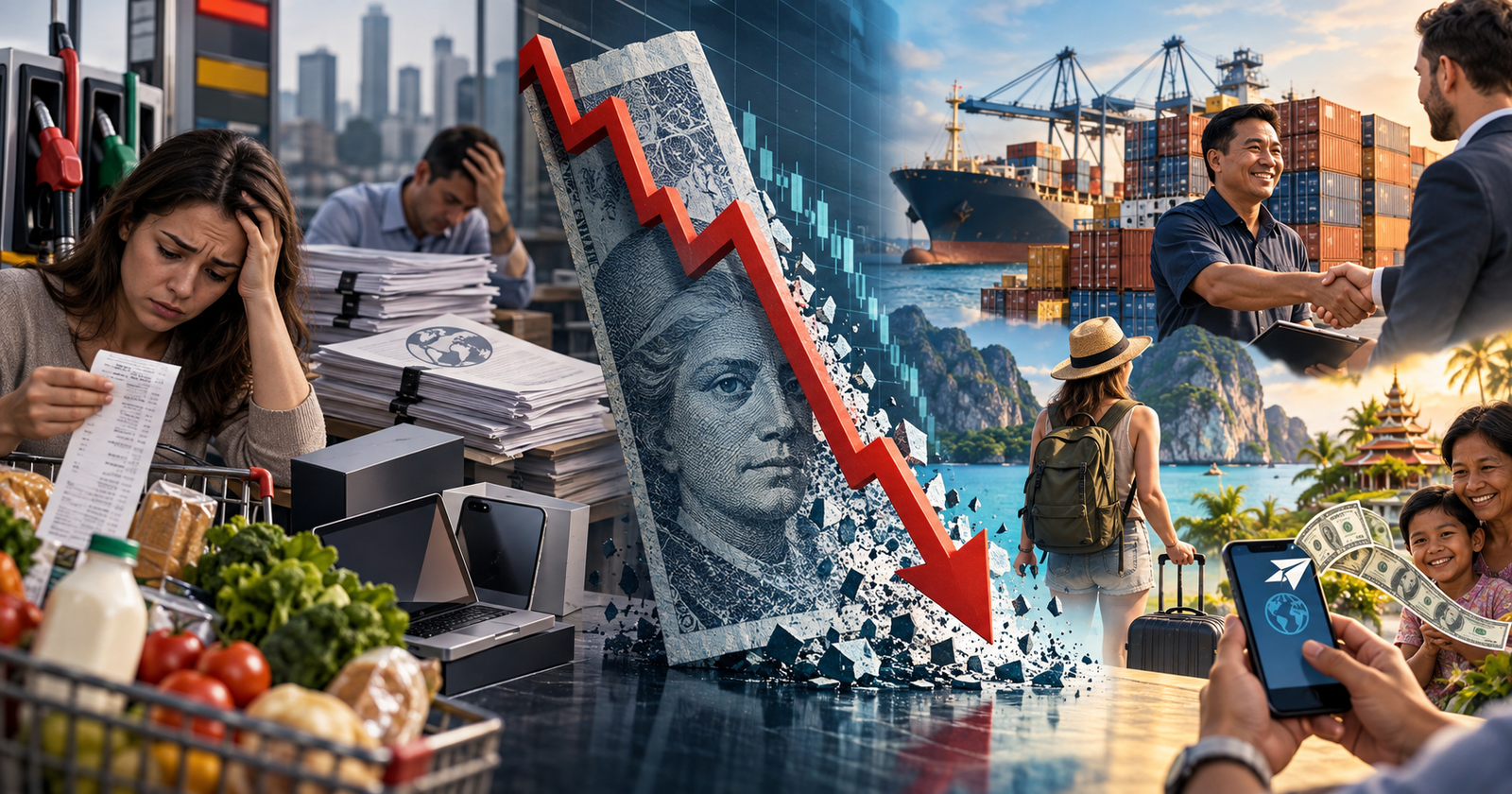
A currency can lose value without anything visibly changing overnight. The same shops remain open, factories continue operating, and workers receive the same number of currency notes in their salaries. Yet the economic position of households, businesses, and governments can change significantly because those notes now buy less in international markets.
After currency devaluation, imported fuel may become more expensive, foreign travel may cost more, exporters can receive more local currency for overseas sales, and debts denominated in dollars or other foreign currencies become harder to repay. A business earning foreign currency may benefit at the same time that another company relying on imported materials faces rising costs. Even two households living next door to each other can experience the same currency movement very differently.
Currency devaluation is therefore not simply a change in an exchange-rate number. It redistributes purchasing power throughout an economy. The real question is not whether a weaker currency is automatically good or bad, but who earns in which currency, who spends in which currency, who owes money in which currency, and what happens to domestic prices afterward.
What Does Currency Devaluation Actually Mean?
In strict economic terminology, devaluation usually means an official reduction in a currency’s value under a fixed or managed exchange-rate system. When a freely traded currency falls because of market forces, the more accurate term is depreciation. In everyday discussion, however, currency devaluation is often used more broadly to describe a substantial loss of external value. This article uses the broader expression while keeping that distinction in mind.
Suppose one US dollar initially exchanges for 100 units of a country’s currency. If the exchange rate later becomes 120 units per dollar, the local currency has lost value against the dollar. A product costing $100 abroad would previously have required 10,000 local currency units. At the new exchange rate, it requires 12,000 before considering shipping, taxes, or any change in the foreign seller’s price.
The reverse is true for someone receiving dollars. An exporter earning $100 can now convert that revenue into 12,000 local units instead of 10,000. That simple example explains why the same currency movement can create both gains and losses across an economy.
1. Imported Goods Usually Become More Expensive
The most immediate effect of currency devaluation is often visible in imported goods. Fuel, machinery, medicines, electronics, industrial components, chemicals, and food ingredients purchased from abroad require more domestic currency when their foreign-currency price remains unchanged.
The impact can extend far beyond products that consumers think of as imports. A locally produced loaf of bread may depend on imported fertilizer, fuel, or machinery. A domestic manufacturer may use foreign components, while a transport company may depend on imported vehicles and petroleum. Exchange-rate weakness can therefore increase costs inside products that appear entirely local.

How strongly consumers feel the change depends on the structure of the economy. Countries that import a large share of their energy, food, equipment or industrial inputs are generally more exposed than economies able to replace some imports with domestic production. Businesses may initially absorb part of the increase through lower profit margins, but sustained currency weakness makes that increasingly difficult.
2. Inflation Can Spread Through the Economy
One of the most important consequences of currency devaluation is its potential effect on inflation, although a weaker currency does not automatically produce an equal rise in consumer prices. Economists describe the extent to which exchange-rate changes feed into domestic prices as exchange-rate pass-through. A 10% decline in a currency does not mean that every product becomes 10% more expensive.
Several factors determine how much of the currency movement reaches consumers. Businesses may have inventories bought at the old exchange rate, contracts may temporarily fix prices, foreign suppliers may reduce their own margins, and competitive pressure can stop companies from passing the full increase to customers. The speed and size of the effect therefore vary between products, industries and countries.
The risk becomes greater when higher import costs spread through supply chains. Manufacturers pay more for materials, transport companies face higher fuel costs, and retailers eventually replace stock at more expensive exchange rates. If households and businesses also begin expecting prices to continue rising, wage demands and precautionary price increases can reinforce the process. Currency weakness can then become part of a broader inflation problem rather than remaining an isolated change in import prices.
3. Exporters May Gain, but Competitiveness Can Fade
Currency devaluation can make a country’s exports cheaper for foreign buyers. If a product continues selling for 10,000 local currency units, a customer paying in dollars, euros or pounds may need less foreign currency to buy it after the exchange-rate change. Alternatively, an exporter that continues charging the same foreign-currency price receives more domestic currency when the revenue is converted.
This can strengthen manufacturers, agricultural exporters, outsourcing firms, software companies, and other businesses earning foreign currency. Greater competitiveness may support production and employment if overseas demand responds to the lower effective price.
However, the advantage depends on more than the nominal exchange rate. Economists often look at the real exchange rate, which takes relative prices and costs into account. If a currency falls sharply but domestic wages, energy costs and other prices then rise quickly, much of the original competitive advantage can disappear. An exporter that also depends heavily on imported machinery, components or fuel may discover that revenue improves while production costs rise at the same time.
4. Foreign-Currency Debt Becomes More Difficult to Repay
Currency devaluation becomes particularly difficult for borrowers whose debts and income are denominated in different currencies. A household, business, or government that borrows in dollars but earns mainly in local currency faces a heavier repayment burden when the domestic currency loses value.
Suppose a company owes $1 million. At an exchange rate of 100 local units per dollar, that liability is equivalent to 100 million local units. If the currency falls to 120 per dollar, the same $1 million debt represents 120 million local units. Nothing has changed in the original loan agreement, but the borrower now needs 20% more domestic currency to repay the principal.
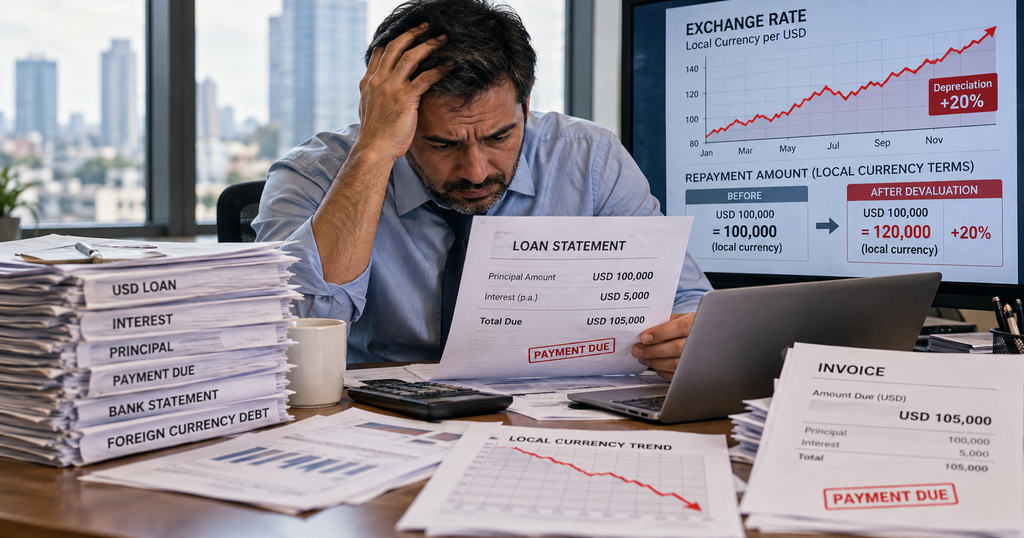
The pressure can become particularly serious when governments or large companies have substantial foreign-currency obligations. Interest payments consume more local resources, refinancing may become more expensive, and lenders can become cautious if they fear further currency weakness. Borrowers whose income and debt are both denominated in the same local currency are less directly exposed to this particular problem.
5. Tourism Becomes Cheaper for Visitors and Costlier for Residents
Currency devaluation changes the relative price of international travel. Foreign visitors arriving with stronger currencies may find hotels, restaurants, transport and entertainment cheaper than before. Tourism businesses can benefit if the lower effective price encourages more visitors or allows them to spend more during their stay.
Residents travelling abroad experience the opposite effect. Hotel rooms, meals, shopping and other expenses priced in foreign currency require more domestic money. Families paying for overseas education or medical treatment can face the same pressure even though they are not tourists.
A weaker currency does not guarantee a tourism boom. Airlines and hotels may face higher costs for imported fuel, equipment, or food, while poor infrastructure, security concerns, visa restrictions, or weak international demand can outweigh the price advantage. Exchange rates can improve competitiveness, but they cannot create demand on their own.
6. Remittances and Foreign-Currency Income Gain an Initial Advantage
Currency devaluation can initially benefit households receiving money from relatives working abroad. If someone sends $500 each month, the recipient receives more local currency after the exchange-rate decline as long as the amount sent in dollars remains unchanged.
The same effect can benefit freelancers, remote workers, consultants, and digital businesses that earn in stronger foreign currencies while paying much of their living or operating expenses locally. Their income can gain purchasing power relative to people whose salaries remain fixed in domestic currency.

The important word, however, is initial. If domestic prices subsequently rise, the advantage can narrow. A household may receive 20% more local currency for the same remittance but not enjoy a 20% improvement in real living standards if food, fuel, rent and other expenses rise as well. The exchange rate changes immediately; the ultimate gain depends on inflation and spending patterns.
7. Businesses Can Win and Lose at the Same Time
Calling exporters winners and importers losers is often too simplistic. Modern businesses can be exposed to several currencies at once. A clothing manufacturer may export finished garments while importing chemicals and machinery. A technology company may earn dollars from overseas clients but pay foreign providers for cloud infrastructure. A retailer may sell entirely to domestic customers while relying heavily on imported inventory.
The effect of currency devaluation on an individual business depends largely on its net currency exposure: the currencies in which it earns revenue, pays expenses, holds assets, and owes debt. A company earning mainly dollars while paying wages and rent locally may benefit, while a business earning local currency but paying suppliers and lenders in dollars may experience severe pressure.
Companies can sometimes reduce this mismatch by matching foreign revenues with foreign expenses, negotiating contracts, adjusting prices, or using financial hedging. Larger firms usually have more tools available than smaller businesses, which may be forced to absorb exchange-rate shocks through narrower margins or higher customer prices.
8. Government Finances Face Conflicting Pressures
Governments can experience both gains and losses after a currency devaluation. Higher nominal prices may increase some tax revenues, and stronger export earnings can support sectors that generate foreign exchange. A more competitive currency can also reduce demand for some imported goods over time.
The difficulties can be substantial, however. Foreign-currency debt service becomes more expensive, while government purchases of imported fuel, medicines, defence equipment or infrastructure components require more local currency. Where governments subsidize imported essentials, the fiscal cost of maintaining those subsidies can rise sharply.
Policymakers then face difficult trade-offs. Higher interest rates may help control inflation or support confidence in the currency, but they can also weaken borrowing, investment, and economic growth. Using foreign-exchange reserves can reduce short-term volatility, but reserves are limited. Devaluation rarely creates a painless policy choice; it changes which economic pressures become most urgent.
9. Domestic Wages and Savings Can Lose Purchasing Power
A worker whose salary remains unchanged after devaluation still receives the same number of currency units, but those units buy less foreign currency and fewer imported goods. If higher import costs then spread into domestic prices, the worker can also lose purchasing power at home.
Cash savings face a similar issue. Someone holding 1 million local currency units still owns exactly 1 million units after the exchange-rate change, but those savings may buy fewer dollars, less foreign travel, fewer imported products, or a smaller amount of overseas education. If inflation rises as well, the real domestic value of those savings can also decline.
This does not mean that everyone should immediately move savings into foreign currency. Exchange rates can recover, foreign assets carry their own risks, and regulations differ between countries. The broader lesson is that nominal wealth and real purchasing power are not the same thing.
Does Devaluation Improve the Trade Balance?
One of the main arguments in favour of a weaker currency is that exports become more competitive while imports become more expensive. In theory, that should encourage foreign demand for domestic goods and reduce demand for imports. In practice, the adjustment can take time.
The trade balance may initially become worse because countries continue buying essential imports at higher domestic prices while export volumes have not yet had time to respond. Economists often describe this pattern as the J-curve effect: the trade balance deteriorates first and improves later if export and import quantities eventually adjust sufficiently.
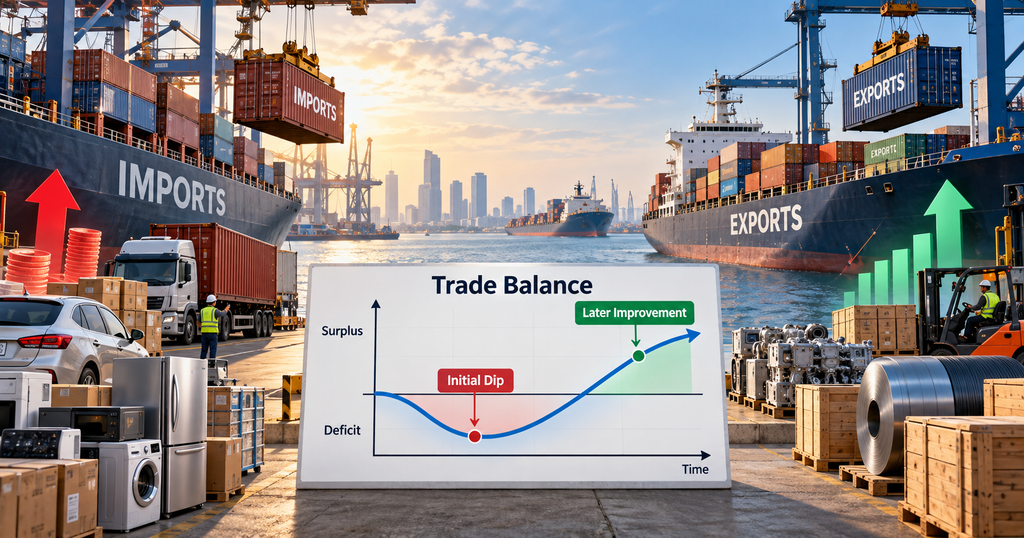
Whether that improvement occurs depends on the economy’s ability to respond. Exporters need spare capacity, reliable energy, infrastructure, and access to finance. Domestic consumers need realistic alternatives to imported products. If a country must continue importing fuel, machinery, or essential food regardless of price, the import bill may remain high even after a major currency decline.
A Weaker Currency Cannot Replace Economic Competitiveness
Devaluation can create an opportunity for exporters and domestic producers, but it cannot manufacture productivity. A country does not become economically stronger simply because its currency becomes cheaper.
Long-term competitiveness depends on productivity, infrastructure, education, technology, reliable energy, regulation, access to finance, and the ability of businesses to produce goods and services that customers actually want. If these conditions are weak, repeated currency depreciation may raise prices without generating a proportionate increase in exports.
This is also why the real exchange rate matters more over time than the initial currency movement. If devaluation is followed by persistent domestic inflation, the country can gradually lose the price advantage that the weaker currency initially created. Sustainable competitiveness ultimately comes from producing more value, not simply from having a cheaper currency.
Who Is Most Likely to Win or Lose?
Currency devaluation does not divide the economy neatly into winners and losers, but some exposures are easier to identify than others.
| More likely to benefit | More likely to face pressure |
| Exporters with mainly domestic costs | Import-dependent businesses |
| Foreign tourists | Residents travelling abroad |
| Households receiving foreign remittances | Households relying on fixed local incomes |
| Workers earning foreign currency | Consumers dependent on imported goods |
| Domestic producers competing with imports | Borrowers with foreign-currency debt |
| Firms with foreign revenues and local costs | Firms with local revenues and foreign costs |
The key distinction is financial rather than occupational. Those who earn foreign currency while spending mainly in local currency are generally better positioned. Those who earn local currency while carrying substantial foreign-currency expenses or debt are more vulnerable. Inflation, contracts, hedging, and the ability to adjust prices can alter the outcome, which is why the same currency movement can produce very different results across businesses and households.
Final Thoughts
Currency devaluation affects far more than the price of one currency against another. It changes import costs, inflation pressures, export competitiveness, debt burdens, tourism, remittances, business margins, government finances, and the real purchasing power of wages and savings.
That is why describing devaluation as automatically good because it supports exports, or automatically bad because it raises import prices, misses the larger economic picture. The outcome depends on what a country produces, what it imports, how much foreign-currency debt it carries, how strongly exchange-rate changes pass into domestic prices, and how quickly businesses and consumers can adapt.
A weaker currency can create an opportunity for an economy to become more competitive, but it cannot substitute for productivity, investment or sound economic management. If exporters expand, domestic production strengthens, and inflation remains contained, some of the adjustment can ultimately benefit the economy. If higher prices, debt pressure and declining confidence dominate instead, households and businesses may mainly experience a loss of purchasing power. The exchange rate begins the adjustment; the structure of the economy determines where it ends.
Author’s Note
This article is intended for general educational and informational purposes and does not constitute financial, investment, tax, legal, foreign-exchange or economic-policy advice. Exchange-rate systems, capital controls, taxation, debt structures, monetary policies and economic conditions differ substantially between countries, so the effects of currency devaluation can vary considerably.
The numerical examples are simplified illustrations designed to explain economic relationships and should not be interpreted as forecasts or guaranteed outcomes. Currency movements are influenced by many factors, and their effects on inflation, trade, businesses and households may develop differently over time.
Readers are not required to agree with the author’s conclusions. BusiPulse examines business, economics, markets and the financial forces affecting everyday decisions, with the aim of explaining complex economic ideas in practical language for an international audience.

[…] crypto prices. Broader monetary conditions can matter as well, especially in economies experiencing currency devaluation, where changing confidence in traditional money may affect interest in alternative […]
[…] can simultaneously become more expensive. These contrasting effects are explored in our analysis of currency devaluation and its economic consequences, which explains how exchange-rate movements influence exporters, importers, businesses, and […]
[…] markup from changes in the market value of a currency. As explained in our analysis of currency devaluation and its economic effects, exchange-rate movements can change the purchasing power of international payments and remittances. […]