


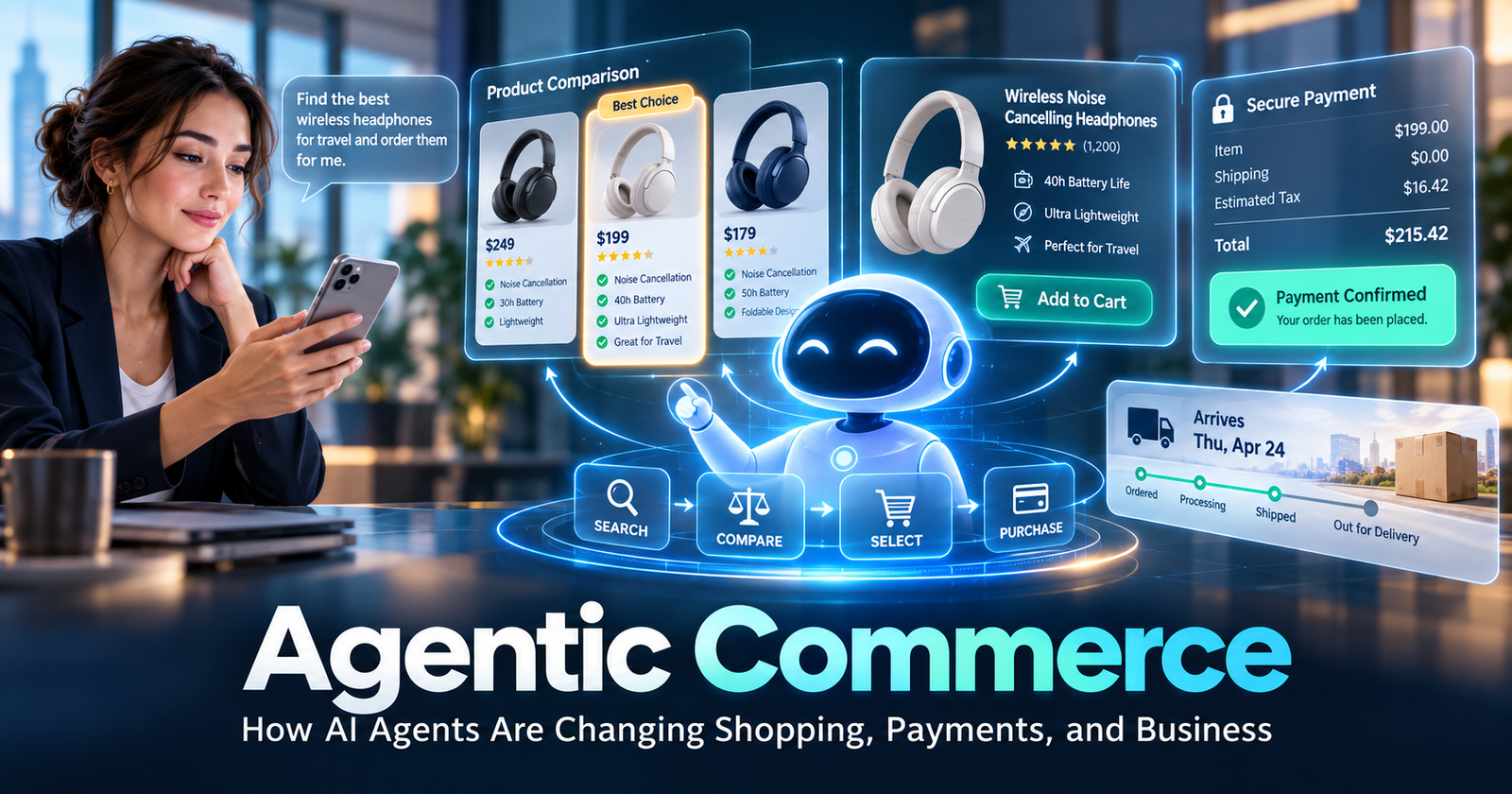
Imagine telling an AI assistant: “Find me a reliable laptop under $1,200, compare the strongest options, make sure it arrives before Friday, and buy it if the price falls below $1,050.”
Until recently, artificial intelligence could help research that purchase, summarize reviews, compare specifications, and recommend a product. The final transaction, however, generally remained the shopper’s responsibility. Agentic commerce begins to change that boundary. Instead of merely helping a person decide, an AI agent can increasingly participate in the commercial process itself, from product discovery and comparison to checkout and, with appropriate authorization, payment.
That transition is already moving beyond theory. OpenAI has developed the Agentic Commerce Protocol to connect merchants with AI-assisted shopping experiences, Google introduced its Universal Commerce Protocol for communication between AI shopping systems and retailers, and Visa and Mastercard are developing infrastructure specifically for AI-initiated transactions. These developments suggest that agentic commerce could become one of the most important changes to digital commerce since mobile shopping, while also raising difficult questions about customer relationships, spending authority, fraud, privacy, and responsibility when automated purchasing goes wrong.
What Is Agentic Commerce?
Agentic commerce refers to commercial activity in which AI agents perform parts of the buying process on behalf of consumers or businesses. An agent might search for products, compare alternatives, evaluate price and delivery conditions, select a merchant, prepare a transaction, or complete a purchase after receiving the required permission.

The important difference is action. Traditional recommendation systems influence what shoppers see, while generative AI can explain and compare options. An agentic system goes further by carrying out tasks toward a defined goal. That is what separates ordinary AI-assisted shopping from more advanced AI-powered shopping. This shift also connects with the broader evolution of prompt engineering as AI systems move beyond generating answers toward using tools and completing multi-step tasks.
Consider a traveler who asks an AI agent to find a hotel near a conference, stay within a certain budget, avoid poorly rated properties, compare cancellation policies, and book the best acceptable option. The traveler provides the objective and restrictions, while the software performs much of the work that previously required several searches, browser tabs, comparison sites, and checkout screens.
The level of autonomy can vary considerably. Some systems may require confirmation before payment, while more advanced systems could eventually operate within previously approved spending limits or purchasing rules. Agentic commerce should therefore be understood as a spectrum rather than as a system in which AI receives unrestricted authority over a person’s finances.
How an AI Shopping Agent Could Complete a Purchase
A typical agentic shopping journey begins with intent rather than a product page. A consumer describes what is needed and may include preferences such as budget, size, quality, delivery date, brand restrictions, or return conditions. The AI then searches available product information and evaluates which options satisfy those requirements.
Accurate product data becomes critical at this stage. AI shopping agents need reliable information about price, inventory, specifications, shipping, and other conditions before they can make useful comparisons. OpenAI’s commerce documentation, for example, requires participating merchants to provide structured product information while allowing the merchant’s existing systems to remain responsible for pricing, taxes, fulfillment, risk decisions, and payment processing. Google’s Universal Commerce Protocol similarly aims to provide a common language connecting AI interfaces, merchants, and payment providers across the shopping journey.
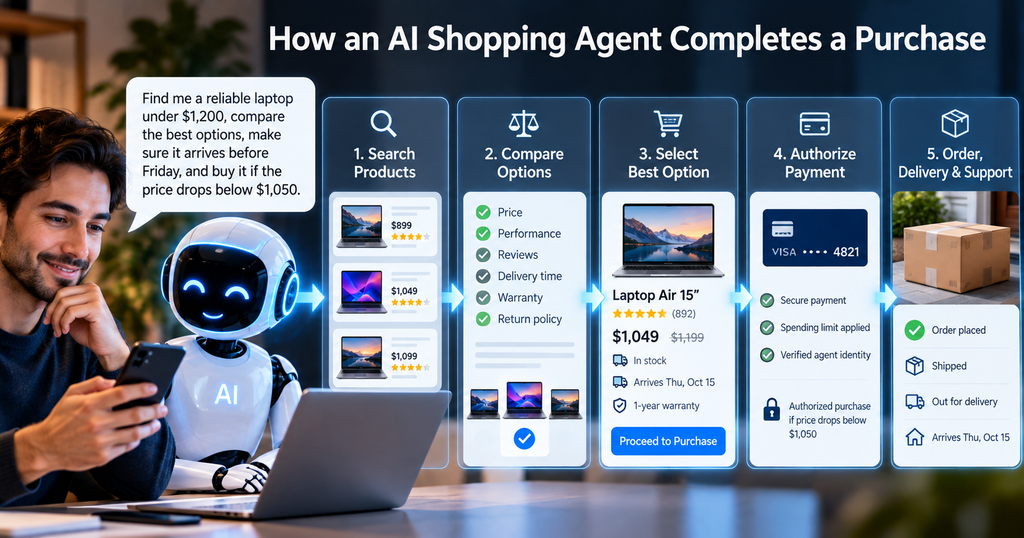
This architecture matters because agentic commerce does not necessarily mean that an AI company becomes the retailer, bank, payment processor, and delivery company. More often, the agent acts as an intelligent interface connecting systems that already perform those functions.
Why Agentic Commerce Is Different From Ordinary E-Commerce
Traditional e-commerce is built largely around human navigation. Companies invest heavily in search rankings, advertising, product pages, menus, filters, recommendations, and checkout optimization because shoppers must move through those interfaces themselves.
Agentic commerce could reduce some of that navigation. A customer may never visit ten competing websites because an AI agent can evaluate those merchants on the customer’s behalf. That changes the competitive question. Businesses have spent years asking, “How do we rank where customers search?” They may increasingly need to ask, “Can an AI agent accurately understand, evaluate, and transact with our business?”
This is one reason AI agents in e-commerce could have a larger effect than ordinary recommendation software. Structured data, accurate inventory, transparent pricing, reliable fulfillment, and machine-readable product information may become more commercially important. A visually impressive website will still matter to human customers, but an AI agent may care more about whether it can confidently determine that a product satisfies the user’s requirements.
A simple example shows why this matters. Two retailers may sell the same laptop at nearly the same price, but one provides complete specifications, live inventory, clear delivery times, and structured product data while the other relies on vague descriptions and outdated stock information. A human shopper may still investigate both. An AI agent may simply favor the merchant whose information is easier to verify.
AI Shopping Agents Could Reshape Product Discovery
Search engines, marketplaces, social platforms, comparison websites, and advertising networks have long acted as intermediaries between buyers and sellers. AI shopping agents introduce another layer between customer intent and the merchant.
OpenAI said in March 2026 that more people were beginning their shopping journeys in ChatGPT and expanded product-discovery capabilities that allow users to explore and compare products conversationally. Google has also built agentic shopping capabilities around its Shopping Graph and introduced infrastructure intended to connect retailers with AI-driven purchasing experiences.
For consumers, this could reduce the work involved in researching routine purchases. For merchants, however, it may weaken some traditional sources of website traffic. If an agent summarizes competing options and sends only the eventual order to the chosen merchant, fewer shoppers may browse individual websites, see promotional material, or develop a direct relationship with the brand.
The competition could therefore shift from winning clicks to winning inclusion, relevance, trust, and visibility inside AI-generated recommendations. Businesses that depend heavily on conventional search traffic may need to think beyond traditional SEO and consider how clearly their products can be understood by machine-driven shopping systems.
Agentic Payments Are the Critical Bridge
Finding the right product is only part of agentic commerce. The more difficult challenge is allowing software to move from recommendation to payment without sacrificing consumer control. This is where agentic payments become critical.
Visa Intelligent Commerce is designed to help agents securely interact with payment credentials and merchant systems, while Mastercard Agent Pay includes mechanisms intended to identify agents and connect transactions with consumer authorization. Mastercard has also introduced Verifiable Intent, designed to create an auditable connection between what a user authorized and what an agent subsequently did.
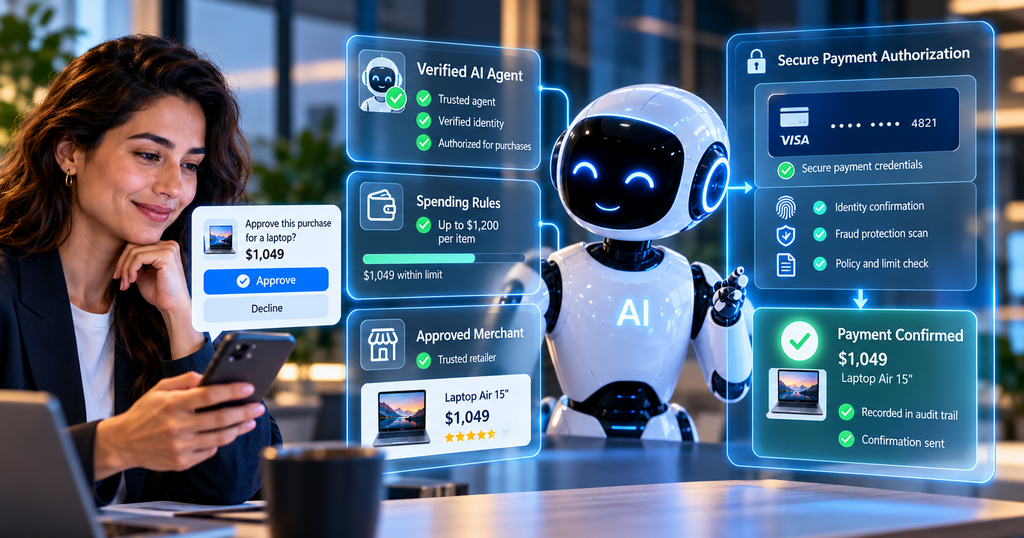
These emerging agentic payments systems point toward an important principle: successful AI commerce cannot simply give an AI unrestricted access to a credit card or bank account. Consumers and businesses may instead authorize specific amounts, merchants, categories, dates, or conditions. An agent might, for example, receive permission to buy office supplies from approved vendors up to $2,000 per month without receiving permission to spend $20,000 anywhere it chooses.
Why Businesses Could Benefit
For merchants, agentic commerce could create customers who arrive with clearer purchasing intent. An AI system may already have evaluated compatibility, price, availability, shipping, and preferences before initiating a transaction, potentially reducing some of the friction that causes consumers to abandon purchases. The commercial value of these tools ultimately depends on whether AI can improve productivity, reduce costs, or strengthen margins, an issue explored in our analysis of AI for small businesses.
Businesses could also use agents internally. Procurement agents may monitor supplies, compare approved vendors, reorder inventory, process routine invoices, or identify lower-cost purchasing alternatives. Mastercard reported in 2026 that agentic transactions were already being developed for business procurement applications in Australia and New Zealand.
This creates commercial opportunities well beyond retail. Payment processors, cybersecurity companies, identity providers, digital-wallet developers, fraud-detection platforms, commerce software companies, product-data specialists, and SaaS providers could all become part of the infrastructure supporting AI commerce.
The Risks: Fraud, Privacy, Errors, and Accountability
Giving software the ability to act increases the consequences of mistakes. An agent could misunderstand a request, rely on outdated product information, encounter manipulated content, exceed intended permissions, or interact with a fraudulent merchant. Criminals could also attempt to impersonate trusted agents, steal credentials, manipulate instructions, or exploit weaknesses in automated purchasing systems.
These are not merely theoretical cybersecurity concerns. The U.S. National Institute of Standards and Technology has been examining how AI agents should be identified, authenticated, authorized, and audited. NIST has highlighted security challenges involving agent access to data, applications, and tools, while issues such as prompt injection and unpredictable autonomous behavior can complicate conventional security models.
The practical response is not to reject agentic commerce but to limit authority intelligently. Strong identity controls, spending limits, secure credentials, transparent logs, human approval for higher-risk transactions, reliable dispute procedures, and clear revocation mechanisms will be essential if consumers and businesses are expected to trust AI with commercial decisions.
Agentic Commerce Is an International Shift
Agentic commerce is unlikely to develop uniformly around the world because payment methods, privacy rules, consumer protections, banking systems, digital identities, and e-commerce behavior differ significantly between countries.
Yet the infrastructure is increasingly international in ambition. Google developed UCP with major retailers and technology companies and received support from payment and commerce businesses operating across multiple markets, while Visa and Mastercard are building agentic-payment capabilities around global networks.
Businesses should therefore avoid assuming that one checkout design, payment method, consent process, or regulatory approach will work everywhere. Global agentic commerce will require localization just as conventional e-commerce does today.
How Businesses Should Prepare for AI Shopping Agents
Businesses do not need to redesign everything at once. The strongest first move is to improve the information and systems that AI shopping agents will rely on.
Start with product data. Titles, descriptions, specifications, availability, pricing, delivery information, return policies, and product identifiers should be accurate, structured, and updated regularly. AI cannot reliably recommend information that a merchant cannot reliably provide.
Next, review commerce infrastructure. Businesses should examine whether their systems can work through APIs and emerging agent protocols rather than depending entirely on customers manually navigating webpages. Checkout systems should support clear authorization rules, while cybersecurity teams may increasingly need to treat AI agents as identities requiring permissions, monitoring, and audit trails.
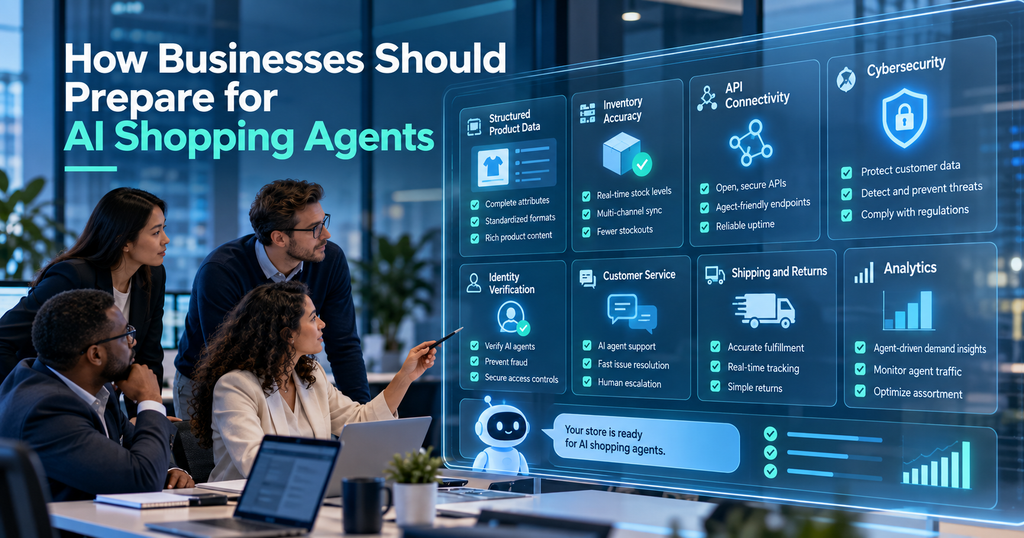
Finally, protect the human customer experience. Businesses should not sacrifice clear branding, customer service, trustworthy information, or good website design in pursuit of AI optimization. The strongest strategy is likely to serve both audiences: humans need confidence and service, while AI agents need structured data, predictable systems, and verifiable transaction rules.
Where the Commercial Opportunity Lies
Agentic commerce could create an entirely new competitive layer around digital transactions. Companies may build software that verifies agents, manages spending permissions, detects agentic fraud, optimizes product catalogs for AI discovery, connects merchants to multiple agent ecosystems, manages returns, or provides infrastructure for machine-to-machine payments.
The companies that benefit most may not necessarily be the ones building the largest AI models. A significant share of long-term commercial value could sit in the infrastructure that makes AI-led commerce trustworthy, interoperable, measurable, and practical for ordinary businesses.
That pattern is familiar. Major technological shifts often create opportunities not only for the companies building the headline technology but also for those supplying the payments, security, data, software, and infrastructure underneath it.
Final Thoughts: The Future of E-Commerce May Be Agentic
Agentic commerce changes a fundamental assumption of online business: the person making the purchasing decision may no longer perform every step of the purchase personally.
AI agents are beginning to sit between consumer intent and commercial execution. They can search, compare, organize, and increasingly participate in checkout and payment. Yet widespread adoption will depend less on how impressive the AI appears and more on whether the commercial system surrounding it can be trusted.
Consumers must know what an agent is permitted to do. Merchants must know whether the agent is legitimate. Payment providers must know that transactions are authorized. Businesses need accurate product information, and all parties need a clear way to correct errors and dispute unauthorized actions.
The most important business lesson is simple: companies should not wait for fully autonomous shopping to become mainstream before preparing. Businesses that make their products easier to understand, their systems easier to connect, and their transactions easier to verify will be better positioned as the future of e-commerce becomes increasingly shaped by AI shopping agents and agentic payments.
If those foundations develop successfully, the future of e-commerce may not simply involve people shopping faster. It may involve people increasingly telling trusted software what they want and allowing that software to handle much of the journey from intention to transaction.
Author’s Note
This article is intended for general educational and informational purposes and does not constitute financial, investment, legal, cybersecurity, payment, or business advice. Agentic commerce, AI regulation, payment infrastructure, privacy rules, consumer protections, and technical standards are developing rapidly and may differ significantly between countries and jurisdictions. Businesses should evaluate the laws, security requirements, commercial risks, and technical standards applicable to their own operations before implementing AI-driven purchasing or payment systems.
The author writes for BusiPulse about developments affecting business, economics, technology, consumers, and the changing digital economy. The purpose is to examine important developments from a practical and balanced perspective rather than promote a particular

[…] identity, routing, authorization, and transaction logic. This also connects with the rise of agentic commerce, where AI agents may increasingly initiate or manage transactions through the same embedded payment […]