



A small-business owner opens the software used to manage invoices and expenses. From the same dashboard, the business can accept customer payments, pay suppliers, issue employee cards, and perhaps access working capital. There is no need to open several banking websites, transfer information manually between systems, or treat every financial task as a separate process.
That is the basic idea behind embedded finance. Financial services that once required customers to visit a bank, lender, card provider, insurer, or payment company are increasingly being integrated directly into the software and digital platforms people already use. Successful embedded finance can become almost invisible because the customer simply sees a payment option, financing offer, digital wallet, insurance product, or virtual card at the moment it is needed, while banks, payment networks, fintech companies, compliance providers, APIs, and identity systems operate behind the experience.
For businesses, this shift is about much more than convenience. Embedded financial services can create new revenue streams, deepen customer relationships, reduce transaction friction, improve retention, and give software companies greater control over the economic activity taking place inside their platforms. As more financial activity moves into software, embedded finance is becoming both a technology trend and a potential business model.
What Is Embedded Finance?
Embedded finance is the integration of financial services into a product or platform whose primary purpose is not traditionally banking or finance. Those services can include embedded payments, embedded lending, bank accounts, digital wallets, insurance, card issuance, virtual cards, and other financial products.
Instead of sending users elsewhere to complete the financial part of a transaction, the platform brings that function into its own customer experience. An online marketplace might allow merchants to receive payments and access financing without leaving the marketplace. Accounting software could enable businesses to pay invoices or issue employee cards directly from the same system used to manage their books. A travel platform might offer payment plans or insurance while a customer completes a booking.
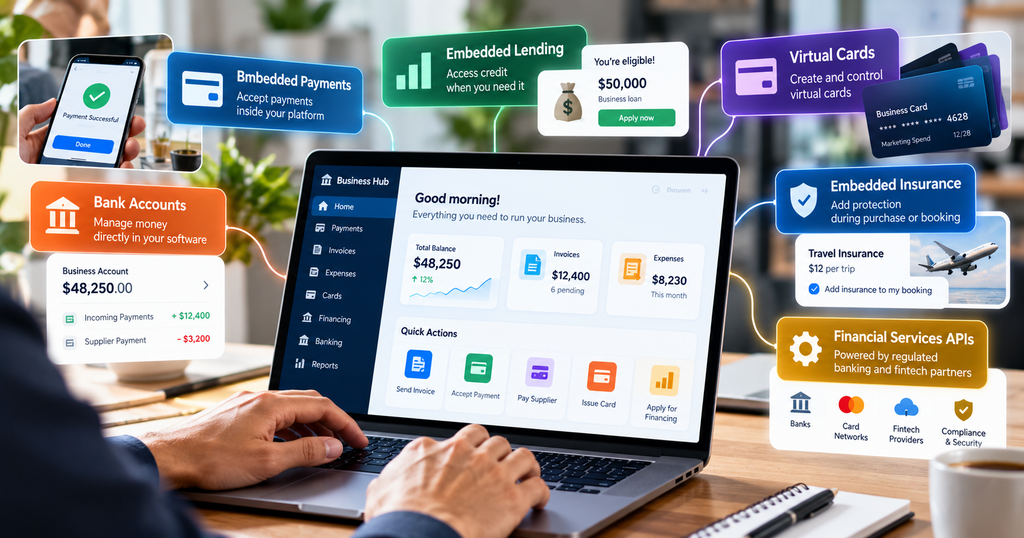
The platform itself does not necessarily become a bank. Licensed financial institutions, payment processors, card networks, fintech infrastructure providers, and regulated partners often supply the underlying service. Embedded finance changes where customers encounter finance rather than eliminating the institutions operating behind it.
Why Embedded Finance Is Growing
Digital businesses increasingly want customers to complete more tasks inside a single environment. Every extra login, form, banking portal, manual transfer, or disconnected system creates friction, and financial services are often among the most cumbersome parts of a customer journey.
That makes finance a natural feature to embed. If a platform already knows what a customer is purchasing, selling, invoicing, booking, or managing, it may be able to present the appropriate financial service precisely when the need appears. A seller who needs working capital, for example, can potentially receive a financing offer inside the commerce platform that already understands the business’s sales activity.
The trend is increasingly visible in enterprise software as well. In October 2026, Mastercard and BMO announced an embedded commercial payments capability for eligible businesses in Canada and the United States, allowing virtual-card payments to be initiated and managed inside participating ERP, procurement, accounts-payable, and travel-management systems. Instead of leaving business software to execute a payment through a separate banking portal and later returning to reconcile it, companies can increasingly connect the payment directly to the workflow that created the expense.
Embedded Payments Are Becoming Part of Software
Embedded payments are probably the most mature form of embedded finance. Consumers already experience them when ordering a ride, booking accommodation, purchasing through a marketplace, or paying inside an app without visiting a separate payment website.
For businesses, however, embedded payments can extend far beyond the checkout screen. Payment initiation, approvals, reconciliation, reporting, spending controls, and supplier payments can increasingly be integrated into accounting, procurement, and operational software. Mastercard reports that 87% of businesses favor an all-in-one software solution for managing B2B purchases, while its embedded-finance platform is connected with more than 30 enterprise software partnerships.
This shift matters commercially because payments generate economic activity every time money moves through a platform. McKinsey estimates that global payments generated about $2.6 trillion in revenue from 3.8 trillion transactions and $2.1 quadrillion in annual value flows, making payments one of banking’s largest revenue pools. As payment activity becomes embedded in software, part of the competitive value may move from the visible checkout screen toward the infrastructure controlling identity, routing, authorization, and transaction logic. This also connects with the rise of agentic commerce, where AI agents may increasingly initiate or manage transactions through the same embedded payment infrastructure.
Embedded Lending Brings Credit to the Point of Need
Traditional credit often requires customers to leave the original transaction, find a lender, submit information, wait for a decision, and then return to the purchase or business problem that created the financing need. Embedded lending attempts to shorten that journey by placing credit directly inside the platform where the need appears.
An e-commerce merchant might receive a working-capital offer based partly on sales history. A customer making a larger purchase may see installment financing during checkout. A business-management platform could offer eligible users access to financing without requiring them to start from scratch with an unfamiliar lender.

This model can also create a commercial advantage for platforms because financing may increase purchasing power, merchant activity, or transaction volume. A platform that helps a seller fund inventory or helps a customer finance a purchase may indirectly increase activity across its own ecosystem. However, embedded lending cannot be treated simply as another conversion tool. Poor underwriting, unclear borrowing costs, unsuitable credit, or aggressive financing can create real financial harm, making responsible lending, disclosure, consumer protection, and regulatory compliance essential.
Virtual Cards and B2B Payments Are Moving Inside Workflows
Virtual cards are becoming an important part of embedded finance, particularly in B2B payments. They can generate unique payment credentials connected to an underlying account while allowing companies to apply spending limits, merchant restrictions, expiration rules, and other controls.
A business could create a virtual card for one supplier invoice, set the permitted amount, process the payment, and automatically connect the transaction with accounting records. That can reduce manual reconciliation while limiting the usefulness of the credentials if they are compromised.
Mastercard’s virtual-card network now involves issuers, platforms, and corporate users across 43 countries and 174 currencies. The company also reported a live embedded-finance transaction in Asia Pacific in which virtual-card functionality was integrated directly into a procurement platform. These developments suggest that the commercial opportunity is not limited to consumer checkout. Procurement, treasury, travel, accounts payable, and corporate expense management could become major markets for embedded financial services.
How Software Companies Can Monetize Embedded Finance
The monetization opportunity is one reason embedded finance for SaaS platforms has attracted so much attention. A software business traditionally earns money through subscriptions, usage fees, advertising, or marketplace commissions. Adding financial services can introduce additional revenue layers around economic activity already taking place inside the platform.

Depending on the structure, a platform may potentially earn revenue from payment processing, card transactions, interchange-sharing arrangements, financing referrals, lending economics, account services, insurance distribution, foreign exchange, or premium financial features. Financial products can also support monetization indirectly by increasing customer retention, transaction frequency, or the amount of activity conducted through the platform.
The strategic advantage can be significant. If two software products perform similar operational tasks but one also manages payments, cards, financing, and cash movement, customers may have more reasons to keep using the broader platform. Financial services can therefore contribute both direct revenue and higher lifetime customer value. As discussed in our analysis of AI for small businesses, technology delivers the strongest commercial results when efficiency or automation translates into higher revenue, lower costs, or better margins.
However, businesses should not embed finance merely because another revenue stream is available. The best monetization model begins with a genuine customer problem. A payment feature that saves hours of reconciliation or financing that helps a merchant fund profitable inventory creates identifiable value. A financial product added only to collect fees may instead weaken customer trust.
Why Banks and Payment Companies Still Matter
Embedded finance may make traditional financial brands less visible, but it does not make regulated financial infrastructure unnecessary. Banks, card networks, payment companies, and financial technology providers can use embedded distribution to reach customers inside software environments where financial needs already exist.
This creates a different kind of competition. The software platform may own the customer interface, while banks provide regulated accounts or credit, payment networks move money, and fintech providers supply APIs, fraud controls, compliance technology, or other infrastructure.

For banks, this model creates both opportunity and risk. Embedded distribution can open access to new customers and transaction flows, but it can also weaken the direct customer relationship if users associate the financial experience primarily with the software platform. As finance becomes more deeply embedded, banks may increasingly compete not only for account holders but also for partnerships, API integrations, and positions inside digital ecosystems.
Embedded Finance vs. Banking as a Service
Embedded finance and Banking as a Service (BaaS) are closely related, but they are not interchangeable. Embedded finance describes the customer-facing outcome: banking or financial functionality appears inside a non-financial platform. Banking as a Service generally refers to the infrastructure, partnerships, technology, and APIs that allow companies to access banking capabilities.
A simple distinction is that embedded finance describes what the customer experiences, while BaaS can describe part of how that experience is built behind the scenes. Financial services APIs, payment processors, banking partners, compliance platforms, and identity providers may all form part of the infrastructure needed to deliver an embedded-finance product.
This distinction also creates business opportunities because many software companies will not want to build financial infrastructure themselves. Providers that can simplify regulatory connectivity, payments, identity verification, card issuance, account infrastructure, lending technology, or compliance may become increasingly valuable as more platforms enter the market.
The Risks: Regulation, Fraud, Privacy, and Customer Trust
Making financial services easier to access does not eliminate the risks associated with money. In some cases, embedded finance can make responsibility less obvious because several businesses may participate in one customer experience. A user may interact with a software platform while another company processes payments, a bank holds funds, and a third provider makes a lending decision.
Clear disclosure is therefore essential. Customers should be able to understand who provides the financial service, how fees are calculated, where funds are held, what happens when a payment fails, and who handles complaints or disputes.
Cybersecurity and privacy are equally important. Connecting financial infrastructure to more software platforms creates additional APIs, permissions, data exchanges, and access points that must be protected. The commercial winners in embedded finance are therefore unlikely to be determined only by who creates the smoothest interface. Trust, fraud prevention, compliance, data protection, resilience, and clear accountability may become important competitive advantages.
Embedded Finance Will Develop Differently Around the World
Embedded finance is global, but the market will not develop identically everywhere. Banking regulations, payment rails, open-banking frameworks, lending laws, digital identities, data-protection requirements, consumer protections, and customer payment preferences differ substantially between countries.
A model built around cards in the United States may need to support account-to-account payments elsewhere. Markets with strong mobile-wallet adoption may develop differently from those centered on traditional banking. Emerging economies may also find opportunities to deliver financial services through digital platforms to customers who have limited access to conventional financial institutions.
This means international embedded-finance companies cannot simply translate an interface and change the currency. Successful expansion requires local banking partners, compliant infrastructure, appropriate payment methods, market-specific risk controls, and an understanding of how customers in each region already move and manage money.
Where the Future Business Opportunity Lies
The long-term embedded finance market is broader than payments and lending alone. Commercial opportunities can emerge across fintech infrastructure, financial services APIs, identity verification, fraud prevention, regulatory technology, B2B payments, virtual cards, card issuance, banking connectivity, reconciliation, treasury software, insurance technology, lending infrastructure, and cybersecurity.
Vertical SaaS companies may be particularly well positioned because they understand the economics and workflow of a specific industry. Software designed for restaurants, healthcare practices, logistics companies, contractors, property managers, travel businesses, or online sellers can potentially embed financial services tailored to problems generic banks may not address as efficiently.
There is also a deeper monetization opportunity. If financial services continue moving inside software, companies controlling the operating workflow may gain influence over where payments are routed, which financing products appear, which cards are used, and which financial providers receive the transaction. In other words, the valuable asset may increasingly be not only the financial product itself but also the digital point at which the financial decision is made.
That does not mean every software company should attempt to become a financial company. The stronger commercial strategy is to identify moments where payments, credit, insurance, or money management genuinely improve the core product and then use appropriate regulated partners to deliver those services.
Final Thoughts
Embedded finance is changing where people encounter financial services. Payments, lending, cards, accounts, and other financial products are increasingly moving from separate destinations into the software, marketplaces, and digital platforms people already use.
The commercial consequences could be substantial. Software companies may gain new revenue streams and stronger customer retention, banks may gain new distribution channels, and fintech infrastructure providers may build businesses around the APIs, compliance, identity, payment, and risk systems required to connect the ecosystem. McKinsey’s 2026 payments analysis suggests that as transactions move deeper into software, economic value may increasingly concentrate in the infrastructure governing trust, routing, and automated financial activity.
But embedding finance successfully requires more than inserting a payment button or lending offer. The service needs to solve a genuine customer problem, operate within appropriate regulation, protect customer data, manage risk, and make responsibility clear when something goes wrong.
For businesses, the central question is therefore not simply, “Can we add financial services?” It is, “Can finance make our existing product significantly more useful?” Companies that answer that question well may discover that the future of finance is not always a separate banking destination. Increasingly, finance may become part of the software customers were already using.
Author’s Note
This article is intended for general educational and informational purposes and does not constitute financial, investment, lending, banking, legal, tax, regulatory, or business advice. Embedded-finance products, banking relationships, payment systems, credit rules, privacy requirements, consumer protections, and financial regulations differ significantly between countries and jurisdictions. Businesses should obtain appropriate professional and regulatory guidance before offering or integrating financial services.
The author writes for BusiPulse about developments affecting business, economics, technology, consumers, and the changing digital economy. The purpose is to examine important developments from a practical and balanced perspective rather than promote a particular company, financial institution, platform, or technology. Readers are not required to agree with the author’s analysis and are encouraged to consider alternative viewpoints and conduct additional research where appropriate.

[…] platforms is also changing how consumers and businesses access payment facilities. Our article on embedded finance and digital payment services explains how banking, payments, and other financial functions are becoming part of everyday […]
[…] Bank transfers and some digital-wallet transactions work differently. The sending institution may record an actual debit before the receiving institution confirms that the beneficiary has been credited. If the transfer fails, a separate reversal process may be required. Financial services are also increasingly integrated into everyday digital platforms, as explained in our analysis of embedded finance and digital payment services. […]