


Suppose I order a $120 item from an online store. Just as I complete the payment, the checkout page freezes, and no confirmation appears. When I open my banking app, I discover that my available balance has dropped by $120, yet the transaction is still marked “pending.” My first concern is whether the payment succeeded. Should I try again, or could another attempt result in a second charge?
This is a familiar problem for people who shop online, transfer funds, or use digital wallets. When money suddenly becomes unavailable without a clear explanation, even a routine purchase can become stressful. The uncertainty is particularly frustrating when the amount is needed for groceries, bills, travel, or another important expense.
However, the situation commonly described as “transaction pending but money deducted” does not necessarily mean the funds have been lost. The amount may be temporarily reserved, awaiting confirmation, undergoing processing, or due for reversal after an unsuccessful transfer. Understanding these possibilities helps consumers identify the problem, avoid unnecessary repeat payments, and choose the appropriate solution.
What Does Transaction Pending but Money Deducted Mean?
A pending transaction is a payment that has been initiated but has not reached its final processing status. Depending on the payment method, the financial institution may have approved an authorization, reserved the amount, or actually debited the account while awaiting further confirmation.
For example, suppose your bank account has an available balance of $800, and you make a card purchase worth $140. Your available balance may immediately fall to $660, even though the transaction has not yet been finalized. In this situation, the bank may have placed an authorization hold on the purchase amount.
The money is temporarily unavailable for other transactions, but the merchant has not necessarily received the payment. According to Stripe’s explanation of authorization holds, banks can reserve funds during card authorization and release them if the merchant does not complete the charge.
Bank transfers and some digital-wallet transactions work differently. The sending institution may record an actual debit before the receiving institution confirms that the beneficiary has been credited. If the transfer fails, a separate reversal process may be required. Financial services are also increasingly integrated into everyday digital platforms, as explained in our analysis of embedded finance and digital payment services.
Pending, Completed, Reversed, and Refunded: Understanding the Difference
The terminology used in banking applications can sometimes be confusing. Four common payment statuses are particularly important:
- Pending: The transaction is awaiting final confirmation, processing, or completion. For card payments, this may involve funds reserved through an authorization hold.
- Completed or posted: The financial institution has recorded the payment as finalized on the customer’s account, although additional processing between institutions may continue.
- Reversed or released: An unsuccessful transfer has been reversed, or an unused card authorization has been released, making the reserved amount available again.
- Refunded: A previously completed payment is returned through a refund process, generally following a cancellation, return, billing correction, or other agreed adjustment.
These distinctions explain why two customers experiencing apparently similar payment problems may receive different responses from their banks. Someone waiting for an authorization hold to expire is not necessarily waiting for a refund, while a customer whose transfer failed after an actual debit may require an investigation and reversal.
Seven Reasons Your Transaction May Still Be Pending
1. Your Bank Has Placed a Temporary Authorization Hold
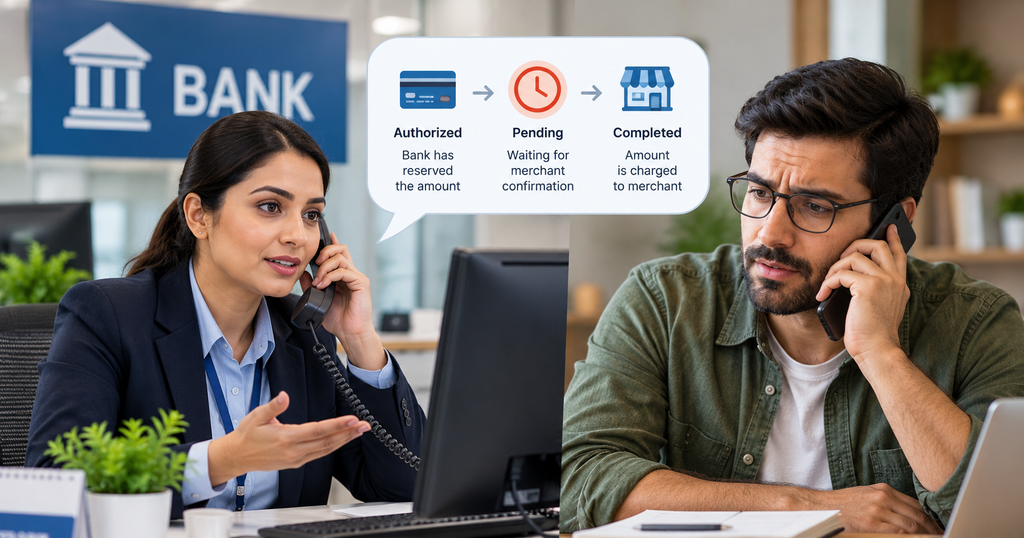
One of the most common reasons for a pending card payment is a temporary authorization hold. When a customer initiates a card transaction, the merchant requests approval from the issuing bank. If sufficient funds or credit are available and the payment passes the required checks, the bank may reserve the amount before the transaction is finalized.
This arrangement is widely used in hotels, fuel stations, car rentals, and online shopping. In some cases, a business does not know the final amount when the initial authorization is requested. A hotel, for example, might reserve an amount that includes an allowance for additional expenses, while the eventual charge reflects the final bill.
The reserved amount reduces the customer’s spending power, even though the final payment has not necessarily occurred. If the merchant does not complete the charge, the authorization normally expires or is released according to the applicable network and issuer rules.
2. The Merchant Has Not Finalized the Payment
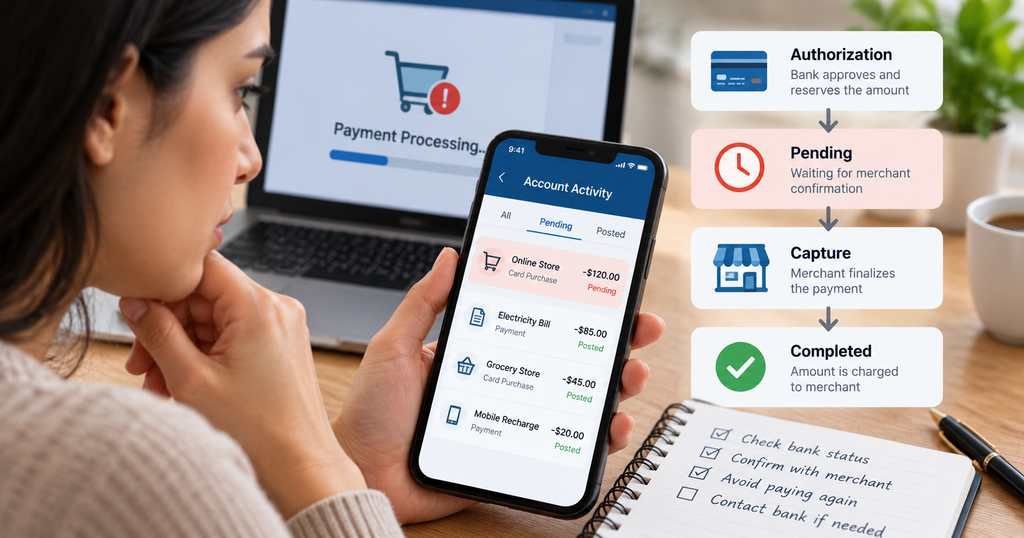
Payment authorization and payment capture are separate stages in many card transactions. An authorization confirms that the requested amount can be charged, while capture begins the process of collecting the authorized payment.
Some online retailers capture payments immediately. Others may wait until an order is confirmed, the goods are ready for dispatch, or a service has been provided. Consequently, the transaction can remain pending even though the customer’s card has already been authorized.
Imagine purchasing a computer from an online retailer that charges customers when products are shipped. The bank may reserve the purchase amount when the order is placed, but the merchant might not capture the funds until dispatch. This delay does not automatically indicate a failed payment.
As Stripe explains in its payment-capture guidance, delaying capture can provide operational flexibility, but authorizations are subject to expiration periods that vary by payment network and transaction type.
3. Payment Processing or Settlement Is Taking Longer
Although digital payments often appear instantaneous, the underlying processing arrangements are not identical. Some transfers are completed through instant-payment networks, while others depend on clearing systems, financial institutions, and operational schedules.
A bank transfer initiated outside normal processing hours may take longer if the relevant service operates on business-day schedules. Weekends, public holidays, or intermediary processing can also affect certain transfers, although these limitations do not apply to every digital payment system. For international transfers, processing delays should also be distinguished from transaction costs, including intermediary-bank charges and currency conversion. These additional expenses are examined in our guide to international money transfer fees.
There is another distinction between a payment being approved and funds reaching the final recipient. A card transaction can be captured while settlement between the participating financial institutions continues. Customers therefore should not assume that every pending status means the same stage of processing.
The appropriate waiting period depends on whether the payment involves a card purchase, domestic transfer, digital wallet, or another method.
4. A Failed Transaction Has Not Yet Been Reversed
Sometimes a customer experiences an actual account debit even though the intended transaction does not succeed. This may happen because of a communication failure, processing interruption, unsuccessful beneficiary credit, or another technical problem.
Suppose someone transfers $200 to a family member through a banking application. The sending account shows the deduction, but the recipient receives nothing. The application continues to display a pending or failed status, leaving both parties uncertain about the payment.
Unlike an ordinary card authorization hold, this situation may require the sending or receiving institution to trace the transfer and complete a reversal if the recipient cannot be credited.
A failed bank transfer is one possible explanation for the problem described as “transaction pending but money deducted.” Some unsuccessful transfers are reversed automatically, while others require an investigation or formal complaint. The important distinction is whether the money was merely reserved or actually debited without reaching the intended recipient. That distinction determines which recovery process is appropriate.
5. A Technical Error Interrupted Payment Confirmation
A payment can be processed without the customer’s application receiving a successful confirmation. An unstable internet connection, server timeout, interrupted checkout session, or delayed response between payment systems can produce this confusing result.
For example, a customer may see “payment unsuccessful” after an online checkout freezes, while the banking application already shows an authorization. The merchant’s system might also take time to update its order records, creating uncertainty about whether the purchase was completed.
This does not necessarily mean the bank or merchant acted incorrectly. Payment processing involves several systems exchanging information, and the message displayed to the customer may not always reflect the final result immediately.
The most significant risk arises when someone repeatedly attempts the same payment without establishing whether the first request was accepted.
6. Security or Compliance Reviews Have Delayed Processing
Financial institutions use security checks to identify potentially unauthorized transactions, verify customer information, and meet applicable regulatory obligations. These controls are important for protecting customers and maintaining confidence in digital payment systems.
Certain transactions may require additional authentication or verification before processing can continue. This can be particularly relevant when a payment is unusual for the account, involves unfamiliar recipient details, or triggers an institution’s risk-monitoring procedures.
However, a pending transaction does not automatically indicate that a security review is underway. Only the financial institution or payment provider can clarify whether a particular payment has been delayed for this reason.
Customers should treat requests for additional information cautiously. Legitimate verification should take place through official channels, and no one should disclose passwords, PINs, or one-time security codes to someone claiming they can release a blocked payment.
7. Repeated Attempts Have Created Duplicate Payment Entries
When a payment appears unsuccessful, trying again can seem like the quickest solution. Unfortunately, repeated attempts can sometimes generate additional authorizations or, in certain circumstances, multiple completed payments.
A customer might see two entries for the same amount: one pending authorization and one completed purchase. These entries do not always represent two finalized charges. The earlier authorization may eventually disappear when it expires or is released.
A genuine duplicate-payment problem arises when more than one completed charge is recorded for a purchase that should have been paid only once.
Distinguishing temporary duplicate-looking entries from actual duplicate payments is essential. The transaction status, reference numbers, merchant records, and final account statement can help establish what occurred.
What to Do When a Transaction Is Pending but Money Has Been Deducted
Once the possible causes are understood, the next challenge is deciding how to respond. The objective is not simply to recover the amount as quickly as possible, but to identify where the transaction stands and avoid actions that could make the situation worse.
Step 1: Examine Your Banking Records
If you are experiencing a “transaction pending but money deducted” situation, begin by examining your official banking application or account statement. Check the transaction date, amount, reference number, recipient or merchant, and the status displayed by your financial institution. These details can help establish whether the funds are temporarily reserved, a payment has been completed, or an unsuccessful transfer requires further investigation.
Where available, compare the posted balance with the available balance. A reduction in available funds without a corresponding posted debit may indicate an authorization hold, although banks do not all present balances in the same way.

If the account shows an actual debit rather than a temporary authorization, the transaction may need tracing or reversal. This initial distinction helps determine which questions to ask the provider.
Step 2: Confirm Whether the Payment Was Received
Before attempting another payment, establish whether the merchant or intended recipient has received the funds.
For an online purchase, examine the order history and confirmation messages. For a bank transfer, ask the beneficiary to review their account rather than relying exclusively on payment notifications.
If the merchant confirms that the order was successful, the pending entry may be associated with normal card processing. If no order exists, the payment provider may need to determine whether the transaction was authorized, captured, cancelled, or unsuccessful.
Step 3: Contact the Appropriate Institution
Different transaction problems involve different responsibilities. Contacting the correct organization can reduce unnecessary delays.
- Pending card authorization: Ask the merchant whether the charge was captured or cancelled, and ask the card issuer about the remaining hold.
- Failed bank transfer: Request a transaction trace or reversal investigation from the sending bank or payment provider.
- Duplicate completed payment: Seek clarification from the merchant and, if necessary, initiate the appropriate dispute process through the card issuer.
- Unauthorized transaction: Report it immediately using the bank’s official fraud-reporting channel.
For unresolved cases, request a written complaint reference and the expected response period. Retaining this information makes follow-up and escalation easier.
Step 4: Preserve Evidence and Monitor the Outcome
Keep the transaction reference, relevant account records, merchant correspondence, and any payment confirmation or error message. If screenshots are necessary, conceal sensitive information that is not required for the investigation.
A customer should also establish what outcome to expect. An unused authorization might simply disappear, while a failed transfer could produce a reversal entry, and a completed purchase might require a refund.
If the stated deadline passes without resolution, a formal complaint is generally more useful than repeatedly contacting different customer-support representatives without a case reference.

How Long Does a Pending Transaction Take to Clear?
There is no universal deadline for every pending transaction. Ordinary card holds commonly last several days, while certain hotel, travel, or rental authorizations may remain active longer. The issuer’s practices, payment network, merchant arrangements, and transaction circumstances all affect the duration.
Bank transfers follow different rules. Some payment systems operate continuously and settle eligible transfers rapidly, while others depend on business-day processing or additional verification.
In India, the National Payments Corporation of India (NPCI) provides guidance on unsuccessful UPI transactions and situations where an account has been debited but the recipient has not received the funds. It explains that failed payments may be reversed automatically, while unresolved cases should be reported to the customer’s bank. The applicable reversal deadline depends on the transaction type and the Reserve Bank of India’s regulatory framework.
These procedures apply to specified Indian payment systems and should not be interpreted as universal requirements for international card payments, bank transfers, or digital wallets. Consumers in other countries should consult their payment providers or national financial regulators for the relevant timelines.
These rules concern specified failures in eligible Indian payment systems. They do not mean that every pending UPI transaction is unsuccessful, nor do they establish a universal deadline for international card payments, bank transfers, or digital wallets.
For consumers elsewhere, the relevant payment provider and national financial regulator remain the appropriate sources for current processing and reversal requirements.
When Should a Pending Payment Be Disputed?
A temporary payment delay does not automatically justify a fraud dispute. However, there are circumstances where immediate action is important, particularly when a transaction was never authorized, a completed payment appears more than once, or an expected reversal has not occurred.
An unfamiliar transaction should be reported promptly, even if it is still pending. Waiting for a suspected fraudulent payment to become fully posted may create unnecessary risk. The bank can explain its reporting and dispute procedures, including whether a formal billing dispute can be opened before the charge is finalized.
Consumer protections differ internationally. In the United States, the Consumer Financial Protection Bureau explains the rights and reporting requirements associated with unauthorized electronic fund transfers. The applicable time limits and potential customer liability depend on the circumstances, making prompt reporting particularly important.
In Pakistan, the State Bank of Pakistan’s consumer-protection guidance identifies the financial institution’s complaint-management unit as the first point of contact. Eligible unresolved banking disputes may subsequently be referred to Banking Mohtasib Pakistan, subject to the relevant requirements.
Consumers should distinguish a dispute about an unauthorized payment from a complaint about processing delays. Both deserve attention, but they may involve different procedures, evidence, and legal protections.
Will the Money Return Automatically?
For consumers experiencing “transaction pending but money deducted,” one of the biggest concerns is whether the missing amount will return automatically. In many cases, reserved funds become available again or failed transactions are reversed without a separate refund request. However, the outcome depends on whether the original payment was authorized, completed, cancelled, or unsuccessful.
If a card authorization was never captured, the hold may expire or be released, restoring the available balance. The customer might not receive a separate refund notification because the transaction was never completed.
If a bank transfer failed after an actual debit, the provider may need to reverse the transaction. A successfully completed purchase that is subsequently cancelled generally requires a refund or another agreed adjustment.
This is why asking whether the payment is awaiting authorization release, reversal, or refund can be more productive than simply asking when the money will return.
Recovery is not guaranteed in every circumstance. A completed transfer made to incorrect recipient details, for instance, may require a recovery request and may not be reversible. Early reporting gives the provider the best opportunity to investigate.
How Can You Prevent Similar Payment Problems?
Not every processing delay is avoidable, but careful payment habits can reduce the likelihood of duplicate charges and make genuine problems easier to resolve.
Before completing a payment, confirm the merchant or recipient details and check the amount. Keep transaction references and order confirmations until processing is complete. If an application freezes, examine your banking records before submitting the payment again.
Account notifications can also help identify unexpected activity quickly. For hotel bookings, vehicle rentals, and other services that commonly use authorization holds, consider the effect on your available balance when planning additional spending.
Above all, remain cautious about unsolicited messages claiming that a pending payment can be released after providing security credentials or making another transfer. Financial problems are easier to resolve when customers use verified channels and maintain clear records of their transactions.
Final Thoughts
Seeing a transaction pending but money deducted can be unsettling, particularly when the amount is needed for another important financial commitment. Yet a pending transaction is not necessarily a failed payment, a completed charge, or evidence that money has disappeared.
The underlying cause may involve a temporary authorization, delayed merchant capture, payment processing, a technical interruption, or a transfer awaiting reversal. Identifying the transaction type is therefore more important than reacting to the pending label alone.
A careful review of account records, confirmation from the recipient, and timely communication with the responsible provider can prevent unnecessary duplicate payments and improve the chances of resolving a genuine error. Where fraud is suspected or an applicable resolution deadline has passed, formal complaint and dispute mechanisms provide additional avenues for protection.
Author’s Note
This article has been prepared to help readers understand common payment-processing problems, particularly situations in which an account balance changes while the associated transaction remains pending. It distinguishes card authorization holds, merchant payment capture, settlement delays, failed transfers, reversals, refunds, and duplicate charges so that consumers can better understand the information displayed by their banks and payment applications.
The explanations are educational and do not constitute individualized financial, legal, or banking advice. Payment systems operate differently across countries, and consumer rights, reversal standards, reporting deadlines, and complaint procedures depend on the relevant financial institution, payment method, and regulatory framework.
Examples involving transaction amounts, banking balances, and consumer experiences are hypothetical and included solely to explain financial processes. The regulatory references are intended to provide reliable context, not to suggest that the same legal protections apply in every jurisdiction.
Readers should verify current requirements directly with their banks, payment providers, or financial regulators. Anyone who suspects unauthorized account activity should report it promptly rather than wait for a pending transaction to clear.