


How are cryptocurrencies created? The answer is more complex than simply “through mining.” Bitcoin made cryptocurrency mining famous, which left many people with the impression that every digital currency is produced by computers competing to solve mathematical problems. That is no longer an accurate picture of the crypto market. Some cryptocurrencies are mined, some are issued by blockchain protocols to validators, some begin with their entire supply already created, and others can be minted by smart contracts whenever predefined conditions are met. Stablecoins can expand when reserve assets enter their issuance systems, while wrapped tokens can appear on another blockchain without creating any additional units of the underlying cryptocurrency.
Understanding how cryptocurrencies are created therefore requires more than knowing how Bitcoin mining works. It requires separating creation, issuance, minting, unlocking, and distribution. These terms can describe different events. A blockchain may create new coins as validator rewards, a smart contract may mint additional tokens, or a project may simply unlock tokens that have existed since launch. An airdrop can distribute existing tokens without increasing total supply at all.

The distinction matters because supply mechanics affect inflation, scarcity, ownership concentration, validator incentives, dilution risk, and the amount of control retained by a company, foundation, protocol, or governance system. They do not determine whether a cryptocurrency will become valuable; that is a separate question. But they reveal something fundamental: who or what can create more units, under which rules, and how those units reach the market.
Coins and Tokens Are Not Created in the Same Way
To understand how cryptocurrencies are created, it is important to first distinguish a native coin from a token. Bitcoin is the native asset of the Bitcoin network, while Ether is the native asset of Ethereum. Their issuance rules are built into their respective blockchain protocols. A token, by contrast, can be created on top of an existing blockchain using that network’s token standards or programs. Thousands of different tokens can therefore operate on the same underlying blockchain while following completely different supply rules.
That difference is commercially important. Building a new native blockchain and securing its monetary system is a very different undertaking from launching a token on an established network. A developer may technically create a new token relatively quickly, but creating a secure network, sustainable economic model, credible business, active market, or useful financial product is considerably harder. Creating units is not the same as creating value.
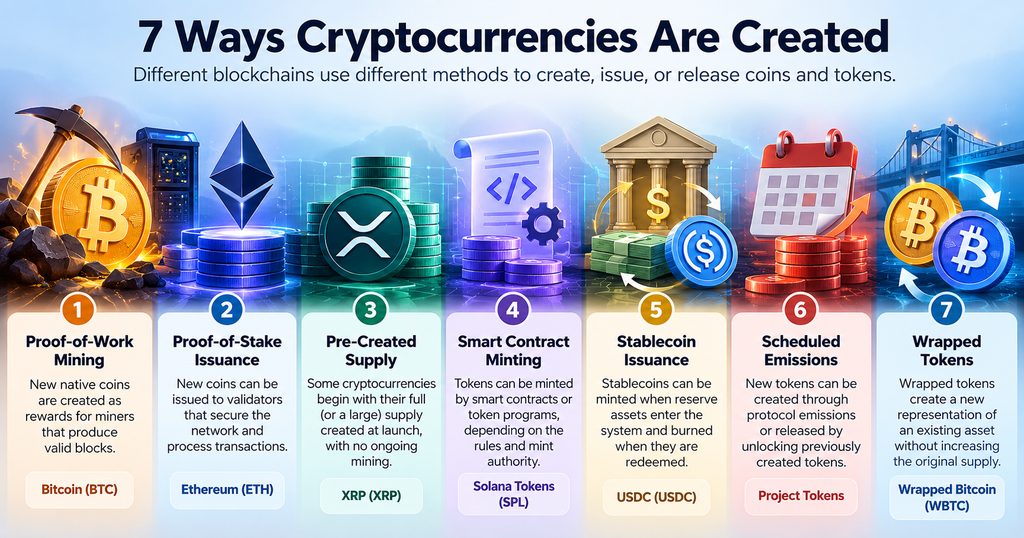
1. Proof-of-Work Mining Creates New Native Coins
Proof-of-Work mining is the most familiar form of cryptocurrency creation, and Bitcoin provides the clearest example of how cryptocurrencies are created through this mechanism. On Bitcoin, miners operate specialized computing equipment and compete to produce valid blocks of transactions. When a miner successfully produces a block, the reward can contain two components: newly issued bitcoin from the block subsidy and transaction fees paid by users. Only the block subsidy creates new bitcoin; transaction fees transfer bitcoin that already existed.
Bitcoin’s supply rules make this mechanism unusually predictable. The subsidy began at 50 BTC per block and is cut in half every 210,000 blocks, roughly once every four years. Following the April 2024 halving, the current block reward from new issuance is 3.125 BTC, with the next halving expected around 2028, when the subsidy falls to 1.5625 BTC. Issuance continues declining until Bitcoin approaches its maximum supply of 21 million.
This shows why mining is more than simply “making cryptocurrency.” Bitcoin uses issuance as part of its security system: miners expend resources securing the network and receive newly created coins as part of their compensation. That mechanism has also created an entire commercial industry involving mining hardware, data centers, energy procurement, hosting, cooling systems, mining pools, financing, and specialized infrastructure.
2. Proof-of-Stake Protocols Can Issue New Coins to Validators
A blockchain does not need miners to create new native cryptocurrency. Proof-of-Stake, or PoS, networks rely on validators that commit assets to the network and participate in verifying transactions, proposing blocks, and maintaining consensus. Depending on the protocol’s monetary policy, new coins can be created and credited to validators as compensation for performing those duties.
Ethereum provides a useful example. Since its transition to Proof-of-Stake in 2022, Ethereum has relied on validators rather than miners. Ethereum’s protocol creates new ETH for validator activity, including block proposals and consensus participation. However, not everything a validator earns is newly created. Transaction tips, for example, come from ETH that already existed, while consensus rewards involve new issuance. Ethereum also burns part of transaction fees, meaning new ETH can be created while other ETH is simultaneously removed from supply.
This is another reason why understanding how cryptocurrencies are created requires looking beyond mining alone. The distinction becomes especially important when people discuss crypto staking rewards. A wallet balance increasing after staking does not automatically reveal where that return came from. Depending on the network or service, rewards might include newly issued coins, existing transaction fees, other incentives, or a mixture of them. To determine whether staking is increasing the cryptocurrency’s overall supply, the key question is whether the protocol created new units to fund the reward.
3. Some Cryptocurrencies Start With Their Supply Already Created
Not every cryptocurrency is gradually produced through mining or staking. Some networks begin with a genesis supply or pre-created supply, meaning a large quantity or even the complete maximum supply exists from the network’s beginning. Those coins may subsequently be distributed, sold, escrowed, locked, granted to contributors, or released over many years.
XRP provides a clear real-world example. XRP Ledger documentation states that 100 billion XRP existed when the network was created. Unlike Bitcoin, XRP is not continuously mined into existence, and XRPL’s transaction rules prevent transactions from creating additional XRP. The supply can instead decline gradually because transaction costs destroy small amounts of XRP.
This mechanism also exposes one of the most common misunderstandings in crypto markets: creation and circulation are different. Suppose one billion tokens are created at launch, but only 150 million are released to users and markets. The remaining 850 million might be locked for teams, investors, ecosystem development, future incentives, or treasury use. When some of those locked tokens become available six months later, circulating supply increases, but total supply may not increase at all. The tokens existed already; they simply became transferable.
4. Smart Contracts and Token Programs Can Mint New Tokens
Understanding how cryptocurrencies are created also means examining who controls a token’s mint authority. A company or developer does not need to build a new blockchain to create a crypto token. Existing networks provide token standards and programs that allow new digital assets to be launched on top of established infrastructure. Depending on how the token is configured, the supply might be permanently fixed or capable of expanding through future minting.
Solana demonstrates the mechanism clearly. A token mint can contain a mint authority, which has permission to create additional units. Solana’s documentation states that minting increases the token’s total supply. The authority can also be revoked permanently; once the relevant mint authority is removed, additional tokens cannot be created through it. A newly created mint can even begin with zero supply before authorized minting takes place.
For anyone analyzing a token, this creates a critical question: Who controls the mint authority? If one company or wallet can create unlimited additional tokens, the supply risk differs significantly from a token whose minting capability has been permanently removed or constrained by transparent protocol rules. This is also why smart-contract auditing, multisignature custody, governance software, blockchain analytics, and token-management systems have become commercially important parts of the crypto infrastructure market.
5. Stablecoins Can Be Minted When Reserve Assets Enter the System
Stablecoins provide another important example of how cryptocurrencies are created, because their supply can expand through authorized issuance rather than mining. Stablecoin issuance works differently from fixed-supply or mining-based models. Reserve-backed stablecoins are generally designed to expand when corresponding assets enter the issuer’s reserve system and contract when tokens are redeemed. Unlike Bitcoin, the objective is not to create scarcity through a declining issuance schedule. The goal is to maintain a reliable relationship between the token and the assets supporting it.
USDC provides a straightforward example. Circle explains that when a qualifying user sends U.S. dollars to an issuer, the issuer requests that an equivalent amount of USDC be minted and makes those tokens available while holding the corresponding dollars in reserve. Redemption reverses the process: USDC is taken out of circulation, and the issuer returns the corresponding dollars from reserves.
Imagine an eligible institutional customer sends $5 million through the appropriate issuance process. If $5 million of new USDC is minted against that funding, the circulating token supply expands by $5 million. If those tokens are later redeemed and removed from circulation, the supply contracts again. Stablecoin supply can therefore respond to user demand rather than following a fixed mining schedule. This model has created substantial business opportunities around banking, custody, reserve management, payments, compliance, settlement systems, blockchain analytics, and cross-border financial infrastructure.
6. Scheduled Emissions Can Increase Supply or Merely Unlock It
Many crypto projects use token emissions, vesting schedules, and unlocks to introduce supply gradually. These concepts are often grouped together even though they do not necessarily mean the same thing. A protocol emission may involve creating new tokens according to predefined rules, while a vesting unlock can simply release tokens that were created months or years earlier.
Consider two projects that each add 10 million tokens to circulating supply this year. Project A mints those 10 million as new network rewards, increasing total supply. Project B already created those 10 million at launch but kept them locked in a vesting contract until this year. Both projects may show an increase of 10 million circulating tokens, yet only Project A created additional total supply. That distinction is critical when analyzing crypto tokenomics.
Scheduled emissions can help fund network security, development, liquidity, community participation, or ecosystem growth. But badly designed emissions can also dilute existing holders or produce persistent selling pressure if supply enters circulation much faster than actual network demand grows. This is why professional investors, exchanges, market makers, analytics firms, and token issuers pay close attention to emission curves, vesting periods, cliffs, treasury allocations, and future unlock dates.
7. Wrapped Tokens Create New Representations, Not More of the Underlying Coin
Wrapped cryptocurrency introduces one of the most important distinctions in this article. A wrapped token can create a new blockchain-based representation of an existing cryptocurrency without increasing the supply of the original asset. The underlying coin already exists; the wrapped system creates a corresponding token that can operate in another blockchain environment.
Wrapped Bitcoin, or WBTC, provides a useful example. WBTC documentation describes the asset as being backed 1:1 by Bitcoin. WBTC can be minted after BTC is deposited through the authorized process, while redemption burns WBTC and releases the corresponding BTC. Creating one additional WBTC therefore does not create another Bitcoin. It creates a token representing Bitcoin that already exists and is being held within the backing structure.
This is also where wrapped cryptocurrency differs from real-world asset tokenization. Wrapped Bitcoin represents an existing digital asset, whereas real-world asset tokenization can digitally represent rights associated with securities, funds, property, commodities, or other assets. The two concepts use some similar blockchain tools, but their economic and legal foundations are different.
Airdrops Do Not Necessarily Create Cryptocurrency
Airdrops are commonly included in lists explaining how cryptocurrency is “created,” but that can be misleading. An airdrop is primarily a distribution mechanism. Suppose a project created one billion tokens at launch and reserved 100 million for future community incentives. If it later sends 20 million of those existing tokens to users, the circulating supply may increase, but total supply has not. No additional tokens were necessarily created during the airdrop.
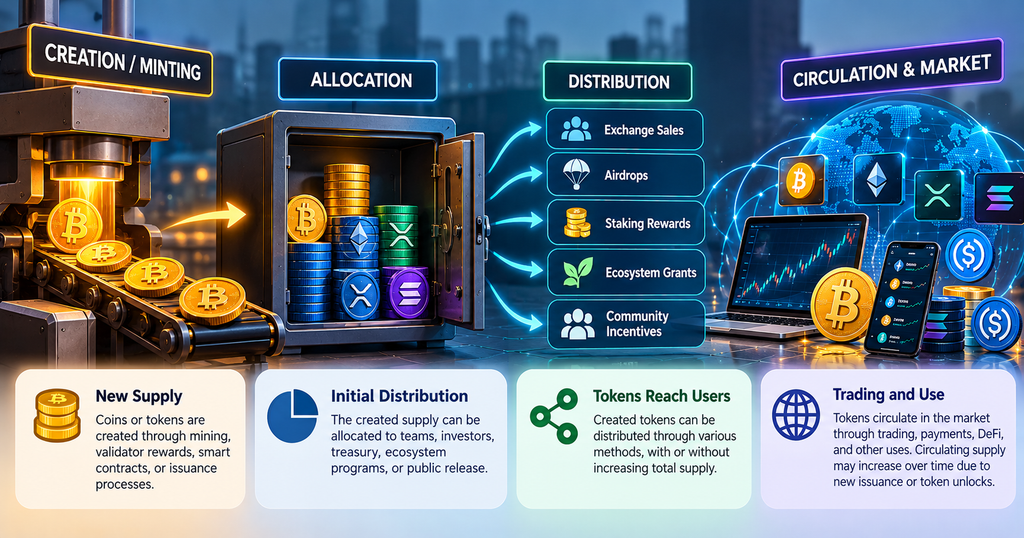
The same logic applies to many liquidity rewards, referral bonuses, ecosystem grants, launch campaigns, and even some staking programs. Tokens reaching a new wallet tells us that distribution occurred; it does not reveal whether minting also occurred. The simplest test is to compare supply before and after the event. If total supply increased, new units were created. If total supply remained unchanged while more tokens became publicly available, the event was primarily an unlock or redistribution.
Total Supply and Circulating Supply Tell Different Stories
Crypto supply figures can appear deceptively simple. Total supply generally describes how many units currently exist after accounting for any permanently destroyed units under the relevant methodology. Circulating supply attempts to measure the portion considered available in the market, while maximum supply, where one exists, describes the upper limit permitted by the asset’s rules. Locked or vested tokens complicate the picture because they can exist technically without yet circulating freely.
Imagine a token with a maximum supply of one billion units, a total existing supply of 800 million, and only 250 million currently circulating. A reader who looks only at the 250 million figure may miss the fact that hundreds of millions of additional existing or future tokens could eventually enter circulation. Conversely, an asset such as Bitcoin has a protocol-defined maximum supply and a declining issuance schedule. The underlying supply structure therefore matters more than any single headline number.
Burning Cryptocurrency Is the Reverse Side of Creation
Crypto supply can move in both directions. Token burning permanently removes units from usable supply according to the relevant protocol or smart-contract mechanism. Some systems burn assets when users redeem another asset, while others destroy part of transaction fees or use scheduled burn mechanisms.
Ethereum demonstrates why issuance should be viewed on a net basis rather than by looking only at newly created ETH. Validators can receive newly issued ETH while the network simultaneously burns the base portion of transaction fees. Depending on network conditions, the relationship between issuance and burning influences whether the overall ETH supply increases or decreases over a given period.
Stablecoin redemption provides another version of the same principle. If reserve-backed tokens are redeemed and removed from circulation, supply contracts because the tokens are burned or otherwise permanently retired. Understanding a cryptocurrency’s supply therefore requires examining both sides of the equation: how new units can enter existence and how existing units can leave it.
How Cryptocurrencies Are Created: 5 Supply Questions That Matter
When evaluating how a cryptocurrency’s supply works, the most useful questions are practical rather than promotional.
- Who has authority to create additional units?
- Is the issuance schedule fixed by protocol rules or subject to human governance?
- Are future tokens genuinely new issuance or previously created tokens becoming unlocked?
- Can supply be burned or redeemed?
- And how much of the eventual supply is already circulating?
Those questions help distinguish fundamentally different assets. Bitcoin’s new issuance follows a predetermined mining schedule. Ethereum uses protocol issuance alongside fee burning. XRP began with its supply created at inception. A smart-contract token may retain an active mint authority. USDC supply can expand and contract through issuance and redemption. WBTC can be minted against existing BTC without increasing Bitcoin’s underlying supply. Calling all of these simply “cryptocurrencies” hides major differences in how their supply actually works.
The Business Opportunity Extends Beyond Creating Tokens
Technically creating a crypto token has become relatively accessible. Building the infrastructure required to issue, secure, distribute, monitor, custody, exchange, redeem, and regulate digital assets is much harder. That is where a significant part of the commercial opportunity exists. Proof-of-Work requires specialized computing and energy infrastructure; Proof-of-Stake creates demand for validator technology and staking services; token issuance requires development and smart-contract security; stablecoins depend on banking, custody, reserves, compliance, and payment rails.

The surrounding businesses can include wallets, exchanges, institutional custody, cybersecurity, blockchain analytics, identity verification, tax software, smart-contract auditing, token-management platforms, validator services, compliance technology, payment gateways, and data providers. Instead of assuming the largest opportunity is launching another token, entrepreneurs may find more durable businesses in solving the operational problems that every serious digital-asset issuer or network eventually faces.
Final Thoughts
Understanding how cryptocurrencies are created reveals why there is no single process responsible for producing every digital asset. Bitcoin creates new coins through Proof-of-Work mining, while Proof-of-Stake protocols can issue coins to validators. Some networks begin with their supply already created; smart contracts and token programs can mint new units, stablecoin issuers can expand supply against reserve assets, and protocols can release tokens through scheduled emissions. Wrapped systems add another model by creating token representations of assets that already exist rather than increasing the supply of the underlying asset.
The deeper lesson is that creation, issuance, unlocking, and distribution should never be treated as interchangeable terms. An airdrop may distribute existing tokens. A vesting event may increase circulating supply without increasing total supply. A staking reward may contain newly issued coins or previously existing fees. A wrapped token may be newly minted without creating any more of the underlying cryptocurrency.
For readers, investors, developers, and businesses, that leads to a better question than simply asking how many coins exist today: Who or what can change the supply tomorrow, under what rules, and can those rules themselves be changed? Understanding that mechanism provides a much clearer picture of how a cryptocurrency actually works.
Author’s Note
This article is intended for general educational and informational purposes and does not constitute financial, investment, legal, tax, mining, staking, or cryptocurrency advice. Cryptocurrency protocols, issuance schedules, token authorities, reward structures, reserve arrangements, regulations, and supply policies can change, and risks differ substantially between networks and jurisdictions. Readers should verify current protocol documentation and applicable rules before making financial or business decisions.
Readers are not required to agree with the author’s analysis or conclusions. The purpose of this article is to explain how cryptocurrencies and tokens can be created, issued, unlocked, distributed, and removed from circulation while distinguishing those mechanisms from questions about market value or investment suitability.