


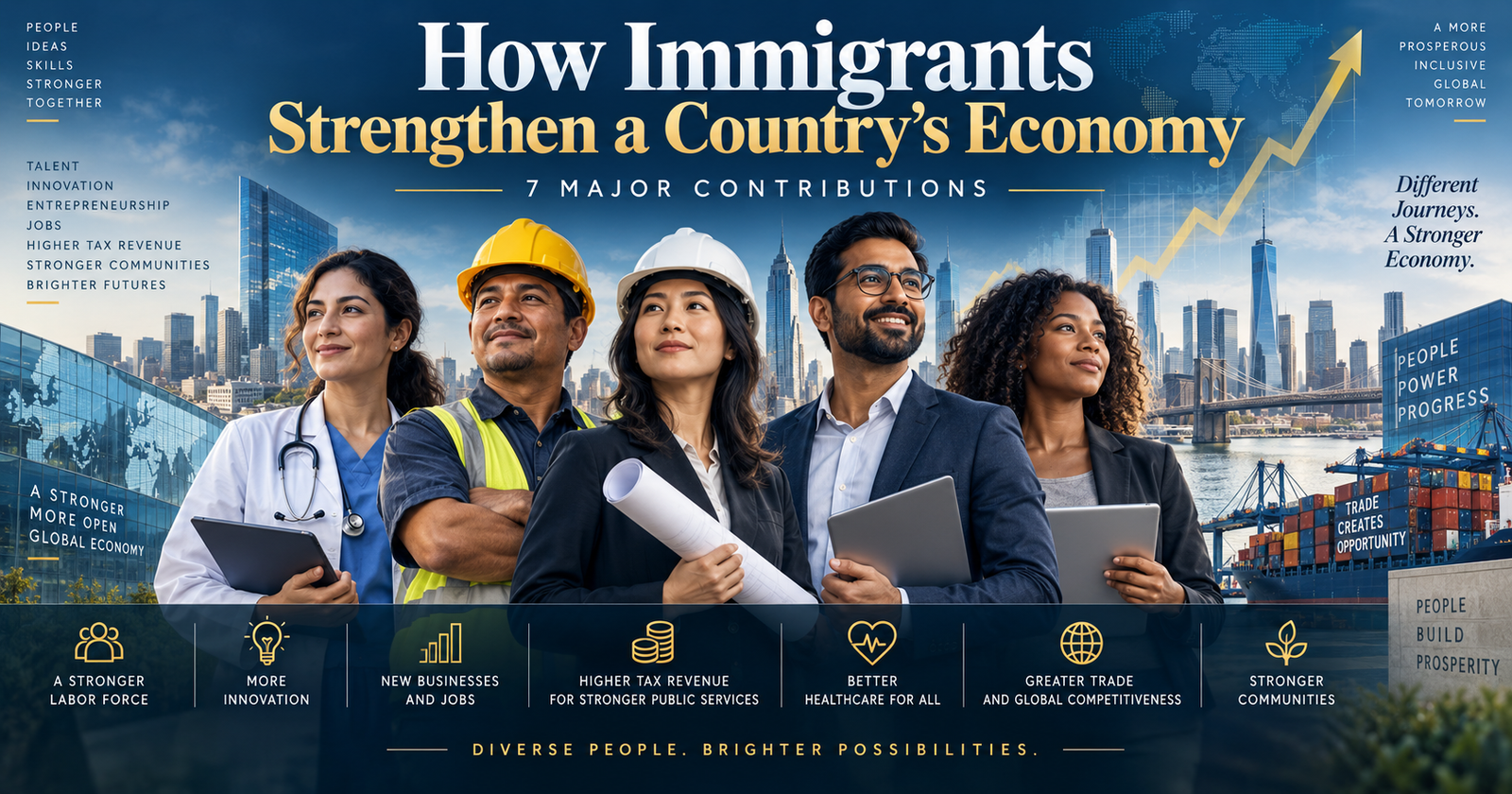
The economic contribution of immigrants extends far beyond population growth. Migrants work, pay taxes, create businesses, spend money, transfer knowledge, and can help countries respond to labour shortages and demographic ageing. The scale of those gains, however, depends on employment, skills, integration, and the ability of institutions to use human capital effectively.
This is the companion to our earlier article examining the pressures rapid immigration can place on housing, wages, infrastructure, welfare spending, and public services. Both sets of effects can exist at the same time. A serious economic assessment therefore asks not whether immigration is universally “good” or “bad,” but where it adds productive capacity and under what conditions.
1. Immigrants Expand the Labour Force
The most immediate contribution is labour. In 2024, almost 77% of immigrants across OECD countries were economically active, and nearly 71% were employed.
The dependence is especially visible in the Gulf. The International Labour Organization reports that migrant workers account for roughly 76% of the workforce in Saudi Arabia and up to 95% in Qatar. Across the Arab States, migrant workers represented 41.4% of the total workforce in the ILO’s 2019 estimates.
In economies with persistent labour shortages, foreign workers can therefore support construction, hospitality, logistics, domestic services, healthcare, and other essential industries.

2. Young Migrants Can Ease Demographic Pressure
Migration can be particularly valuable when a young, labour-abundant country is connected to economies facing ageing populations or worker shortages.
Pakistan provides a striking example. The country’s 2023 census reports that approximately 66.6% of the population is under age 30, giving Pakistan an unusually young demographic structure. That youth can become an economic asset when education and skills are connected to productive employment. Overseas work provides one outlet. Pakistan’s Bureau of Emigration and Overseas Employment records Saudi Arabia as by far the largest long-term destination for registered Pakistani workers, with the UAE and other Gulf economies also major destinations.
For receiving countries, these workers can relieve shortages. For Pakistan, migration can generate employment opportunities and remittances. The trade-off is that excessive departure of highly skilled professionals can also create brain-drain concerns at home.
3. Migrant Doctors Can Strengthen Health Systems
The economic contribution of immigrants is especially visible in healthcare, where foreign-trained professionals can help fill critical shortages and sustain essential services. OECD data show that more than 830,000 foreign-born doctors were working in OECD countries in 2020–21, representing roughly one-quarter of the physician workforce.
Pakistani doctors form a meaningful part of this international workforce. A JAMA Network Open study using the 2019 American Medical Association Physician Masterfile identified 14,352 international medical graduates who were Pakistani citizens when they entered medical school. Pakistani physicians were represented in internal medicine, family medicine, pediatrics, psychiatry, and other specialties.
Canada also depends substantially on international medical talent. The Canadian government reports that 31% of family physicians were internationally trained in 2024. Earlier Canadian Institute for Health Information data placed Pakistan among the leading countries of medical graduation for internationally trained physicians licensed in Canada. In 2026, Pakistani and Canadian officials also discussed closer cooperation in postgraduate medical education and specialist training.
Saudi Arabia has likewise recruited Pakistani consultants, specialists, and resident doctors through official channels, including in internal medicine, pediatrics, surgery, orthopedics, anesthesia, and radiology. Pakistan’s overseas-employment system continues to advertise medical positions in the Kingdom.
These examples show how skilled migration can reinforce essential services, while also reminding origin countries of the need to retain and train enough professionals for their own populations.

4. Migrants Pay Taxes and Support Public Finances
Working migrants contribute through income taxes, payroll charges, consumption taxes, social-security payments, and business taxes, depending on the country.
OECD cross-country analysis found that immigrants, on average across the countries studied, contributed more in taxes and social contributions than governments spent specifically on their social protection, health, and education. When all categories of government spending are included, however, the overall fiscal result varies considerably between countries. Age, earnings, employment, family composition, and benefit eligibility all matter. This is why productive labour-market integration is one of the strongest determinants of immigration’s fiscal contribution.
5. Immigrant Entrepreneurs Can Create Jobs and Wealth
Migrants can become employers, investors, founders, and innovators rather than simply employees. Entrepreneurship is another important part of the economic contribution of immigrants, particularly when new businesses create jobs, attract investment, and expand productive capacity. Some exceptional examples demonstrate the upper end of that possibility. Sergey Brin arrived in the United States from the Soviet Union as a child and later co-founded Google with Larry Page. Elon Musk was born in South Africa, moved to Canada, and later built major U.S.-based businesses including Tesla and SpaceX.
These cases are obviously not representative of the average migrant, but that is precisely the point: migration can bring not only labour but also entrepreneurial talent capable of creating companies, technologies, employment, and investment.
In a July 2026 interview with The Economist, Musk described himself as an immigrant and said he supports immigration when newcomers become productive members of society. That is his stated view rather than an economic rule, but it is consistent with the broader evidence that economic outcomes improve when migrants can participate effectively in the labour market.

6. Migrants Increase Consumer Demand and Business Activity
Migrants are not only workers; they are consumers. New residents spend on food, housing, transportation, telecommunications, banking, education, healthcare, and entertainment. Businesses can respond to that additional demand by expanding production, investing, opening new locations, or hiring more workers.
This is why immigration cannot be evaluated solely through competition for jobs. It can increase labour supply while simultaneously increasing demand for what businesses produce. OECD analysis treats employment, entrepreneurship, public finances, and broader economic activity as interconnected channels through which migration affects receiving economies.
7. Migration Can Add Skills, Innovation, and Global Connections
Migrants may bring technical expertise, languages, professional networks, and knowledge of foreign markets. Those capabilities can help businesses recruit talent, find international suppliers, reach new customers, and develop commercial relationships across borders.
But the benefits depend heavily on whether migrants can actually use their qualifications. OECD research shows that immigrants often begin their host-country careers in lower-paying sectors and firms, with earnings gaps narrowing as they move into better jobs.
Poor recognition of foreign credentials can therefore waste valuable human capital. Language support, fair professional licensing, effective skills recognition, and protection from workplace exploitation are not merely social policies; they can influence productivity and tax revenues as well.

The Economic Contribution of Immigrants Depends on Integration
A balanced view of the economic contribution of immigrants should consider labour, taxation, entrepreneurship, skills, consumer demand, and long-term integration. The Gulf demonstrates how deeply entire labour markets can depend on migrant workers, while Pakistani doctors serving in the United States, Canada, and Saudi Arabia illustrate how skilled migration can reinforce essential public services.
Housing shortages, infrastructure strain, public-service demand, and distributional effects can coexist with higher output and valuable labour contributions. Those benefits do not cancel the pressures discussed in our earlier analysis of the economic impact of immigration.
The stronger conclusion is therefore conditional rather than ideological: migration creates the greatest economic value when countries connect people with productive work, recognize their skills, enforce labour standards, and expand infrastructure alongside population growth. How effectively people are integrated can matter just as much as how many arrive.
Author’s Note
This article approaches immigration from an accounting, finance, and economics perspective rather than advocating a political position. The reader is not required to agree with the author’s analysis or conclusions and is encouraged to consider alternative evidence and perspectives. Migration systems, labour markets, taxation, professional licensing, demographic conditions, and integration policies differ significantly between countries, so individual examples should be interpreted within their relevant national and regional context. This article is intended for general educational and informational purposes and should not be regarded as legal, financial, political, or immigration advice.

[…] while productivity improvements, automation, retirement reform, labour-force participation and migration can address pressures already emerging today. There is unlikely to be one universal formula because countries differ greatly in their economies, […]