


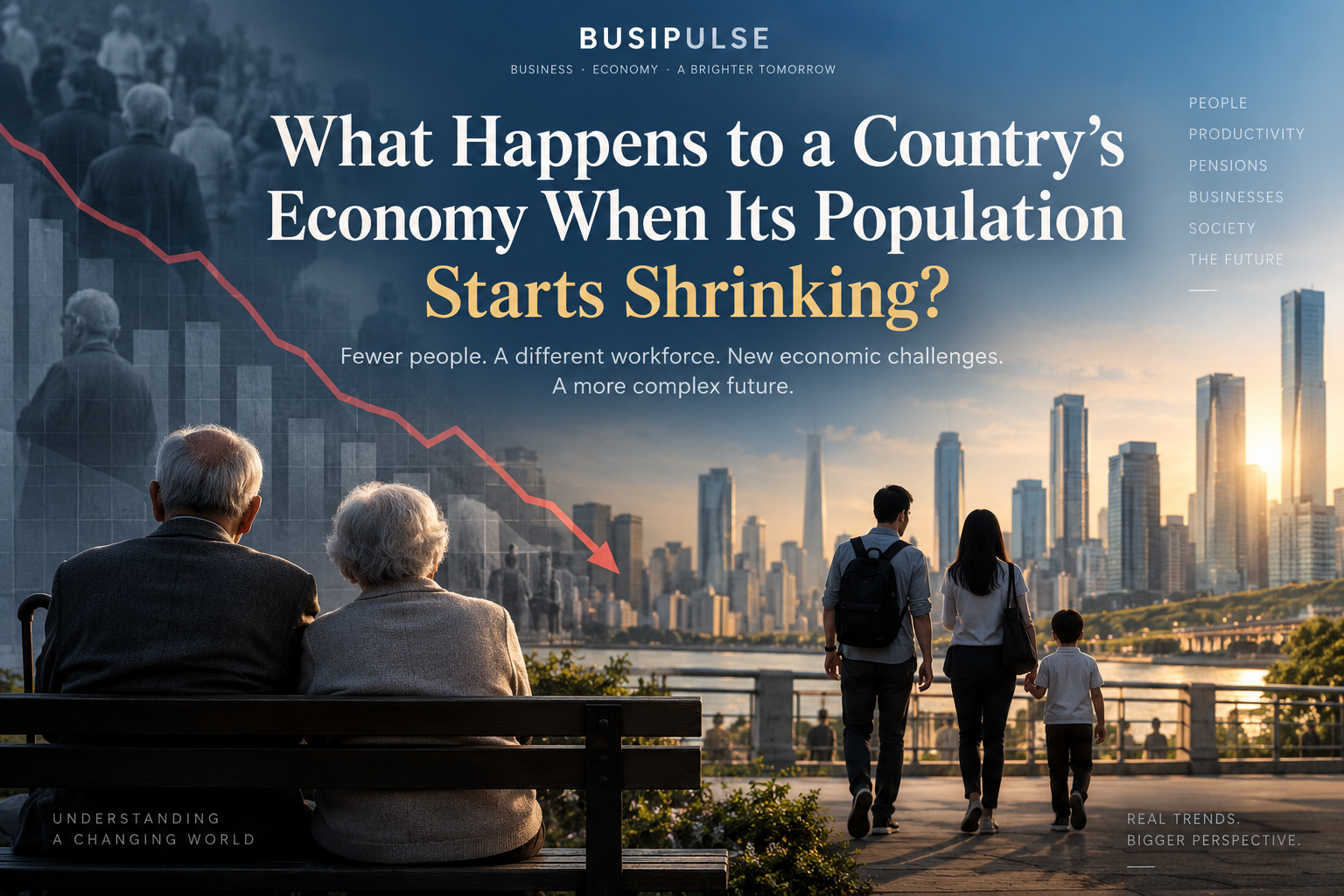
Economic effects of population decline are becoming increasingly important as more countries face ageing populations, falling birth rates and shrinking workforces. For generations, economic planning has largely been built around population growth. Governments have expanded schools, transport networks and housing, while businesses have generally assumed that tomorrow’s workforce and consumer market would be larger than today’s. Yet a growing number of countries are entering unfamiliar territory: their populations are ageing, birth rates are falling and, in some cases, the total number of people has already begun to decline.
This demographic shift raises an important economic question: what happens to a country’s economy when its population starts shrinking? The answer is more complicated than simply saying that fewer people produce a smaller economy. Population decline can reduce the workforce, place pressure on pensions and healthcare, change housing demand, and reshape consumer markets. At the same time, higher productivity, automation, longer working lives, and carefully managed migration can offset some of these pressures. Ultimately, the economic consequences depend less on population numbers alone than on how effectively a country adapts.
Population Decline Is Becoming an Economic Reality
Population decline is no longer confined to a handful of countries. According to the United Nations’ World Population Prospects 2024, populations had already peaked in 63 countries and areas containing about 28% of the world’s population. This group includes China, Germany and Japan, and its combined population is projected to fall by about 14% over the following 30 years.
Low fertility is an important part of the change. In more than half of countries and areas worldwide, fertility is already below the level of roughly 2.1 births per woman required to maintain population size over the long term without migration. However, the economic challenge is not simply that there may be fewer people. In many countries, population decline occurs alongside ageing, meaning that the number of working-age people can fall while the number of retirees remains high or continues growing.
Why Are Populations Shrinking in the First Place?
It is tempting to explain falling populations simply through contraception or deliberate birth control, but the demographic transition is considerably more complicated. Modern contraception has given people greater control over the timing and number of children they have, but fertility has also fallen alongside urbanisation, rising education levels, changing family structures, later marriage and parenthood, and greater participation of women in higher education and paid employment. At the same time, the economic calculation involved in raising children has changed significantly in many societies.
Housing costs, childcare expenses, education costs, and insecure employment can make starting or expanding a family financially difficult, particularly for younger adults living in expensive cities. Delayed marriage and later parenthood can also reduce the number of years available for having children, while some adults choose to remain childless or have smaller families for personal, career or lifestyle reasons. These influences do not operate identically everywhere, and it would be misleading to attribute low fertility to any single social or economic change.
There is also a deeper economic transformation behind the numbers. In predominantly agricultural societies, larger families historically could contribute labour to farms and family enterprises, while formal pension and social-security systems were limited or nonexistent. As economies industrialised and urbanised, children increasingly became a substantial long-term financial commitment rather than an immediate source of household labour. Improvements in healthcare also reduced infant and child mortality, meaning parents no longer needed as many births to have the same number of surviving children. Falling mortality followed by falling fertility is a central feature of what demographers call the demographic transition.
Another important factor is demographic momentum. Once fertility remains below replacement level for several decades, each new generation can become smaller than the one preceding it. Eventually there are fewer potential parents themselves, meaning that even a modest recovery in the average number of children per woman may not immediately stop the total number of births from falling. Population decline can therefore become difficult to reverse quickly, which helps explain why governments offering childcare subsidies, parental leave, housing assistance or cash incentives have not always produced dramatic demographic turnarounds.
Migration adds the final part of the equation. A country with more deaths than births can still maintain or increase its population if net immigration is sufficiently high, while a country experiencing both low fertility and substantial outward migration can shrink considerably faster. Population decline should therefore be understood not as the result of one choice or policy, but as the cumulative outcome of births, deaths, migration and long-term changes in how people live, work and form families.

1. A Smaller Workforce Can Slow Economic Growth
One of the most immediate consequences of population decline is pressure on the labour supply. When smaller generations enter employment while larger generations retire, businesses can find it increasingly difficult to recruit enough workers. The OECD projects that the working-age population across its member countries could decline by about 8% between 2023 and 2060, while more than a quarter of OECD countries could experience declines exceeding 30%.
A smaller workforce does not automatically produce an equivalent decline in economic output. If businesses invest in better technology, employees become more skilled and productivity rises; fewer workers can still produce more goods and services. Without those improvements, however, labour shortages can constrain production and weaken long-term economic growth. The challenge therefore shifts from simply increasing the number of workers to increasing the economic value produced by each worker.
2. Labour Shortages Can Create Opportunities as Well as Problems
A shortage of workers is usually presented negatively, but it can also alter the balance of the labour market. Employers competing for a smaller pool of available employees may need to offer better wages, improve working conditions and invest more heavily in retaining experienced workers. Scarcer labour can also make automation financially attractive, encouraging companies to replace repetitive tasks with machines, software and artificial intelligence.
The result depends heavily on productivity. Rising wages supported by greater output per worker can improve living standards, whereas labour costs rising much faster than productivity can place businesses under pressure and contribute to higher prices. Population decline can therefore create an incentive for companies to become more efficient rather than relying indefinitely on an expanding supply of inexpensive labour.

3. Pension and Healthcare Systems Face Greater Pressure
The financial challenge becomes particularly visible when looking at pensions. Many public retirement systems depend substantially on taxes or contributions from today’s workers to support today’s retirees. As populations age, that relationship changes. The OECD’s old-age dependency ratio, the number of people aged 65 and over relative to the working-age population, rose from about 19% in 1980 to 31% in 2023 and is projected to reach 52% by 2060. These fiscal pressures are among the most significant economic effects of population decline, particularly in countries where ageing is advancing faster than productivity.
Healthcare and long-term care create additional pressure because older populations generally require more of these services. The OECD estimates that population ageing could increase annual public spending on pensions and health by around three percentage points of GDP on average across OECD countries by 2060. Governments may consequently face difficult combinations of higher contributions, later retirement, changes to benefits, greater taxation or reforms designed to increase labour-force participation. The precise solution will differ by country, but the underlying demographic arithmetic cannot simply be postponed indefinitely.
4. Government Finances Can Come Under a Demographic Squeeze
A shrinking workforce also affects government revenue. If the number of taxpayers declines while pension, healthcare and long-term-care obligations increase, governments must finance more age-related expenditure from a relatively narrower economic base. The pressure can be especially significant for countries already carrying high levels of public debt or struggling with weak productivity growth.
This does not necessarily mean taxes must rise dramatically. Higher wages, stronger productivity, increased employment among underrepresented groups, and economic restructuring can expand the tax base even when population is declining. Nevertheless, demographic change makes fiscal efficiency increasingly important. Governments have less room to assume that future population growth will automatically generate additional taxpayers to finance commitments made today.
5. Housing Markets May Split Into Winners and Losers
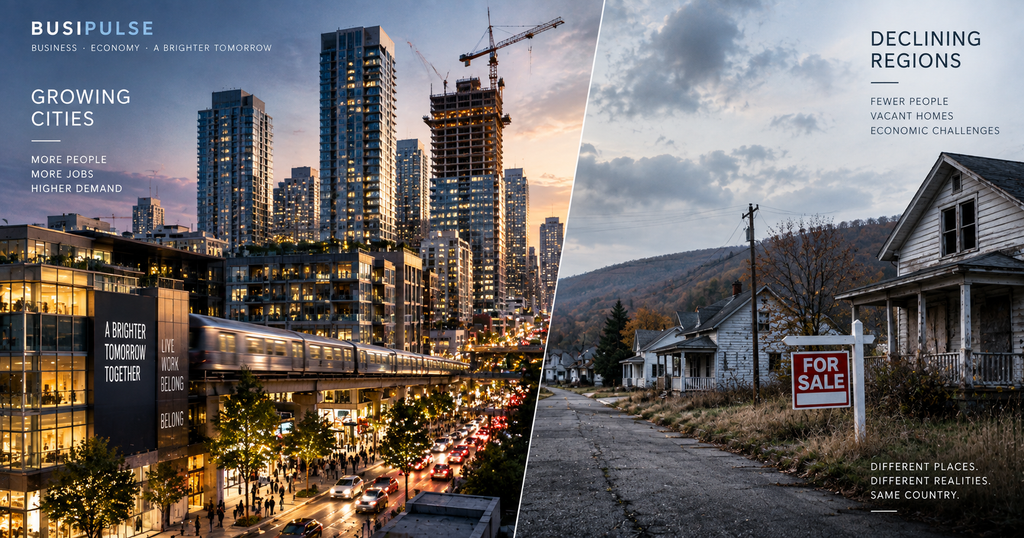
It might appear logical that fewer people would automatically mean cheaper housing, but demographic change does not operate evenly across a country. People often continue moving from smaller towns towards major employment centres even while the national population is declining. As a result, successful cities can continue experiencing strong housing demand while regional communities face empty properties and falling demand. The economic effects of population decline can therefore vary sharply between major cities and less populated regions.
Japan provides a useful example. Official statistics show that its population stood at about 123.8 million in October 2024, declining by approximately 550,000 in a single year and marking the fourteenth consecutive annual fall. Yet population increased in Tokyo and Saitama while declining in 45 of Japan’s 47 prefectures. This illustrates an important point: national population decline can coexist with local population growth, meaning that housing shortages in major cities and vacant homes elsewhere can occur at the same time.
6. Businesses Must Adapt to a Different Consumer Market
Population decline affects not only who produces goods and services but also who buys them. Smaller younger generations can weaken demand for products associated with children and young families, while an expanding older population creates greater demand for healthcare, pharmaceuticals, retirement services, accessible housing, financial planning and personal assistance. Businesses that assume consumer demand will simply continue following historical patterns may therefore struggle.
China demonstrates the scale on which this transition can occur. Official statistics show that its population fell by about 3.39 million during 2025, with 7.92 million births compared with 11.31 million deaths. People aged 60 and over represented about 23% of the population by year-end. China still possesses an enormous workforce and consumer market, but its demographic direction demonstrates that population ageing and decline are no longer issues limited to relatively small developed economies.
7. Immigration Can Slow Decline, but It Is Not a Complete Solution
Migration can increase the working-age population, fill labour shortages and broaden the tax base. The United Nations notes that countries including Germany and Italy would have reached their population peaks earlier without immigration. Economically, therefore, migration can moderate some of the effects of ageing and population decline, particularly when newcomers successfully participate in the labour market.
However, immigration cannot be treated as a simple numerical solution. Its effects depend on employment, skills, housing supply, infrastructure and successful integration, while rapid population increases can create short-term pressure on housing and public services. Migration can also create substantial economic benefits, but those benefits generally depend on effective economic planning and integration.
8. Productivity Could Matter More Than Population Size
The most important economic response to demographic decline may ultimately be productivity. A country with 40 million highly productive workers can potentially generate more output than one with 50 million less productive workers. Investment in education, robotics, digitalisation, artificial intelligence, infrastructure and better management can allow an economy to produce more value with fewer people.
This distinction also explains why total GDP and individual prosperity should not be confused. If population falls while economic output remains stable, GDP per person can actually rise. Conversely, a rapidly growing population can increase total GDP while producing relatively little improvement in income per person. When evaluating population decline, policymakers and readers should therefore examine productivity, real incomes and living standards alongside the headline size of national GDP.

Economic Effects of Population Decline Are Not Always Negative
Japan is particularly useful in challenging simplistic assumptions about demographics. Almost 29.3% of its population was aged 65 or older in 2024, yet Japan remains a highly developed economy with sophisticated infrastructure, advanced manufacturing, globally competitive businesses, and substantial technological capabilities. Its demographic challenges are serious, but they have not transformed the country into an economic failure.
The more dangerous scenario is population decline combined with weak adaptation. If productivity stagnates while the workforce contracts, pension costs rise, government debt expands, and businesses fail to invest, demographic pressure can reinforce existing economic weaknesses. By contrast, countries that raise productivity, improve labour-force participation, enable healthy older people to remain economically active where appropriate, reform retirement systems gradually and invest in automation may be able to maintain improving living standards even with fewer inhabitants.

Can Governments Reverse Population Decline?
Many governments have attempted to encourage higher birth rates through childcare support, parental leave, housing assistance and financial incentives. Such measures can reduce some of the economic barriers associated with raising children, but demographic policy operates over very long periods. A child born today will not become a full participant in the workforce for roughly two decades, meaning that even a significant recovery in fertility would not immediately solve current labour shortages or pension pressures.
For that reason, countries facing population decline generally need a combination of long-term and immediate responses. Family policies may influence future demographics, while productivity improvements, automation, retirement reform, labour-force participation and migration can address pressures already emerging today. There is unlikely to be one universal formula because countries differ greatly in their economies, institutions and social preferences.
Final Thoughts
The economic effects of population decline are significant, but they are not predetermined. A shrinking population can create substantial challenges, particularly when it occurs alongside rapid ageing. Fewer workers may need to support more retirees, businesses can face labour shortages, governments may encounter greater fiscal pressure, and some communities may struggle to maintain infrastructure designed for larger populations. These consequences are real, but treating population decline itself as an automatic economic catastrophe overlooks how economies actually generate prosperity.
The central question is not simply how many people live in a country, but how productive those people are and how effectively economic institutions adjust to demographic change. A smaller population with rising productivity, sustainable public finances and improving living standards can remain prosperous, while a growing population without sufficient jobs, housing, infrastructure or productivity can face difficulties of its own. The challenge for ageing economies is therefore not necessarily to preserve population growth forever, but to build systems capable of maintaining prosperity even when the number of people stops increasing.
Author’s Note
My professional background in financial administration and accounting procedures has shaped my interest in examining how large economic changes eventually affect governments, businesses and ordinary households. This article is intended to explain the economic implications of population decline from an analytical and educational perspective rather than to advocate a particular demographic, immigration, or public-policy position. Readers are not required to agree with the author’s interpretations or conclusions and are encouraged to examine the evidence, consider different perspectives and form their own views.
The information presented here is for general educational purposes and should not be considered financial, investment, tax, legal or public-policy advice. Demographic conditions, pension systems, taxation, labour markets, healthcare structures and migration policies vary considerably between countries, meaning that the effects of population decline will not be identical everywhere. Busipulse aims to make complex economic and financial issues easier to understand by connecting large economic trends with their practical consequences for individuals, businesses and society.

[…] quickly enough. The reverse problem also exists: as explored in our Busipulse analysis of the economic effects of population decline, ageing societies can face labour shortages and increasing pension […]