


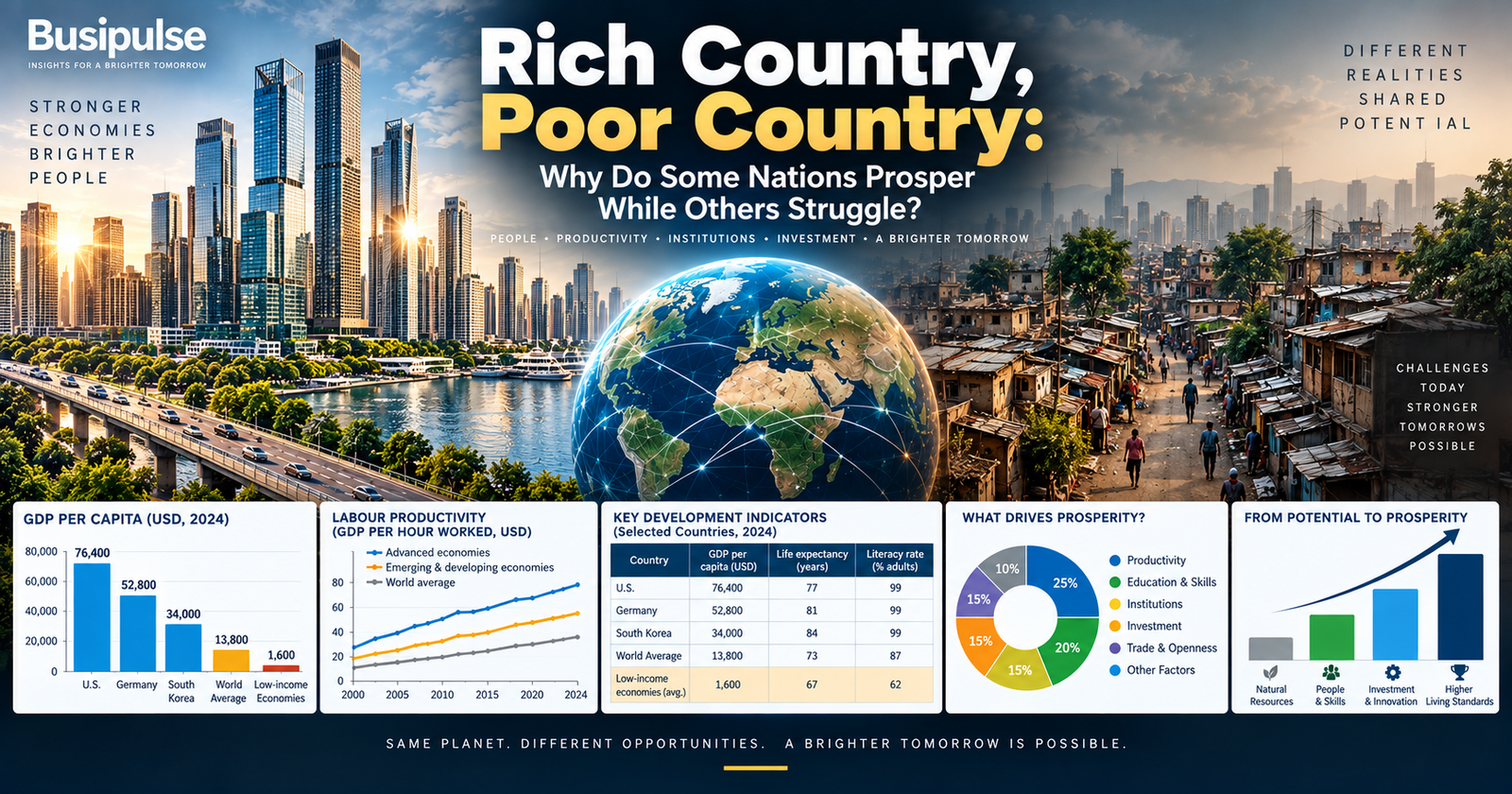
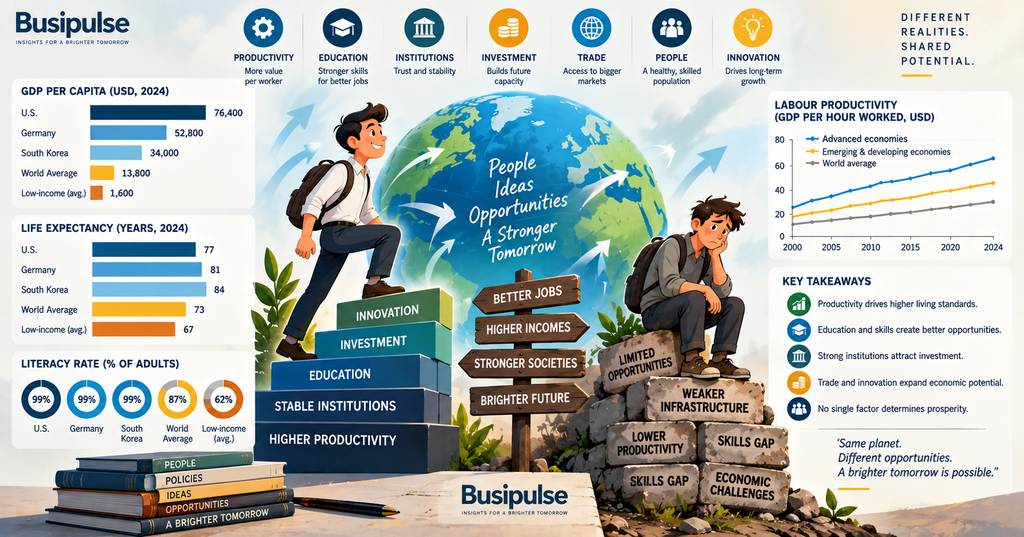
Rich Country, Poor Country is more than a contrast in income; it is a question about why some nations consistently create higher productivity, stronger institutions, and better living standards while others struggle to convert their resources and people into lasting prosperity. Look across the global economy and the differences are striking: some countries provide high wages, sophisticated infrastructure, advanced healthcare, and globally competitive industries, while others struggle to generate enough productive employment or reliable public services.
Why are some countries rich while others remain relatively poor? There is no single answer. Geography and history matter, and natural resources can provide substantial advantages, but long-term prosperity depends heavily on how effectively a country turns its people, capital, knowledge and resources into productive economic activity. Institutions, education, investment, technology, trade and productivity all influence whether economic potential eventually becomes higher living standards.
Being a Rich Country Is About More Than Having Money
The size of an economy alone tells us surprisingly little about the prosperity of its average citizen. A country with hundreds of millions of people can produce an enormous total GDP while income per person remains relatively modest. Conversely, a smaller economy can support high living standards when its workers produce substantial economic value.
This distinction matters because national prosperity is ultimately connected to productivity and income per person, not simply the headline size of GDP. Economic growth can improve living standards, but population growth, inflation, employment, and the distribution of income all influence how much of that progress households actually experience.
1. Productivity Is the Engine Behind Long-Term Prosperity
Imagine two factories employing the same number of workers. One uses outdated equipment, suffers frequent power interruptions, and operates with inefficient logistics. The other combines skilled employees with modern machinery, reliable infrastructure, and better management. Even with identical workforces, the second factory can produce considerably more economic value.
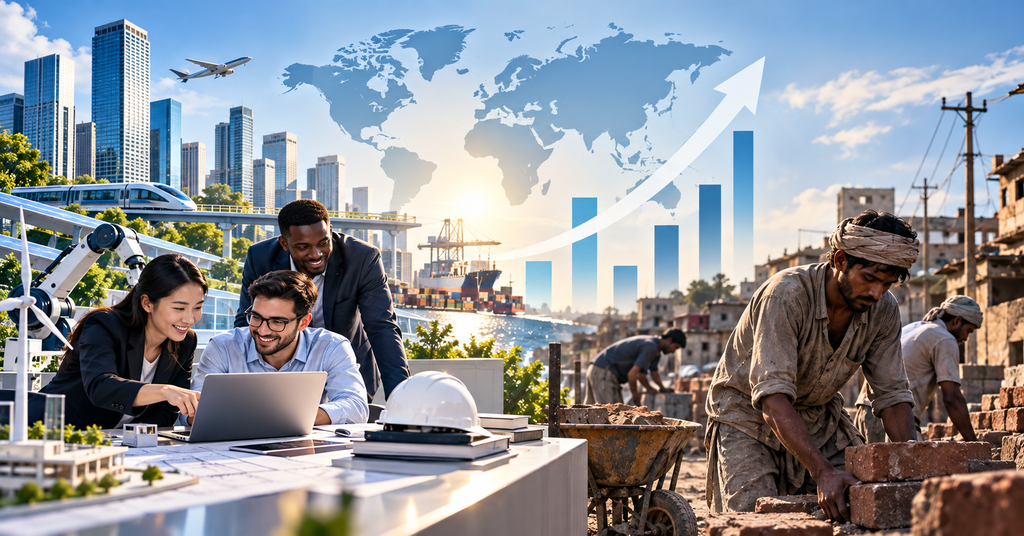
The same principle applies to countries. Workers become more productive when they have appropriate skills, reliable energy, efficient transport, technology, access to capital, and businesses capable of organising those resources effectively. World Bank research estimates that productivity accounts for about half of the differences in GDP per person across countries, making it one of the central drivers of long-term living standards.
This is also why cheap labour does not necessarily make a country prosperous. Low wages may attract certain industries, but sustained improvements in living standards require workers eventually to produce enough additional value for businesses to pay higher wages while remaining competitive.
2. Natural Resources Can Help — but They Do Not Guarantee Wealth
Oil, gas, minerals, fertile land and other natural resources can create enormous opportunities. Export earnings can finance infrastructure, education, healthcare and investment, giving resource-rich countries advantages that others do not possess.
Yet natural wealth does not automatically become national prosperity. An economy heavily dependent on a few commodities can become vulnerable to international price movements, while other industries remain underdeveloped. The quality of institutions, investment decisions and management of resource revenues can therefore matter almost as much as the resources themselves.
The opposite is equally revealing. Some prosperous economies possess relatively limited natural resources but create substantial value through manufacturing, technology, logistics, finance and international trade. What an economy learns to produce can eventually become more important than what happens to lie beneath its soil. From a Rich Country Poor Country perspective, natural resources matter far less than how effectively institutions, businesses and workers turn them into productive economic value.
3. Institutions Turn Economic Potential Into Economic Activity
A business considering a factory, research centre or other long-term investment must make assumptions about the future. Will contracts be enforced? Will regulations remain reasonably predictable? Can property be protected? Will taxes and administrative procedures allow the business to operate efficiently?
These questions explain why institutions matter economically. Courts, regulators, tax administrations, central banks and other public institutions influence the environment in which households and businesses make decisions. Strong institutions do not mean governments never make mistakes; they mean economic rules are sufficiently credible and administrative systems sufficiently capable for people to plan, invest and compete.
Where uncertainty becomes persistent, businesses may delay investment or move capital elsewhere. Over many years, those decisions can create substantial differences in productive capacity between countries.
4. Education Matters, but Useful Skills Matter More
Education is one of the most important investments a society can make, but enrolment statistics alone can be misleading. What matters economically is whether students actually develop knowledge and skills that improve their productivity, adaptability and ability to participate in modern industries.
Human capital also extends beyond formal schooling. Health, vocational training, professional experience and technical competence influence what workers can produce. Universities can graduate thousands of students, but if businesses cannot use their skills productively, the economic return from education will remain below its potential.
Successful development therefore requires a connection between education, industry, technology and labour-market demand. A skilled population becomes far more valuable when businesses and institutions provide productive opportunities in which those skills can be used.
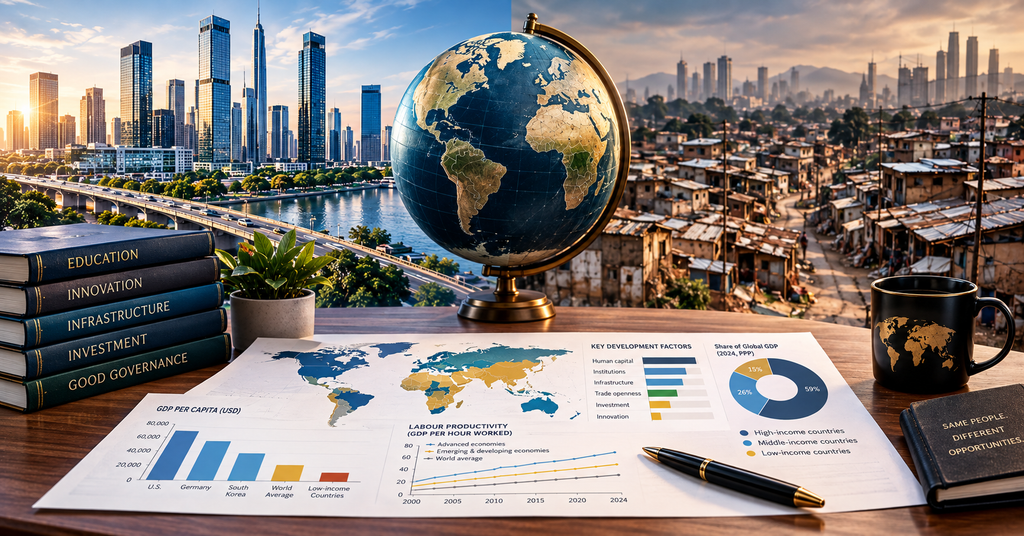
5. Trade Allows Economies to Grow Beyond Their Borders
International trade allows businesses to reach markets far larger than their domestic populations. A company based in a relatively small country can manufacture goods or provide services for millions of customers abroad, allowing successful industries to operate at scales that would otherwise be impossible.
South Korea provides a powerful historical example. After the Korean War, it was a relatively poor economy receiving international assistance; over subsequent decades, industrialisation, education, infrastructure, exports and technological development helped transform it into a high-income, innovation-driven economy. The country’s experience does not provide a formula that every nation can simply copy, but it demonstrates that a country’s economic position is not permanently fixed.
Trade alone does not guarantee development. However, access to international markets can reward businesses that become more efficient and innovative while allowing countries to specialise in activities where they can compete effectively.
6. Investment Builds Tomorrow’s Productive Capacity
Infrastructure and productive investment determine much of what an economy will be capable of producing in the future. Reliable electricity keeps factories operating, transport networks reduce logistics costs, telecommunications support digital businesses, and machinery allows workers to generate greater output.
Private investment matters for the same reason. Businesses must be willing to build factories, develop technology, train employees, and take commercial risks. Persistent instability, weak infrastructure, or unpredictable economic policies can discourage those decisions, reducing not only today’s investment but also tomorrow’s productive capacity.
Pakistan offers a useful contemporary reference. Recent macroeconomic stabilisation has eased some immediate pressures, but longer-term prosperity still depends on structural improvements in areas such as productivity, investment, exports, human capital and fiscal capacity. Its experience illustrates a broader principle relevant to many developing economies: stabilising an economy is an important achievement, but it is not the same as transforming its productive capacity.
7. Geography Matters, but Geography Is Not Destiny
Geography can create advantages and disadvantages that economic policy cannot simply erase. Access to major shipping routes can lower trade costs, fertile land can support agriculture, and navigable rivers can facilitate commerce. Conversely, difficult terrain, disease environments, or lack of direct sea access can make development more expensive.
Yet geography does not completely determine economic outcomes. Infrastructure, technology and regional cooperation can reduce many geographic disadvantages. A landlocked country cannot create a coastline, for example, but it can improve transport connections, customs procedures and trade relationships with neighbouring countries. Development therefore often involves reducing the economic costs imposed by geography, rather than pretending those costs do not exist.
8. A Large Population Is Potential, Not Prosperity
A large population can provide workers, entrepreneurs and consumers, but population size alone says little about living standards. The economic value of a large workforce depends on whether people are healthy, educated, productively employed and supported by adequate infrastructure and capital.
Rapid population growth can itself become challenging when job creation, schools, housing and infrastructure fail to expand quickly enough. The reverse problem also exists: as explored in our Busipulse analysis of the economic effects of population decline, ageing societies can face labour shortages and increasing pension pressures.
Demographics therefore matter in both directions. The relevant question is not simply how many people a country has, but whether its economy can create sufficient productive opportunities for them. The Rich Country Poor Country divide therefore cannot be explained by population size alone; what matters is whether people can participate in productive economic activity.
9. Why Some Countries Become Stuck in the Middle
Economic development can become harder as countries become wealthier. Early gains may come from moving workers into more productive industries, building basic infrastructure, or adopting technology already developed elsewhere. Eventually, however, economies must compete through increasingly sophisticated businesses, stronger skills, and innovation.
This challenge is commonly described as the middle-income trap. According to the World Bank’s World Development Report 2024, since the 1990s, only 34 economies classified as middle-income have moved into high-income status. The report argues that countries generally need to progress from investment towards the diffusion of technology and successful business practices, and eventually towards greater innovation as their economies become more advanced.
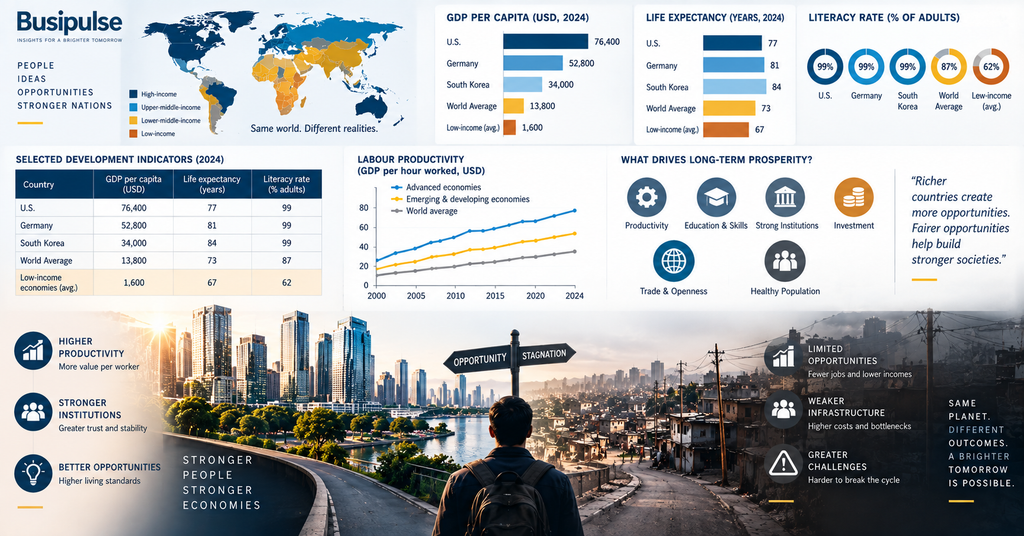
Temporary booms in commodities, credit, property or foreign capital can raise economic growth without permanently improving productivity. The more difficult test is whether an economy continues creating greater value after favourable conditions disappear.
10. Four Popular Myths About Rich and Poor Countries
Several popular explanations for national prosperity become less convincing when examined closely. Natural resources can help, but they do not guarantee wealth; a large population can create opportunity, but not automatically high incomes; cheap labour can attract investment, but genuine prosperity eventually requires rising productivity; and rapid GDP growth does not necessarily mean household living standards are improving at the same rate.
These explanations share a common weakness: each treats one economic variable as though it determines the destiny of an entire country. Development is rarely that simple. Prosperity generally emerges from several economic strengths reinforcing one another over long periods.
Rich Country Poor Country: What Actually Makes a Nation Prosper?
There is no universal formula, but the broad pattern is reasonably clear. Countries tend to become wealthier when workers become more productive and when economic systems allow productive businesses and individuals to invest, compete, innovate, and expand.
That usually requires some combination of useful education, functioning infrastructure, macroeconomic stability, reliable institutions, productive investment, technology, competitive markets, and access to trade. Different countries have reached prosperity through different routes, and historical circumstances mean policies that succeed in one place may not produce identical results elsewhere. The underlying objective, however, is remarkably consistent: enable people and capital to move towards increasingly productive activities and create more economic value over time.
Final Thoughts
The Rich Country Poor Country divide is ultimately about differences in productive capacity, institutions and long-term economic opportunity. The difference between a rich country and a poor country cannot be explained simply by natural resources, geography, population size or government spending. National prosperity develops through decades of accumulated investment, skills, institutions, technological progress and improvements in productivity. Some countries begin with considerable advantages and fail to use them effectively, while others overcome significant disadvantages.
Perhaps the most important lesson is that a country’s economic position is not necessarily permanent. South Korea’s transformation demonstrates how dramatically productive capacity can change within generations, while the difficulties experienced by some resource-rich economies show that inherited advantages alone are insufficient. More broadly, economic stabilisation can provide an essential foundation for development without being the same thing as long-term economic transformation.
A rich country, ultimately, is not merely one that has more. It is one that has developed the capacity to produce more value from its people, knowledge, capital and resources—and to keep improving that ability over time.
Author’s Note
My professional background in financial administration and accounting procedures has shaped my interest in understanding why similar economic resources can produce very different outcomes across countries. This article examines national prosperity from an economic and developmental perspective rather than advocating a particular political system, government or policy programme. Readers are not required to agree with the author’s interpretations or conclusions and are encouraged to examine the evidence, consider alternative explanations and form their own views.
The information presented here is intended for general educational purposes and should not be considered financial, investment, tax, legal or public-policy advice. Economic development is influenced by complex historical, institutional, geographic and social factors, and no single development strategy is appropriate for every country. Busipulse aims to make complex economic and financial issues easier to understand by connecting large economic questions with their practical consequences for individuals, businesses and societies.

[…] This connects with the broader argument in BusiPulse’s Rich Country, Poor Country analysis: productive capacity matters. An economy generating stronger income and revenue growth generally has greater capacity to carry financial obligations than one in which debt rises while the economic base supporting it stagnates. (BusiPulse) […]
[…] A productive economy can support higher wages and profits without relying entirely on higher prices. Competitive companies may expand internationally, while foreign businesses may want to invest in factories, technology, shares, infrastructure and new enterprises within the country. […]