



The hidden costs of homeownership can make buying a property far more expensive than the mortgage payment alone suggests. Buying a home is often one of the largest financial decisions a person will make, offering stability, personal freedom, and the opportunity to build wealth over many years. Yet buyers frequently judge affordability by looking mainly at the purchase price, down payment, and monthly mortgage.
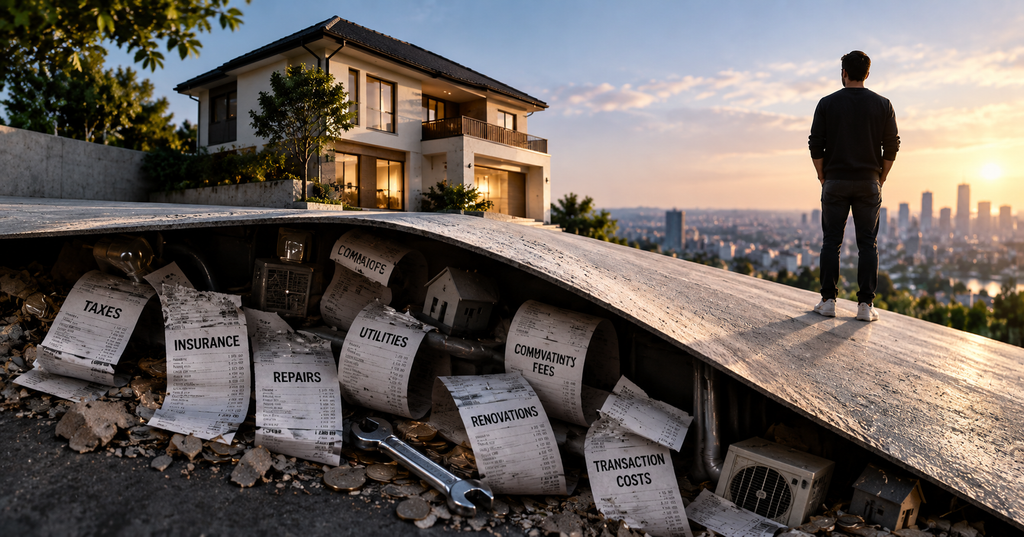
Taxes, insurance, maintenance, repairs, utilities, community charges, transaction costs, and the money tied up in the property can all affect the household budget.
At the same time, a home is not simply an expense. It is an asset that may build equity and rise in value. A realistic assessment therefore needs to consider both the costs of ownership and its potential long-term financial benefits.
1. Property Taxes and Local Charges
Homeowners in many countries face recurring property taxes, municipal rates, land charges, or similar local levies. The way these are calculated varies widely.
Some governments base them largely on assessed property value, while others consider location, land value, property type, or local services. Even within one country, neighboring cities or regions may impose very different charges.
These expenses can also rise over time as valuations and tax policies change. Buyers who calculate affordability using only the loan payment may therefore underestimate their long-term housing costs. Before purchasing, it is important to understand the current rules applying to the specific location rather than relying on national averages.
2. Home Insurance
Insurance protects homeowners from potentially severe financial losses, but it is also an ongoing expense that can become more costly over time. Premiums depend on factors such as property value, construction type, local rebuilding costs, security, and exposure to hazards including floods, storms, earthquakes, or wildfires. In some countries, particular types of coverage may be required by mortgage lenders, while in others the arrangements are less standardized.
Climate risk is making this issue increasingly important. Properties exposed to repeated natural hazards can face higher premiums, restricted coverage, or additional insurance requirements. The cheapest home to purchase is therefore not necessarily the cheapest home to protect.
3. Maintenance and Routine Upkeep
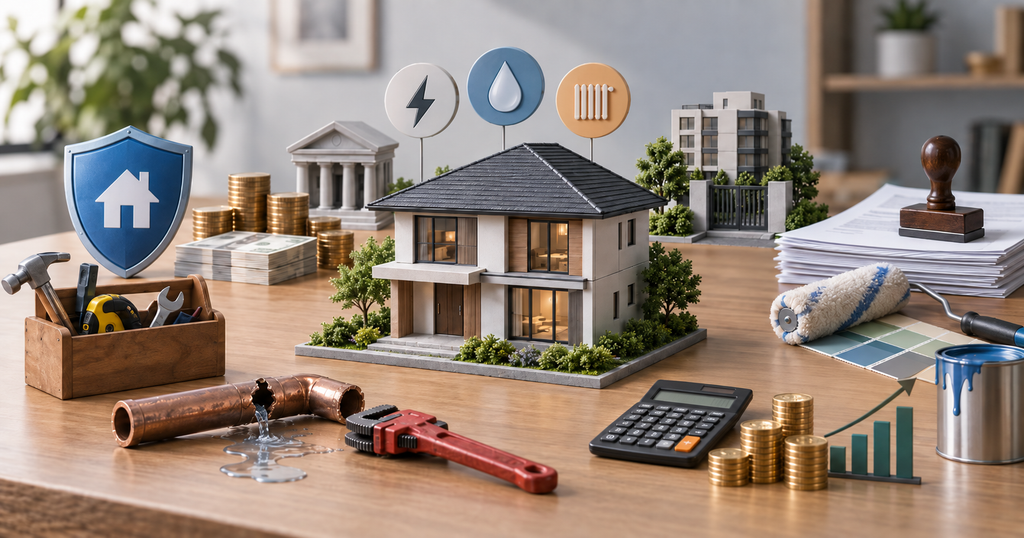
No property remains in perfect condition without ongoing spending. Roofs deteriorate, plumbing systems require attention, walls need repainting, heating and cooling equipment needs servicing, appliances wear out, and exterior areas require regular upkeep.
Unlike a mortgage payment, maintenance rarely arrives as a predictable monthly bill. A homeowner may spend very little for several months and then face multiple expenses at once.
The condition and age of a property make a significant difference. An older house with aging electrical, plumbing, or structural systems may demand far more attention than a recently constructed home. Maintenance should therefore be treated as a permanent part of homeownership rather than an occasional inconvenience.
4. Major Repairs and Unexpected Problems
Routine upkeep can usually be planned. Major repairs are harder to predict. A failed heating system, damaged roof, water leak, structural problem, electrical fault, drainage issue, or major appliance replacement can result in a large bill with little notice.
These expenses illustrate one of the fundamental differences between owning and renting. A renter can often transfer responsibility for major structural repairs to the landlord. The owner generally carries the financial risk directly.
For that reason, buying a property without retaining an emergency reserve can create unnecessary vulnerability. A household may technically afford the purchase but still struggle if a major repair occurs soon afterward. Major repairs are among the hidden costs of homeownership that can place the greatest pressure on an unprepared household budget

5. Association, Management, and Community Fees
Apartments, condominiums, gated developments, and planned communities frequently involve recurring charges for shared services. These may fund security, elevators, landscaping, cleaning, building insurance, waste management, recreational facilities, or maintenance of communal spaces. Such services can improve convenience and protect the quality of the development, but the fees must still be included in the affordability calculation.
Owners may also face special assessments when major work is required. If a building needs structural repairs, a new roof, elevator replacement, or extensive exterior work, individual owners may be asked to contribute additional money. Reviewing the financial condition and maintenance history of the development can therefore be just as important as inspecting the individual property.
6. Utilities and the Cost of Running the Home
The cost of living in a property depends on more than the mortgage. Electricity, heating, cooling, water, waste collection, internet, landscaping, security, and other household services can add considerably to monthly expenses. Size matters, but efficiency matters as well. A smaller, well-insulated home may cost less to operate than a larger property with inefficient heating, poor insulation, outdated windows, or energy-intensive appliances.
Climate also plays a role. Cooling costs can dominate household energy bills in hot regions, while heating becomes a major consideration in colder markets. Buyers should therefore ask not only, “How much does this house cost?” but also, “How much will it cost to operate every year?”
7. Buying and Selling Costs
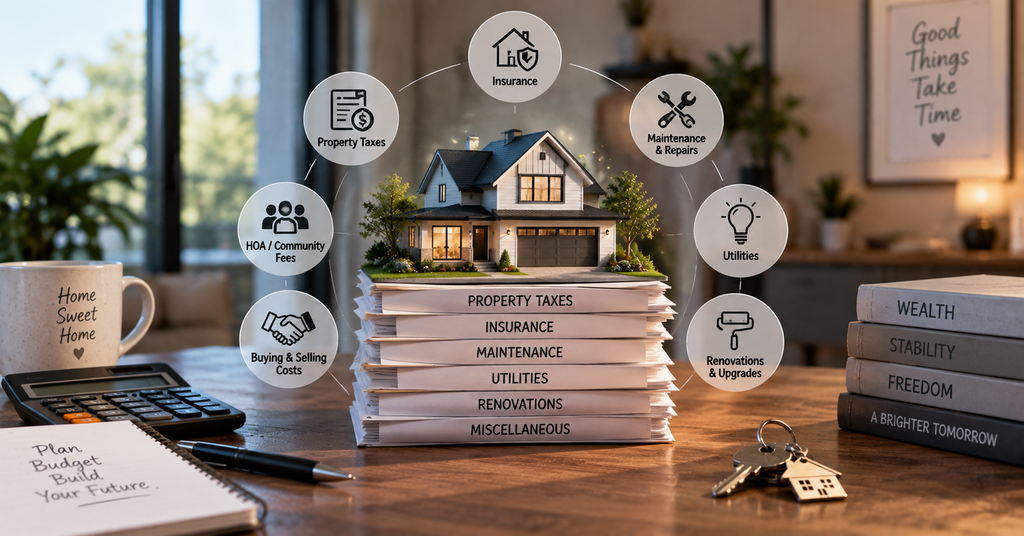
Some of the hidden costs of homeownership arise before the first mortgage payment, particularly during the buying and selling process. Depending on the country, buyers may face legal fees, transfer duties, registration charges, inspections, valuations, mortgage fees, notary costs, agent commissions, or other transaction expenses. The amount varies dramatically between jurisdictions because property-transfer systems and taxation differ worldwide.
Selling may create another set of costs. This matters particularly for people who expect to move again within a few years. A property may rise in value, yet legal fees, taxes, commissions, financing costs, and selling expenses can absorb a meaningful portion of that gain. The length of time a buyer expects to remain in the property should therefore form part of the purchase decision.
8. Renovations, Furnishing, and Improvements
Many buyers discover that receiving the keys creates a new category of spending. The property may need furniture, appliances, painting, security equipment, landscaping, repairs, or renovations. Even a house that requires no urgent work can encourage owners to spend heavily on personalization and upgrades. Improvements can certainly make a home more comfortable, and some may enhance its market value. But homeowners should not assume that every renovation produces an equal financial return.
A highly personalized improvement may have considerable value to the owner while adding relatively little to the eventual selling price. Separating necessary repairs from lifestyle upgrades can help prevent the first years of ownership from becoming more expensive than expected.
9. The Opportunity Cost of Your Capital
A down payment becomes equity, so the money has not vanished. However, it is no longer freely available for other purposes. Capital committed to property could instead have remained in savings, been invested in financial markets, funded a business, supported retirement, or provided greater liquidity. This is known as opportunity cost.
The concept does not imply that buying a home is inferior to investing elsewhere. It simply recognizes that financial resources are limited and choosing one asset means giving up alternative uses of the same capital.
Homeowners should also remember that property is an illiquid asset. Accessing the wealth stored in a home usually requires selling, refinancing, or borrowing against it, each of which can involve additional costs and risks.
The Major Advantage: A Home Can Build Wealth
The costs above are significant, but focusing only on them would give an equally distorted view of homeownership. A home can become one of a household’s most valuable assets. As mortgage principal is repaid, the homeowner’s equity generally increases. If the property also appreciates, the effect can be substantial over a long holding period.
Recent international data demonstrate both the opportunity and the risk. According to the Bank for International Settlements, inflation-adjusted global residential property prices in early 2026 remained around 20% above their level at the end of the 2007–09 global financial crisis. Yet global real prices were 1.2% lower year over year in the first quarter of 2026. (Bank for International Settlements)
The global average also hides enormous differences. In Q1 2026, real residential prices rose about 15% year over year in Portugal and 10% in Spain, while they fell about 7% in both China and Canada. Australia recorded growth, whereas the United States and United Kingdom experienced modest real declines. (Bank for International Settlements) This is why the phrase “property always goes up” is misleading.
Housing markets are shaped by interest rates, employment, population trends, credit conditions, construction activity, land availability, regulation, and local supply. Recent IMF research on Europe, for example, found that supply constraints have become increasingly important drivers of housing affordability and prices. (IMF)
For a homeowner, appreciation can create meaningful wealth, but it also creates concentration risk. A large share of household wealth may become tied to a single asset in one location. If the local housing market weakens, the owner cannot diversify the property as easily as a portfolio of financial investments.
The strongest case for homeownership therefore comes not from assuming rapid price growth, but from combining sensible financing, adequate reserves, a suitable location, a long ownership horizon, and realistic expectations. For readers interested in the broader investment and commercial side of property, these real estate business opportunities show how property can generate value beyond personal homeownership
How the Hidden Costs of Homeownership Affect Affordability
Homeownership can provide stability, greater control over living space, accumulated equity, and exposure to long-term property appreciation. It can also bring taxes, insurance, maintenance, repairs, transaction expenses, community fees, higher operating costs, and financial commitments that continue regardless of short-term changes in income. The most useful affordability test is therefore broader than the mortgage payment.
A prospective buyer should consider whether the household can carry the full cost of ownership while continuing to save, manage emergencies, and pursue other financial goals. A home can become both a place to live and a powerful long-term asset. The advantage comes from understanding not only what the property may eventually be worth, but also what it will cost to own along the way. Understanding the hidden costs of homeownership makes it easier to judge whether a property remains affordable beyond the initial purchase
Author’s Note
This article is intended for general educational purposes and does not constitute financial, tax, legal, mortgage, insurance, or real-estate advice. Property laws, taxes, financing structures, insurance requirements, transaction costs, buyer protections, and housing-market practices differ significantly between countries and regions. Readers should therefore consider the information in light of the laws, regulations, and market conditions applicable in their own country and seek qualified local professional advice where necessary.

[…] weaknesses considerably harder to ignore. For buyers, these pressures can also increase the broader hidden costs of homeownership, particularly when taxes, insurance, and maintenance are already […]
[…] of the discount from a previous peak. Buyers should compare property prices with household incomes, mortgage costs, and realistic monthly expenses. A home may be 15% cheaper than before but remain overvalued […]