

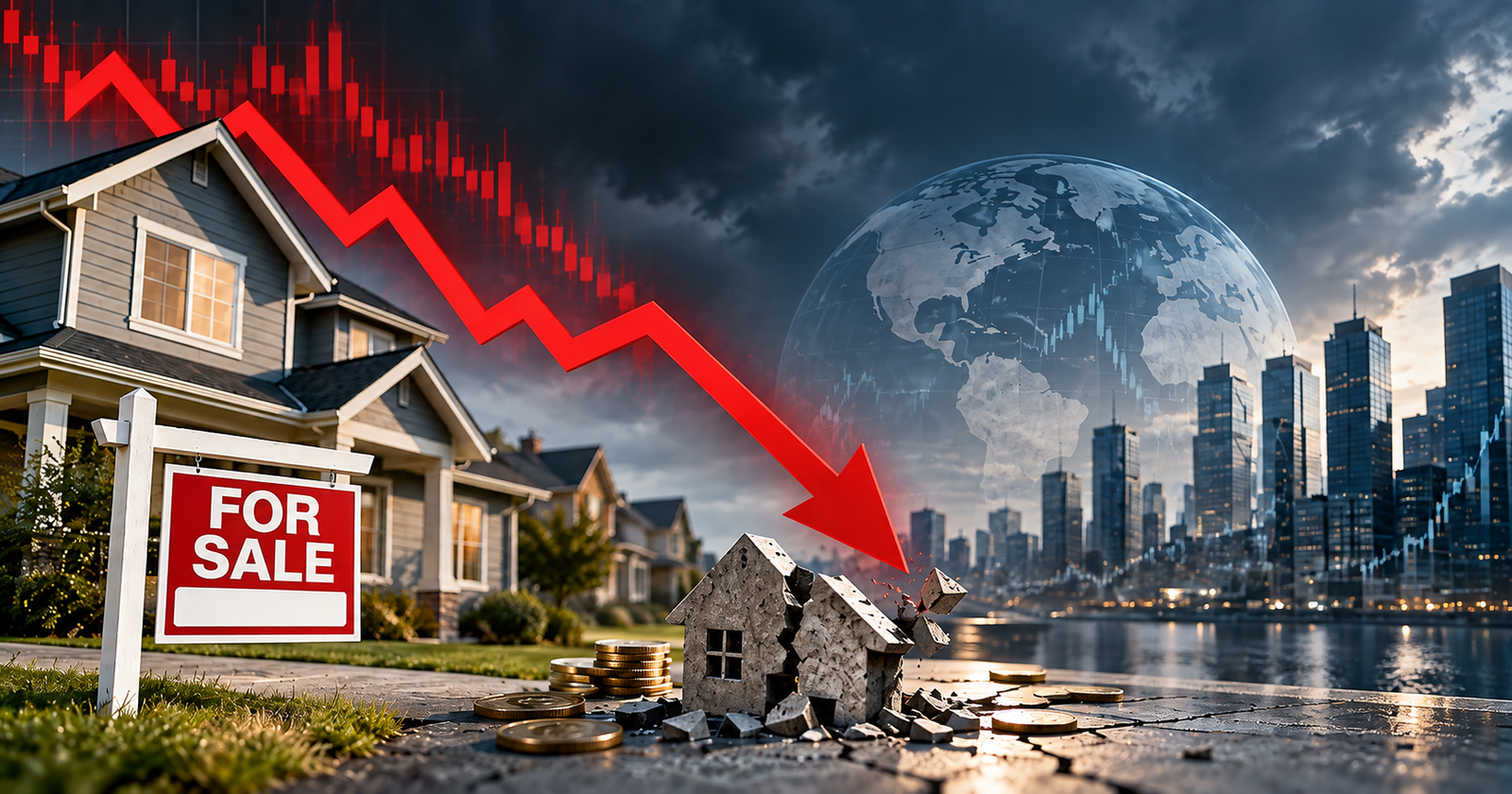
A fall in home prices may initially seem like a problem for homeowners, property investors, and developers. In reality, housing reaches much further into an economy. Banks hold mortgages, families store a large share of their wealth in homes, builders support extensive supply chains, businesses use property as collateral, and governments collect revenue from transactions, construction and wider economic activity linked to real estate.
That connection matters when prices fall sharply. A housing crash can weaken household spending, construction, employment, bank lending, business investment and government finances at the same time. The danger becomes greater when the downturn follows years of heavy borrowing or speculative price growth.
Recent figures show why the subject remains relevant. Bank for International Settlements data show that inflation-adjusted global residential property prices fell 1.2% year on year in the first quarter of 2026. Real prices fell about 7% in both China and Canada and about 4% in New Zealand, although conditions varied widely across countries and some markets continued to rise. (Bank for International Settlements)
A falling property market, however, is not automatically an economic crisis. What matters is what lies beneath the prices: household debt, lending standards, bank exposure, affordability, employment and confidence.
What Separates a Housing Correction From a Housing Crash?
Property prices do not rise indefinitely. A moderate decline after years of rapid growth can simply be a correction, particularly if prices had moved far ahead of household incomes. Such an adjustment can even improve affordability without seriously damaging the broader economy.
A housing crash is more disruptive. It generally involves a substantial and sustained deterioration in prices or transactions accompanied by weaker construction, financial stress, forced selling or declining confidence. The damage can be especially severe when households borrowed heavily on the assumption that property values would continue rising.

New Zealand illustrates why the distinction matters. Its median dwelling price in August 2026 was 18.2% below its post-pandemic peak, with Wellington 27.2% below its peak and Auckland 24.5% below its peak. Yet falling prices alone do not make the country another 2008-style financial crisis. Debt structures, employment, banking resilience and credit conditions determine how far the damage travels. (New Zealand Parliament) The crucial question is therefore not simply, “How much have house prices fallen?” It is, “How much of the economy depended on those prices continuing to rise?”
1. Falling Home Prices Can Reduce Household Spending
For many households, a home is their largest asset. When its value rises, owners often feel financially stronger, even if they have no plans to sell. Higher values may also increase the amount of equity available for borrowing.
When prices fall, the effect can reverse. Net worth declines, borrowing against property becomes harder, and households may become more cautious about cars, furniture, renovations, holidays, and other discretionary spending. An OECD review of housing-market cycles notes that falling house prices can reduce household wealth and collateral values, weakening spending and the broader economy. (OECD)
One family cutting spending is insignificant at the national level. Millions doing so simultaneously can affect retailers, manufacturers, and service businesses that have no direct connection with property. That is one reason housing weakness can become an economic problem rather than remaining a real-estate problem.
2. Debt Can Turn Falling Prices Into Financial Stress
A housing decline becomes more dangerous when it follows a borrowing boom. Consider a buyer who purchases near the market peak with a small deposit and a large mortgage. If the home later becomes worth less than the outstanding loan, the owner enters negative equity. Selling the property may no longer generate enough money to repay the mortgage.
Negative equity does not automatically lead to default. A household with stable income and manageable monthly payments may continue servicing its mortgage without difficulty. Problems intensify when falling prices arrive together with unemployment, declining incomes, or higher borrowing costs.

This is why leverage matters so much. A 15% price decline in a market dominated by low-debt homeowners can have very different consequences from the same decline in a market where buyers borrowed aggressively and banks relaxed lending standards. The property price itself is only part of the risk. The debt attached to the property can determine whether a correction becomes a crisis.
3. Construction Weakness Can Spread Through Employment
Housing is not merely an investment asset. It is also a major industry. Residential development supports builders, architects, engineers, electricians, plumbers, estate agents, lenders, cement producers, steel companies, furniture manufacturers and many other businesses. When buyers disappear and prices weaken, developers may postpone or cancel projects because expected returns no longer justify construction.
That means fewer contracts, fewer jobs and lower demand for building materials. Employees whose incomes decline then reduce their own spending, transferring weakness from construction into retail and services.
China provides a powerful contemporary example. New-home prices were 3% lower year on year in August 2026, while property sales, investment and new construction remained weak. The prolonged property downturn has continued to weigh on household demand and the wider Chinese economy. (Reuters) A housing downturn can therefore travel through the economy long before every homeowner personally experiences a financial loss.
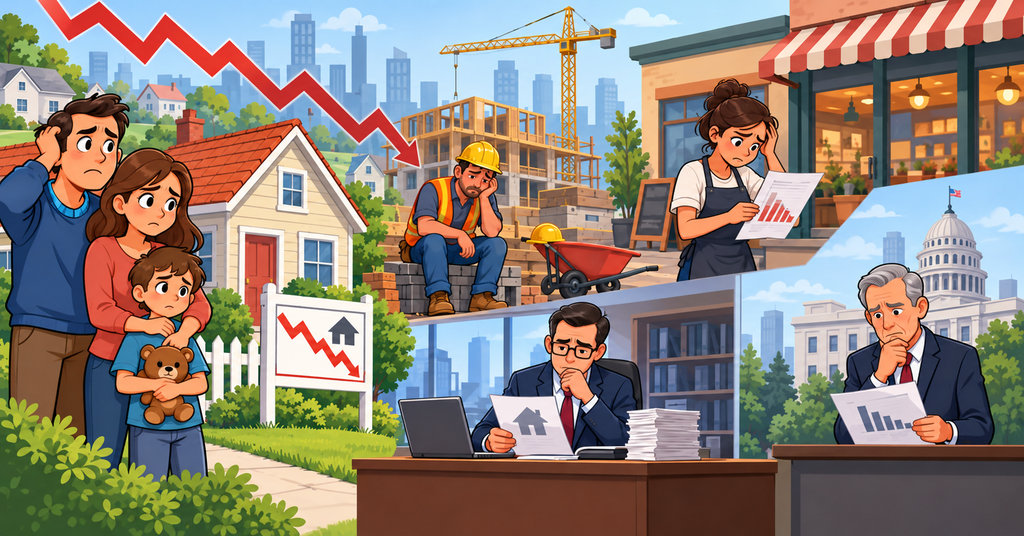
4. Banks May Become More Cautious
Property downturns become particularly dangerous when they reach the banking system. Mortgages are valuable assets for banks as long as borrowers continue making payments. When defaults increase, losses rise. If the properties securing those loans have also fallen sharply in value, banks may recover less money when distressed properties are sold.
Lenders often respond by becoming more conservative. They may demand larger deposits, impose stricter affordability tests or reduce lending to businesses and households. That creates a second economic shock. A financially healthy business may struggle to obtain funding for expansion, while a household with a stable income may find it harder to qualify for a mortgage. Falling collateral values can therefore restrict credit even for people who were not responsible for the original property boom. The OECD notes that housing busts can lower collateral values, increase potential lender losses, and weaken financial stability, consumption and investment simultaneously. (OECD)
5. Businesses Can Be Hit Even If They Never Sell Property
Property frequently acts as collateral for business borrowing. A small-business owner may use a home, office or commercial property to secure financing for machinery, inventory or expansion. If property values decline substantially, the lender may be willing to advance less money against that asset.
The business itself may still be profitable, but its financing capacity has weakened. This is an important transmission channel because it explains how a housing crash can affect entrepreneurship and investment well beyond estate agents and developers. A property downturn can remove collateral from the financial system just when businesses need credit to survive a slowing economy.
Housing downturns also look very different from one country to another. In some markets, the main sign of weakness is falling prices; in others, transaction volumes collapse before headline values move significantly. Pakistan offers a useful example of the second pattern. ICT Revenue Department figures reported by Dawn show registered property transfers in Islamabad falling from 40,890 in 2021 to 20,726 in 2024, while the land covered by those transfers declined from 26,629 kanals to 9,912 kanals over the same period.
The slowdown prompted policy measures aimed at reducing transaction costs and encouraging activity in the real-estate sector. However, Pakistan’s housing system is structurally different from highly mortgage-dependent markets. A National Assembly committee was told in 2026 that mortgage finance represented only about 0.3% of GDP and 0.56% of total private-sector credit. This means a property slowdown there may affect transactions, construction and investor confidence without necessarily creating the same banking risks seen in countries where household mortgage debt is much larger.
The broader lesson is that a weak housing market should not be judged by prices alone. Transaction volumes, access to credit, household leverage and the structure of the financial system can reveal important stress even when headline property values appear relatively stable.
6. Confidence Can Reinforce the Downturn
Property markets are unusually sensitive to expectations. If buyers believe prices will be lower six months from now, many will wait. Sellers may resist reducing their asking prices because they remember what similar properties sold for during the boom. Transactions can therefore collapse before headline prices adjust significantly.
Developers may postpone new projects, banks may tighten lending, and investors may keep money on the sidelines. Weak activity reinforces pessimism, which produces still weaker activity.
This explains why transaction volumes deserve attention alongside prices. A market in which asking prices appear stable, but almost nobody is buying may be less healthy than headline price figures suggest. Confidence cannot override fundamentals indefinitely, but it can accelerate or prolong a housing downturn.
7. Governments Can Lose Revenue Just When They Need More Money
Property downturns can also reach public finances. Lower transaction volumes reduce revenue from taxes, duties and fees associated with real estate. Weaker construction means less economic activity across related industries, while declining household spending can reduce other tax receipts.
At the same time, governments may face higher expenditure if unemployment rises or if financial institutions require support. Local governments that depend heavily on property development or land-related revenue can face particular pressure.
China’s experience demonstrates this connection. Its prolonged property slump has affected construction and investment while putting pressure on local-government finances that previously benefited heavily from land-related activity. (Reuters) Housing can therefore affect both sides of a government’s finances: revenue may fall while economic-support costs rise.
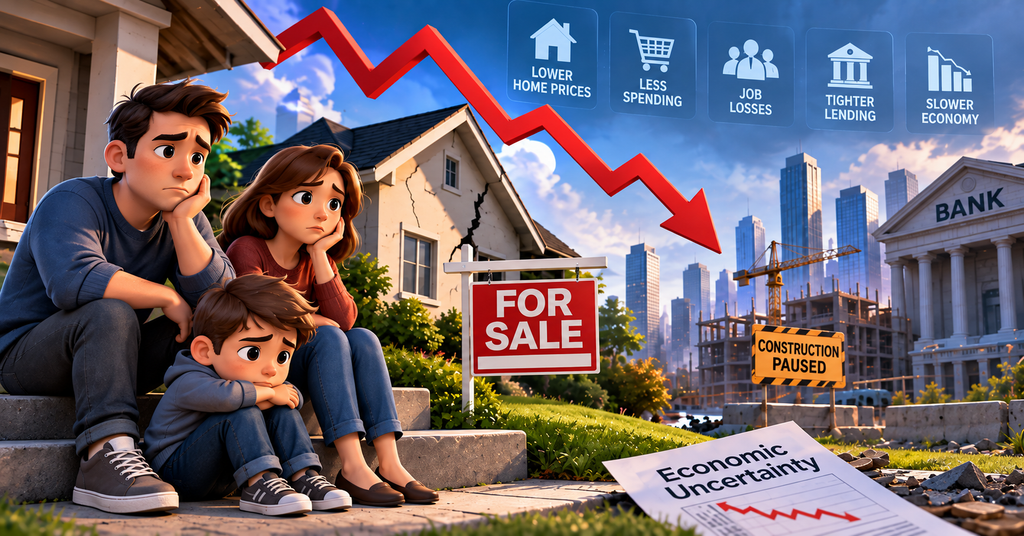
The 2008 Crisis Shows What Happens When Housing Meets Excessive Leverage
The global financial crisis remains the clearest modern example of how property risk can spread throughout an economy. In the United States, a long housing boom was accompanied by increasingly risky mortgage lending and financial securities built around those loans. Once home prices stopped rising and mortgage defaults increased, losses spread through institutions that had become heavily exposed to housing-related assets.
Credit markets seized up, banks suffered severe stress, companies struggled to obtain finance, and unemployment surged. Former Federal Reserve Chair Ben Bernanke later described the housing boom and bust, together with the subsequent rise in mortgage delinquencies and defaults, as among the principal causes of the financial crisis and deep recession. (Federal Reserve)
The lesson is not that every property downturn will become another 2008. In fact, most will not. The deeper lesson is that falling prices become far more dangerous when they expose excessive leverage, weak underwriting, and fragile financial institutions. Housing was the trigger, but financial vulnerabilities amplified the damage.
Why Some Housing Downturns Cause Far Less Damage
The latest global figures demonstrate that housing conditions can move in very different directions at the same time. In early 2026, the BIS recorded substantial real-price declines in China, Canada and New Zealand while prices continued rising in markets including Australia and Spain. (Bank for International Settlements) Even similar price falls do not necessarily produce similar outcomes.
A country with well-capitalised banks, responsible mortgage lending and households that can comfortably service their debts may absorb a correction without major financial instability. A highly leveraged economy with weak underwriting standards may not.
Mortgage structures also matter. Fixed-rate borrowers respond differently to rising interest rates than households whose mortgage costs reset quickly. Bankruptcy laws, mortgage insurance, consumer protections, and housing supply vary across countries as well. The strength of the financial system beneath the housing market can matter more than the headline fall in prices.
Can Falling Home Prices Ever Be Helpful?
Not every decline is undesirable. In places where property values moved far ahead of incomes, lower prices can improve access for younger households and first-time buyers. More affordable land can also reduce costs for new businesses and future construction. But a lower price is not the same as better affordability.
A house that falls from $500,000 to $425,000 may still become harder to purchase if mortgage rates rise sharply. Someone who loses a job during the downturn may be unable to buy at any price. A bank worried about further falls may require a larger deposit just when households are struggling to save one.
The healthiest outcome is therefore not necessarily rising prices or falling prices. It is a market where homes are reasonably connected to incomes, supply responds to genuine demand, and financing remains sustainable.
What Should Buyers and Property Investors Watch During a Downturn?
A falling market can create opportunities, but the phrase “prices have dropped” is not enough to justify buying. The first question should be affordability rather than the size of the discount from a previous peak. Buyers should compare property prices with household incomes, mortgage costs, and realistic monthly expenses. A home may be 15% cheaper than before but remain overvalued relative to what local residents can afford.
For investors, rental income deserves equal attention. A property that produces a weak rental yield may remain a poor investment even after its asking price falls. Maintenance, taxes, vacancies, insurance, financing costs, and management expenses should be considered before treating gross rent as profit.
Liquidity matters too. In a weak market, listed prices may tell only part of the story. Investors should look at actual completed transactions, how long properties remain unsold and whether sellers are accepting meaningful discounts. A property is less attractive if an investor may later struggle to find a buyer.
Local conditions can also be more important than national headlines. A neighbourhood gaining jobs, transport links, universities or business investment may behave differently from one suffering oversupply or economic decline. Property is unusually location-specific, which means national price trends should never replace local research.
Finally, buyers should consider time. Housing downturns do not follow a fixed schedule, and previous peaks are not guaranteed to return quickly. An investor capable of holding a property for many years and servicing its costs faces a different risk from someone relying on a short-term resale. A downturn can produce value, but only when price, income, financing, location and time horizon make sense together.
Final Thought
Housing is unusual because it is simultaneously shelter, household wealth, collateral, an investment asset, a major industry and part of the financial system. That is why a severe housing crash can affect people who never bought an investment property and never worked in construction.
Current experiences in China, New Zealand, Canada and Pakistan also show why property downturns should not all be described in the same way. Some markets face measurable price declines, others suffer weak transactions or affordability problems, and the consequences depend heavily on how much debt and financial risk accumulated during the preceding boom.
For buyers and investors, falling prices can create opportunity, but they can also reveal problems that were hidden while prices were rising. The most important question is therefore not whether property has become cheaper. It is why it became cheaper, whether the income and demand supporting it remain healthy, and whether the buyer can withstand a longer downturn than expected. A healthy housing market is not one in which property prices always rise. It is one in which households, lenders, businesses and the wider economy can remain functional when they do not.
Author’s Note
This article is intended for general educational and informational purposes and does not constitute financial, investment, mortgage, property, banking, tax or economic-policy advice. Property prices, lending rules, taxation, mortgage structures, transaction costs and buyer protections vary significantly among countries and regions. Readers should therefore assess local conditions and, where appropriate, seek qualified professional advice before making major property or investment decisions. Readers are not required to agree with the author’s interpretation and are encouraged to consider alternative economic perspectives and updated market evidence. The author writes from a background in accounting, finance, and economics, with the aim of explaining complex economic and financial issues in clear, practical language for an international readership.