


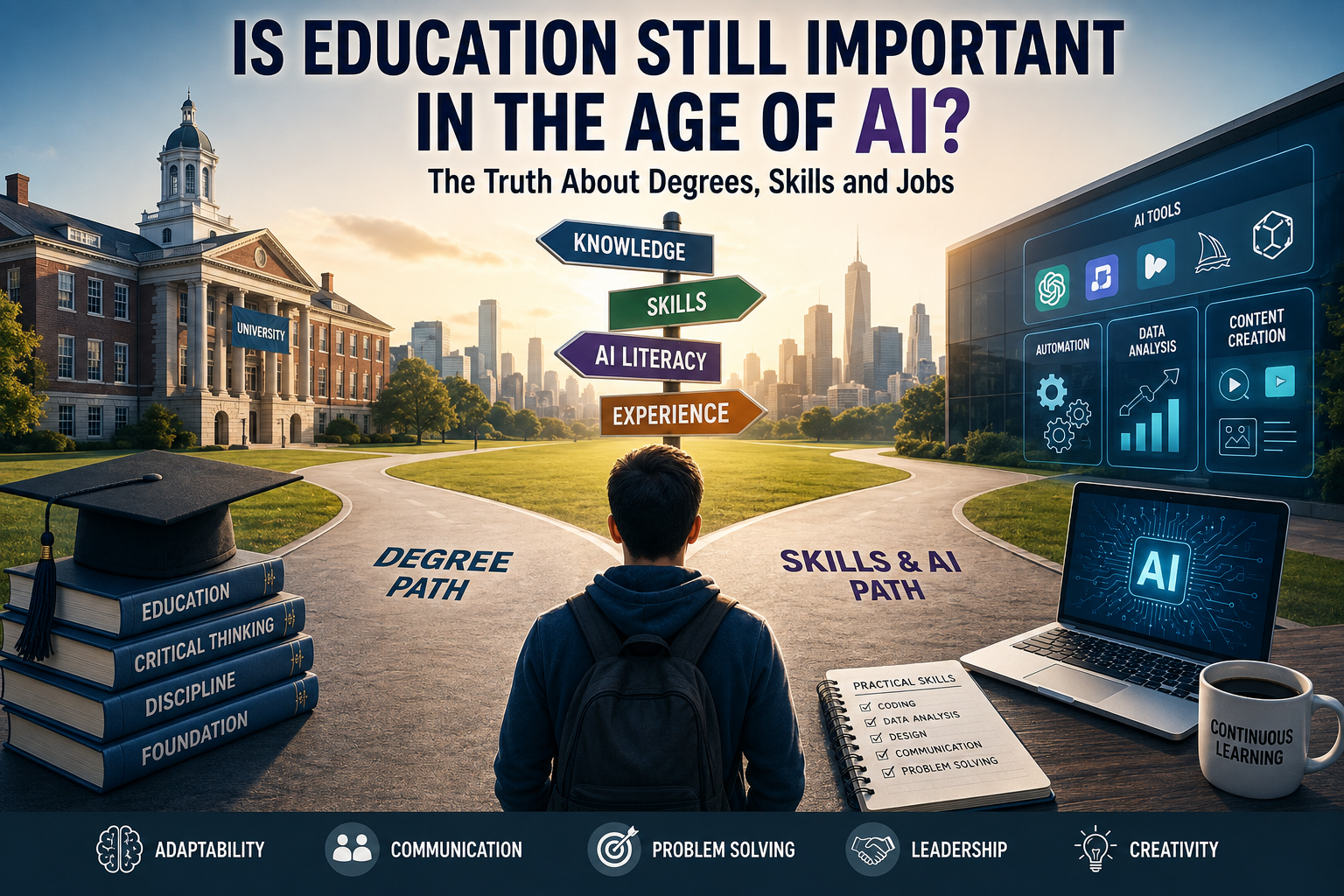
Education in the age of AI is becoming one of the most important questions facing students, workers, and employers as artificial intelligence changes the way people think about work, careers, and learning. Among some younger people, a powerful idea is taking hold: perhaps traditional academic education no longer matters. If AI can help people write, code, design, research, analyze information, create content, and even build businesses, why spend years earning a degree? Why not simply learn AI, develop practical skills, and start making money?
The question is understandable. AI skills are becoming more valuable, employers are reconsidering some traditional hiring requirements, and people can now learn skills online that once required access to expensive institutions. But there is a danger in turning a real change into an exaggerated conclusion.
The rise of AI does not necessarily mean education is becoming irrelevant. It may mean that what we learn, how we learn, and how we demonstrate what we know are changing. The more useful question, therefore, is not whether education or AI will win. It is this:
In an economy increasingly shaped by AI, what combination of education, practical skills, experience and technological ability gives people the strongest chance of succeeding?
Why Are Young People Questioning Traditional Education?
There are understandable reasons why younger people may question the traditional education-to-career pathway. Higher education can require several years of study. Depending on the country and institution, it can also be expensive. At the same time, the internet has dramatically expanded access to knowledge.
Someone who wants to learn programming, digital marketing, video production, entrepreneurship, or AI can find courses, tutorials, communities, and practical projects online. AI has accelerated this development.
A learner can ask an AI system to explain a difficult concept, generate practice questions, help debug code, compare business models, or provide feedback on an idea. Social media adds another influence. Young people regularly encounter stories of entrepreneurs, creators, freelancers, and technology workers who apparently achieved high incomes without following a conventional academic path. It can therefore seem reasonable to ask:
If skills can be learned independently, why does a degree matter?
The problem is that exceptional success stories tell us what is possible, not necessarily what is probable. Seeing a successful entrepreneur who left university proves that success without a degree can happen. It does not prove that leaving education makes success more likely. That distinction is crucial.
AI Skills Really Are Becoming More Valuable
The argument against relying entirely on traditional credentials does have evidence behind it. The World Economic Forum’s Future of Jobs Report 2025 identifies AI and big data as the fastest-growing skills, followed by networks and cybersecurity and technological literacy. At the same time, creative thinking, resilience, flexibility, curiosity, and lifelong learning are also expected to increase in importance. (World Economic Forum) The report also found that employers expect 39% of key skills required in the job market to change by 2030. (World Economic Forum)
That has an important implication: earning a qualification cannot be the end of learning. Workers may increasingly need to update their skills throughout their careers as technology changes. This trend also connects with a broader question Busipulse has examined before: how prompt engineering is evolving as AI tools become easier to use and the value shifts toward broader capabilities. The lesson is not simply “learn prompting.” It is to understand how technological skills themselves can change rapidly.
What Does “Learning AI” Actually Mean?
There is a deeper problem with the advice that young people should simply “learn AI” instead of pursuing education: AI is not one skill. Knowing how to use a generative AI chatbot is very different from understanding machine learning. Writing effective prompts is different from building AI software. Building an automation workflow is different from data science. And using AI effectively inside accounting, engineering, marketing, medicine, or another profession requires knowledge that extends well beyond the AI tool itself.
This distinction matters because basic AI applications are becoming easier to use. If almost anyone can generate text, images, presentations, summaries, or basic code using widely available tools, simply knowing how to operate those tools may become less valuable over time. The greater economic value may lie in knowing what to ask, what to build, what to trust, what to reject, and which real-world problem is worth solving. That requires knowledge of something beyond AI.
An entrepreneur needs to understand customers and markets. An accountant needs financial knowledge. A programmer needs to understand software systems. A marketer needs to understand consumers, positioning, and strategy. AI can strengthen those capabilities. It does not automatically create them.
A Degree and an Education Are Not the Same Thing
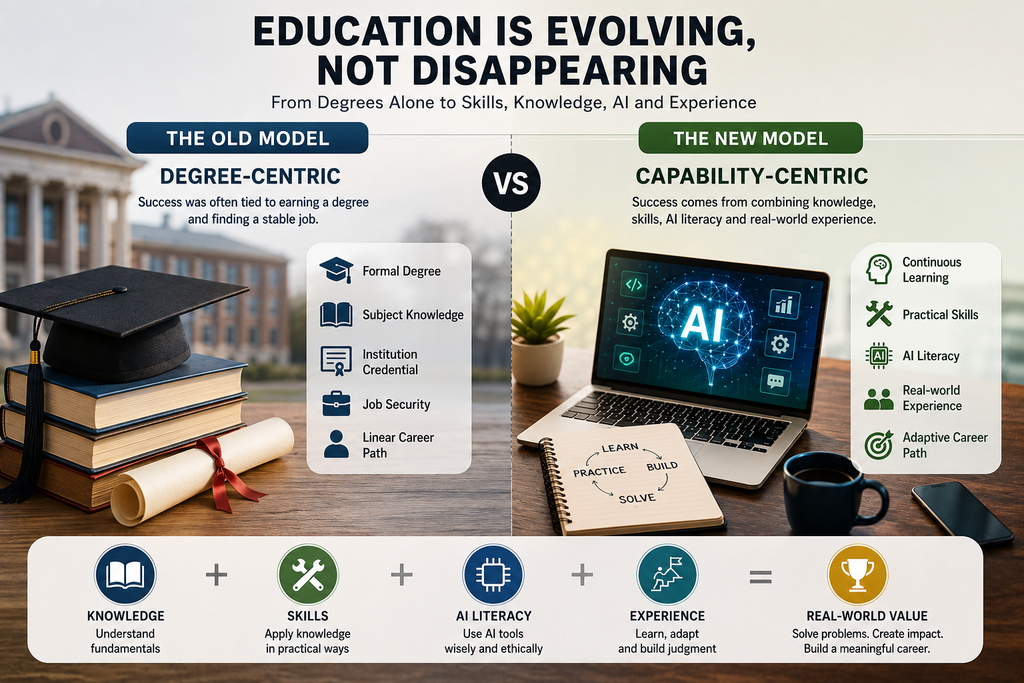
Much of the online debate becomes confused because people use the words education and degree as though they mean exactly the same thing. They do not. A university degree is one form of education.
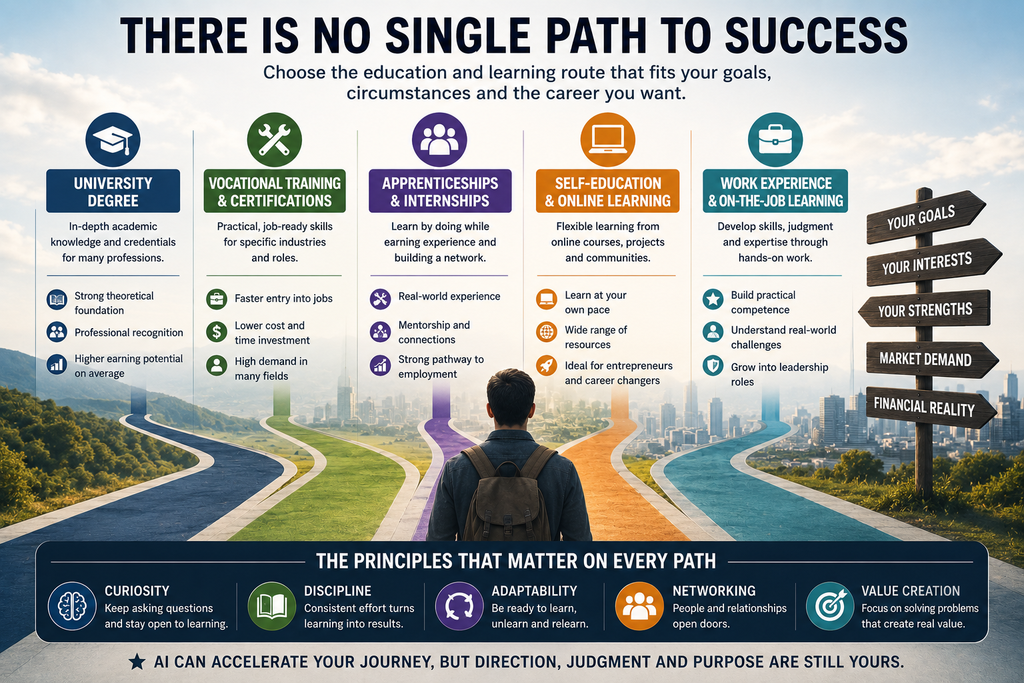
Education can also include vocational training, apprenticeships, professional certifications, technical colleges, employer training, online courses, independent study, mentorship, and years of practical experience.
A person without a university degree can be highly educated. Likewise, possessing a degree does not guarantee that someone will remain knowledgeable throughout a 40-year career. This distinction becomes even more important when considering education in the age of AI, because the real debate is not simply about whether someone holds a university degree.
Perhaps the future is not simply degree versus no degree. It may increasingly be about whether people can continually acquire useful knowledge and demonstrate that they know how to apply it.
Does Formal Education Still Have Financial Value?
Despite claims that degrees are becoming worthless, the available international evidence says formal education continues to have significant economic value on average.
The OECD’s Education at a Glance 2025 reports that across OECD countries, adults with bachelor’s degrees earn 39% more on average than those whose highest attainment is upper-secondary education. For master’s or doctoral qualifications, the average earnings advantage is considerably higher. (OECD) But averages need careful interpretation. They do not prove that every individual should attend university, nor that every degree offers a good financial return.
The OECD data themselves show substantial variation among countries. The financial advantage associated with tertiary education differs according to location and level of qualification. (OECD) Field of study, tuition costs, employment opportunities, and the amount of time spent outside the workforce also matter.
Someone who spends heavily on a qualification with weak labor-market demand may receive a poor return. Someone who completes lower-cost vocational training in a field facing severe worker shortages may do very well. The evidence therefore supports a more careful conclusion:
Education can have substantial economic value, but the value of a particular educational path should not be assumed automatically.
The Economics of Education Are Different Around the World
Any discussion of education in the age of AI also needs an international perspective, because the economics of education differ substantially around the world. The decision to attend university does not have the same economics everywhere. Tuition fees, government subsidies, student debt, scholarships, graduate wages, living expenses and employer expectations differ enormously among countries.
A young person studying in a country where higher education is heavily subsidized faces a different investment decision from someone who must borrow a large amount of money to obtain the same level of qualification.
The labor market also matters. In one economy, employers may routinely require degrees for professional positions. In another, vocational qualifications or practical experience may carry greater weight. This is why sweeping statements such as “college is always worth it” or “college is a waste of money” are difficult to defend internationally. The better question is: What is the likely return on this particular education, for this particular career, in this particular labor market? That is an economic question, not an ideological one.
Can You Learn AI and Earn a Lot of Money Without a Degree?
Yes, some people can. But remove one word from that sentence, “some,” and the claim becomes misleading. A person might build valuable AI skills without attending university and become a successful developer, consultant, marketer, entrepreneur, automation specialist, or content creator. AI has lowered barriers to performing certain kinds of work. But learning how to use AI does not automatically create customers, employment, or income. There is an economic principle underneath this:
A skill becomes commercially valuable when somebody is willing to pay for the problem that skill solves.
Knowing how to generate an attractive presentation with AI is useful. Knowing how to use AI to help a company reduce administrative costs, improve customer service, analyze data, reach customers, or increase sales may be commercially valuable. The difference is not simply access to AI. It is the value created with AI.
This is similar to the profitability question surrounding AI for small businesses: productivity and technological capability matter, but they do not automatically become financial results. The same principle applies to individuals. Knowing a tool is not the same as having a marketable profession.
Success Stories Can Distort the Debate
Social media makes this distinction particularly important. A video might feature a 19-year-old entrepreneur claiming to earn thousands of dollars each month through an AI-powered business. Another might describe someone who left university, learned to code, and built a successful company.
Such stories can be genuine and still create a misleading impression. Why? Because unsuccessful attempts are much less visible. Thousands of people might try similar strategies without achieving comparable results, but their stories are unlikely to attract millions of views. This is a form of survivorship bias: we notice the people who succeeded while overlooking those who followed similar paths but did not.
The fact that someone can build a high-income career without a degree demonstrates possibility. It does not establish the probability that another person following the same route will achieve the same result. Young people should therefore be particularly cautious about making expensive career or education decisions based on exceptional online success stories.
Knowing AI Is Not the Same as Knowing a Profession
Imagine two people using the same advanced AI system. One is an experienced accountant. The other knows very little about accounting. Both can ask AI to analyze a financial statement. Both may receive an impressive-looking answer. But who is more likely to recognize an incorrect classification, an unreasonable assumption, or a conclusion that does not make financial sense? Usually, the person with deeper domain knowledge.
The same principle applies to engineering, law, medicine, finance, architecture, cybersecurity, and many other fields. AI can make knowledge easier to access. It does not automatically give the user the judgment that comes from understanding a subject. In fact, increasingly powerful AI may make expertise more, not less, important in situations where mistakes carry serious consequences.
AI Can Produce Answers. Education Helps Us Judge Them.
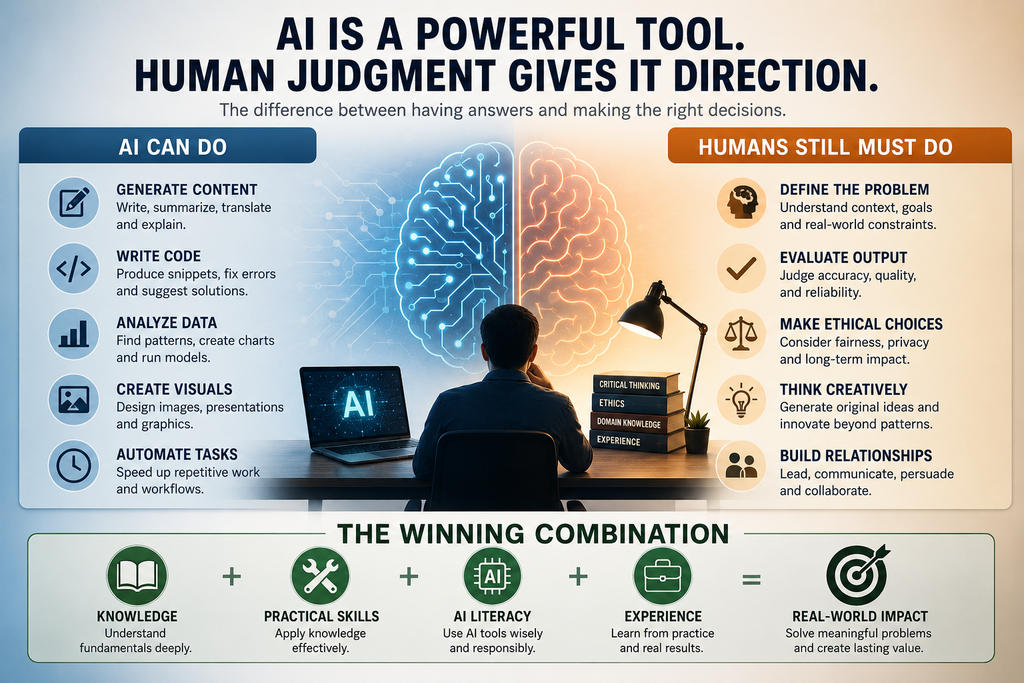
Generative AI has created an unusual problem. Historically, producing a sophisticated-looking answer often required significant knowledge. Today, AI can produce one in seconds. That changes what human skill means. The ability to produce information may become less valuable in some circumstances. The ability to evaluate information may become more valuable.
- Is the answer correct?
- What assumptions were made?
- What information is missing?
- Is the source reliable?
- Does the recommendation make economic sense?
- Could following it create legal, financial, or reputational risk?
These questions require reasoning and judgment. Education at its best does more than transfer facts from a teacher to a student. It develops the ability to understand concepts, evaluate evidence, recognize weak arguments, and solve unfamiliar problems. Those abilities remain relevant even when AI can provide information instantly.
What About Human Skills?
Another reason not to reduce the future of work to “learn AI” is that employers need more than technical ability. The World Economic Forum found that analytical thinking remains the most sought-after core skill among employers, while resilience, flexibility, leadership, and social influence also rank highly. AI and big data are rapidly increasing in importance, but so are several cognitive and human capabilities. (World Economic Forum) This makes sense.
Businesses do not operate through technology alone. People negotiate with customers. Managers make decisions under uncertainty. Entrepreneurs identify unmet needs. Teams resolve disagreements. Salespeople build trust. Leaders persuade people to act. AI can support many of those activities. It cannot automatically turn someone who lacks judgment, reliability, or communication skills into an effective professional simply because that person knows how to use an AI tool.
If Everyone Has AI, AI Alone Is Not a Competitive Advantage
This may become one of the most important career questions of the next decade. Imagine that almost every serious job candidate knows how to use AI. What happens then? Simply writing “AI skills” on a résumé will no longer differentiate someone. The competitive question becomes:
What can you do with AI that creates more value than someone else using the same technology?
An accountant who understands AI may outperform an accountant who ignores it. A marketer who understands customers, strategy, data, and AI may outperform someone who knows only how to generate marketing copy. A programmer who understands systems, security, and software architecture may use AI far more effectively than someone who simply asks it to produce code. AI therefore may be best understood as an amplifier.
- It can amplify expertise.
- It can amplify productivity.
- It can amplify creativity.
But it can also amplify poor assumptions, weak judgment, and mistakes. The advantage may increasingly come from combining: knowledge + practical skills + AI literacy + experience.
Some Careers Still Require Formal Qualifications
There is another practical limitation to the “forget education and learn AI” argument. Certain careers cannot simply abandon formal education because an AI tool exists. Doctors, lawyers, accountants, engineers, architects, teachers and other regulated or specialized professionals may face qualification, licensing or certification requirements depending on the country and profession.
Even where a university degree is not legally mandatory, employers may still prefer formal qualifications when jobs involve significant responsibility, technical complexity or risk. AI may change how these professionals work. It does not automatically eliminate the need to understand the profession. The more consequential the decision, the more important human knowledge and accountability may become.
When Might a Degree Be Less Important?
None of this means everyone needs a traditional four-year university degree. For some careers, another route may be more rational.
Entrepreneurship is an obvious example. Customers generally care more about whether a business solves their problem than whether its founder possesses a particular degree. Some areas of software development, digital marketing, creative work, sales, and technology may also place considerable weight on portfolios, experience, and demonstrated ability. Skilled trades provide another reminder that valuable education does not have to take place at a university.
The sensible question is therefore not: “Should everyone get a degree?” It is: “What form of education provides the best return for the career I actually want?” For one person, that may be university. For another, vocational training. For another, an apprenticeship. For another, professional certifications combined with work experience. And for an entrepreneur, it may be continuous self-education combined with experimentation and experience.
Education Is an Investment: So Examine the Return
The debate should not romanticize formal education either. A degree requires both money and time. Its value should therefore be evaluated partly like any other investment. Prospective students can ask:
- What does the qualification cost?
- How much income might be sacrificed while studying?
- What careers does it realistically open?
- What are employment prospects in that field?
- What do graduates typically earn?
- Could a lower-cost qualification provide access to similar opportunities?
- How important are credentials in the country where I intend to work?
These questions do not diminish education. They make the decision more rational. Saying “education is valuable” is not the same as saying “every degree is worth any price.” AI may make this calculation even more important as occupations and skill requirements change faster. Educational institutions themselves will have to adapt.
The Bigger Risk May Be Stopping Learning
The greatest mistake young people can make when thinking about education in the age of AI may not be choosing university or rejecting university. It may be believing that learning can stop. A graduate who earns a degree and refuses to learn new technology may become less competitive. A self-taught AI user who refuses to learn economics, communication, mathematics, business fundamentals, or a professional discipline may also reach a ceiling.
The World Economic Forum reports that employers expect substantial skills disruption through 2030, while curiosity and lifelong learning are among the capabilities increasing in importance. (World Economic Forum) That suggests a different model of career development: Education is no longer something you finish before starting work. Learning increasingly becomes part of work itself.
What Should Young People Learn in the Age of AI?
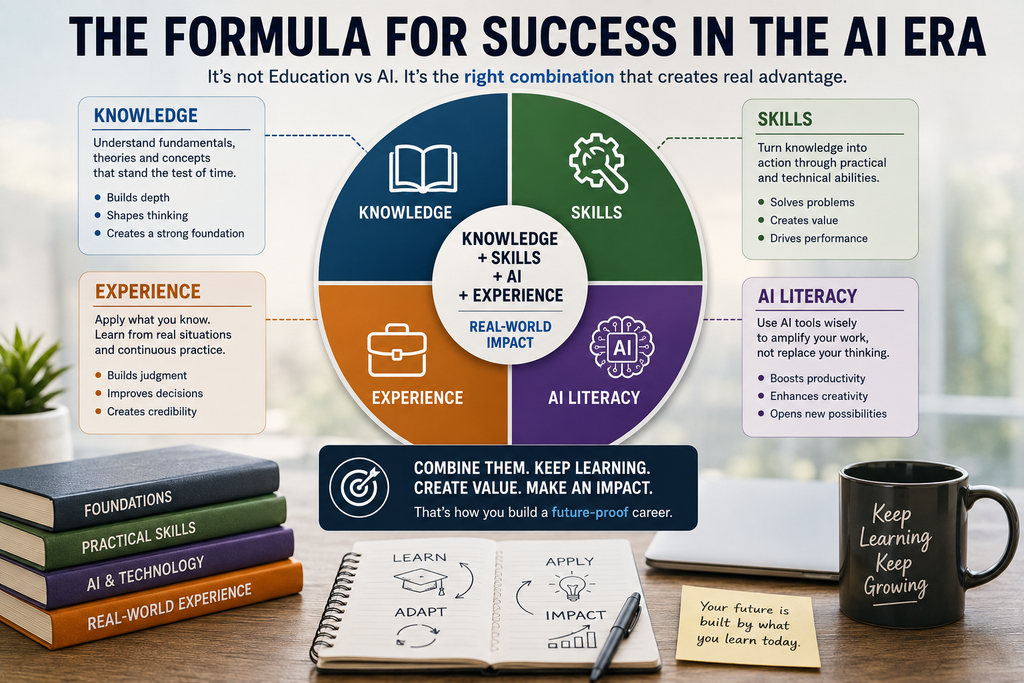
A sensible strategy is not to choose between education and AI as though one must replace the other. Instead, young people can build four complementary forms of capability.
- Knowledge provides an understanding of a subject and the principles behind it.
- Practical skills provide the ability to turn knowledge into useful work.
- AI literacy provides the ability to use new technology effectively, understand its limitations, and integrate it into real tasks.
- Experience develops judgment, the ability to recognize what works, what fails, and what matters in real situations.
Formal education can contribute to several of these. So can vocational training, apprenticeships, professional courses, independent learning, and employment. The exact combination will differ from person to person. But relying entirely on only one element is risky.
- A degree without continuously updated skills can lose value.
- AI skills without domain knowledge can be shallow.
- Knowledge without experience can remain theoretical.
- Experience without continued learning can become outdated.
The strongest position is often the combination: Knowledge + Skills + AI + Experience. That may be a more useful career formula for the AI era than either “get a degree” or “forget education.”
So, What Does Education in the Age of AI Really Mean?
Yes, but its role is changing. The evidence does not support the idea that academic education has suddenly become economically worthless. Across OECD countries, higher educational attainment continues to be associated with substantial average earnings advantages, although the size of those advantages varies considerably. (OECD) At the same time, possessing a degree does not guarantee career success.
Technology is changing what employers need. AI capabilities are becoming more valuable, and continuous upskilling is becoming increasingly important. The World Economic Forum expects technological and human capabilities to remain important together rather than one simply replacing the other. (World Economic Forum) The future therefore may not belong exclusively to people with the most qualifications. Nor will it necessarily belong to people who simply know the latest AI tools. It is more likely to reward people who can combine knowledge with technology and turn both into useful results.
Final Thoughts
AI is challenging an old assumption: that formal credentials alone determine professional value. That challenge can be healthy. But replacing one simplistic belief with another would be a mistake. “Get a degree, and you will automatically succeed” was never universally true. “Forget education, learn AI and you will become rich” is not universally true either.
AI can accelerate work, lower barriers to learning, and create opportunities for people following non-traditional career paths. But technology cannot guarantee income, replace every form of expertise, or remove the need for judgment. If everyone eventually has access to powerful AI, merely having AI will not be enough. What will matter is what people know, what they can do, how well they can judge information, what problems they can solve, and whether others value those solutions. Perhaps the most useful lesson for the next generation is therefore neither “get a degree” nor “skip college.” It is:
Build knowledge. Develop valuable skills. Learn to use AI. Gain real experience. And never assume that learning is finished.
The future may not belong to the degree holder or the AI user. It may belong to the person who can combine knowledge, practical skill, experience, and AI better than others can.
Author’s Note
This article is intended for general informational and educational purposes. The value of academic, vocational, and professional education varies by country, occupation, institution, cost, and individual circumstances. Labor-market conditions and AI technologies also change rapidly. Readers should evaluate education and career decisions according to their own objectives, financial circumstances, and reliable information relevant to their location and profession.
Readers are not required to agree with the author’s views. The purpose of this article is to encourage informed discussion, critical thinking, and independent analysis of the issues presented.

[…] Pakistan an unusually young demographic structure. That youth can become an economic asset when education and skills are connected to productive employment. Overseas work provides one outlet. Pakistan’s Bureau of […]