


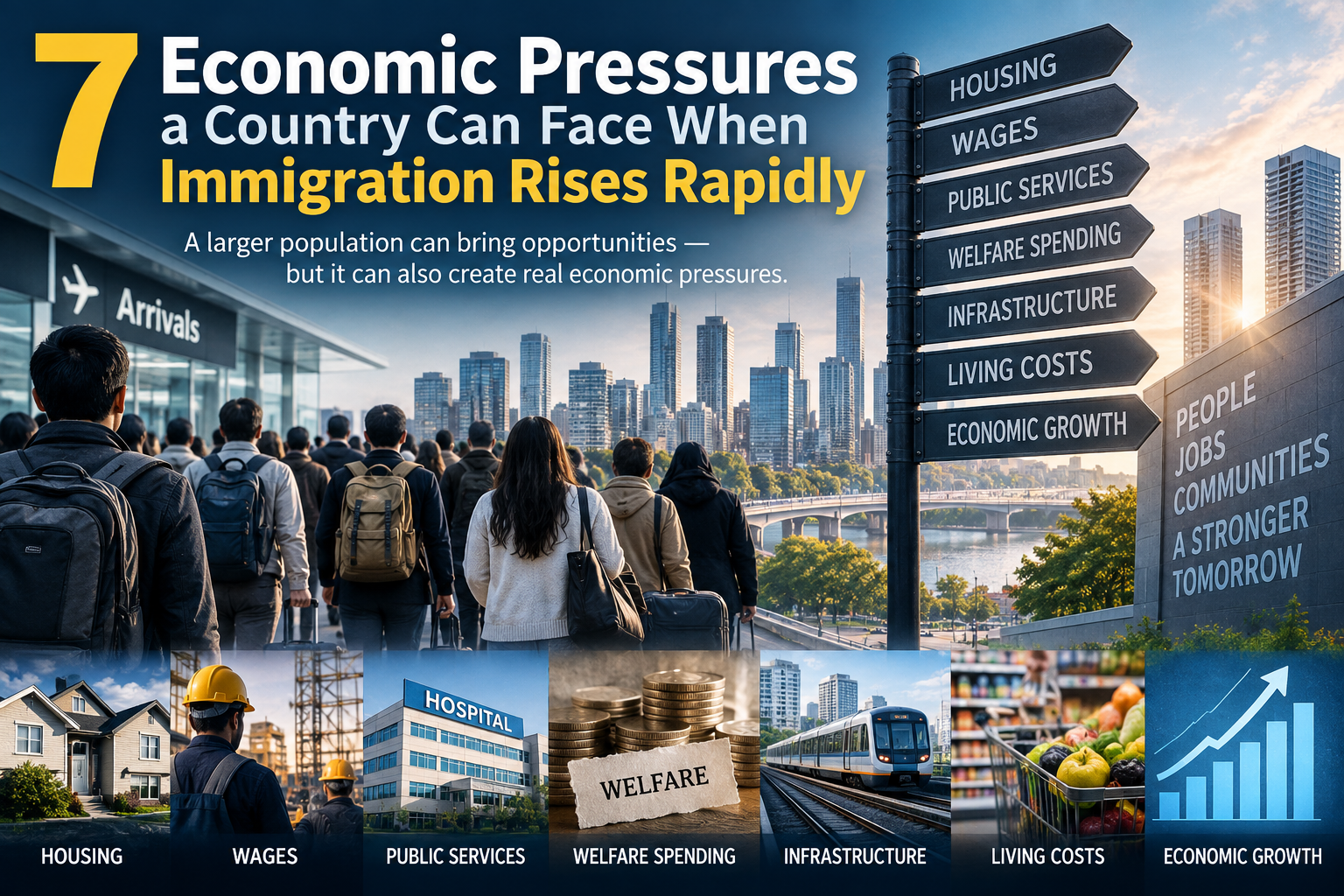
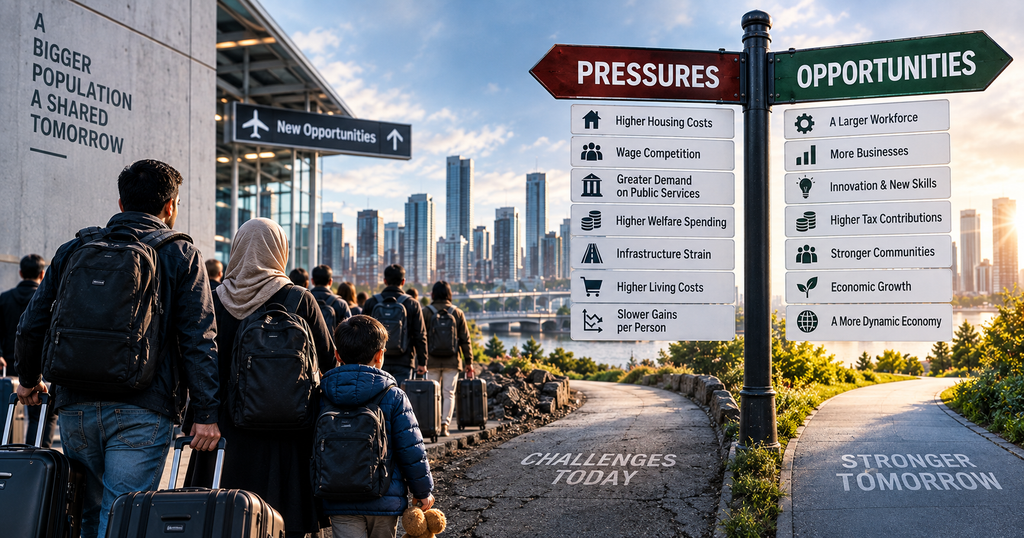
The economic impact of immigration can become especially visible when population growth rises faster than housing, infrastructure, public services, and parts of the labor market can adjust. When immigration increases within a relatively short period, governments and communities may face pressure on housing, wages, welfare spending, transportation, healthcare, education, and other essential services.
That does not mean immigration is inherently harmful to an economy. Migrants also work, pay taxes, establish businesses, spend money, fill labor shortages, and contribute to economic growth. Those contributions deserve detailed consideration and will be examined separately in the second part of this series. This article concentrates on the economic pressures that can arise when immigration expands faster than a receiving economy’s capacity to absorb new residents.
The outcome varies enormously between countries. The skills and age of migrants, employment opportunities, housing supply, welfare rules, infrastructure, and speed of integration can all change the economic impact. OECD analysis consistently emphasizes that migration outcomes depend heavily on these underlying conditions. The economic impact of immigration therefore depends not only on how many people arrive, but also on how effectively the receiving country can adjust.
1. Housing Demand Can Outpace Supply
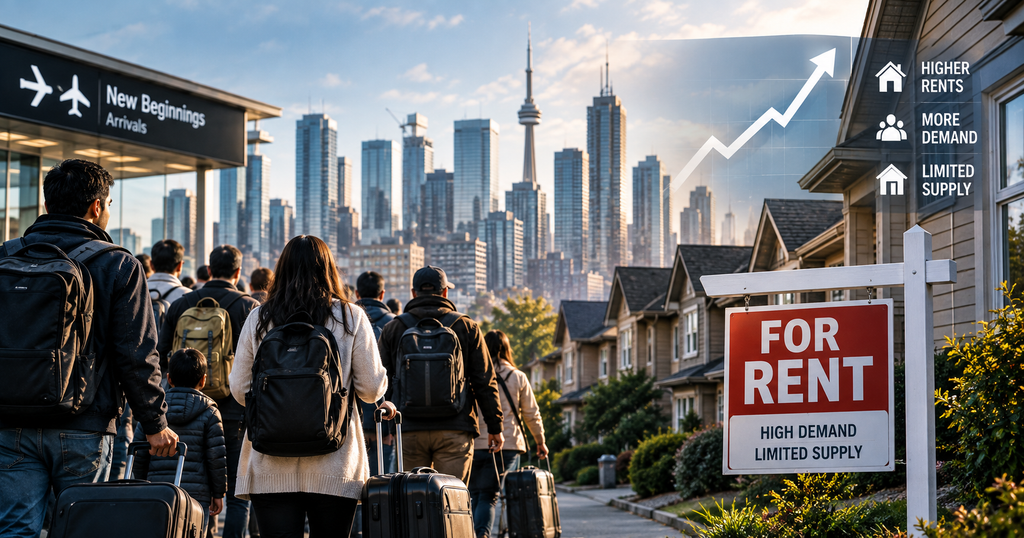
Every growing population needs additional housing. If construction keeps pace, increased demand can be absorbed relatively smoothly. Problems become more visible when immigration rises in cities where housing was already scarce.
Canada illustrates the distinction. The OECD’s 2025 economic survey concluded that inadequate housing supply and a mismatch between available homes and demand were fundamental affordability problems, while strong recent immigration amplified those existing pressures. Canadian rents rose 6.3% in 2023 and 7.9% in 2024, faster than earnings in both years.
The important lesson is that migration does not independently create every housing crisis. Restrictive planning, slow construction, financing costs, limited land, and years of underbuilding may already exist. Rapid population growth can make those weaknesses considerably harder to ignore. For buyers, these pressures can also increase the broader hidden costs of homeownership, particularly when taxes, insurance, and maintenance are already rising.
2. Wage Competition Can Affect Some Workers More Than Others
Immigration increases the supply of workers, but its effect on wages is not uniform. New arrivals also become consumers, generate demand, and may complement rather than replace existing workers. For that reason, national averages can hide what happens within particular occupations. Workers whose skills closely overlap with a large number of newcomers may experience greater competition for jobs or slower wage growth, especially in lower-paid sectors where labor can be substituted relatively easily.
At the same time, immigrants themselves can face substantial wage disadvantages. The OECD’s 2025 analysis across 15 countries found that immigrants entering the host-country labor market earned about 34% less than native-born workers of the same age and sex. Around two-thirds of that gap reflected their concentration in lower-paying sectors and firms. The gap narrowed substantially as migrants spent more time in the country.
The economic question is therefore more complex than whether “immigration lowers wages.” The effects depend on skills, occupations, local labor demand, worker protections, and how effectively migrants move into productive employment.
3. Public Services Can Face Sudden Demand
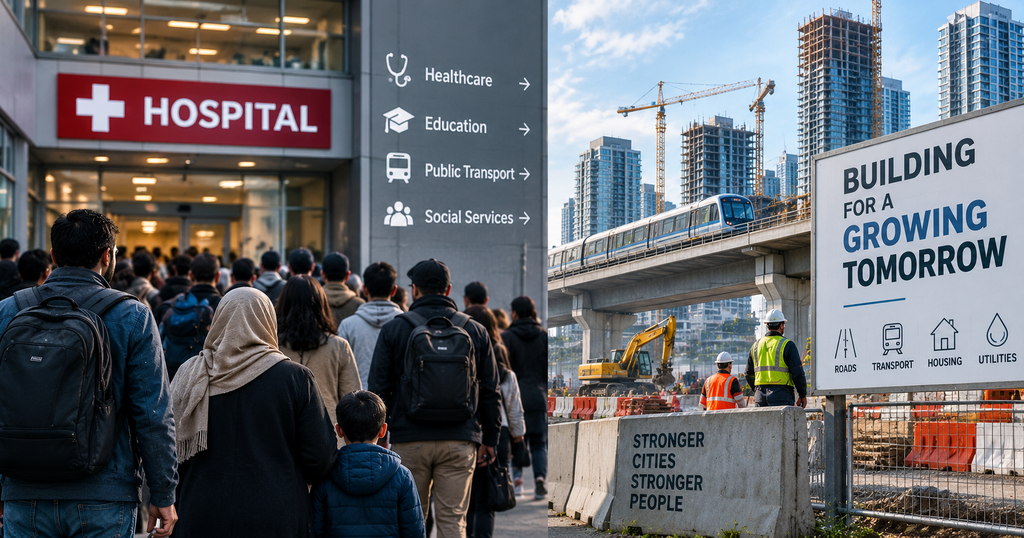
Population can increase much faster than governments can build hospitals, schools, transport systems, or public housing. A city receiving large numbers of residents may need more teachers, doctors, classrooms, hospital capacity, buses, trains, sanitation services, and administrative staff. Expanding those systems usually takes years because governments must secure funding, land, construction capacity, and skilled workers.
The OECD has specifically identified housing availability, health, and education among the essential services that can experience pressure from migration flows. This is primarily a capacity problem. A region with unused infrastructure may accommodate population growth relatively easily. Another already operating schools and hospitals near capacity can experience deterioration in service quality unless investment catches up.
4. Welfare Spending and Public Finances Can Be Affected
Welfare is among the most politically debated economic aspects of immigration, but treating all migrants as one fiscal category produces misleading conclusions. A working-age migrant who quickly enters employment may pay income, consumption, payroll, or other taxes while making limited use of benefits. A refugee requiring accommodation, language training, healthcare, or employment assistance may initially require considerably more public expenditure.
Governments can also face costs for schooling, integration programs, administrative processing, temporary accommodation, and social assistance. The size of these expenses depends on national welfare rules, eligibility requirements, migrant demographics, employment rates, and earnings.
OECD evidence shows why gross welfare spending should not be confused with the overall fiscal effect of immigration. Fiscal outcomes depend strongly on migrants’ employment and income because higher participation increases tax contributions and reduces reliance on benefits. The central fiscal question is therefore whether newcomers can become economically productive quickly enough for their contributions over time to balance the additional public services they require. Public finances are therefore a major part of the economic impact of immigration, but the result can differ sharply depending on employment, income, and benefit eligibility.
5. Infrastructure Investment May Lag Behind Population Growth
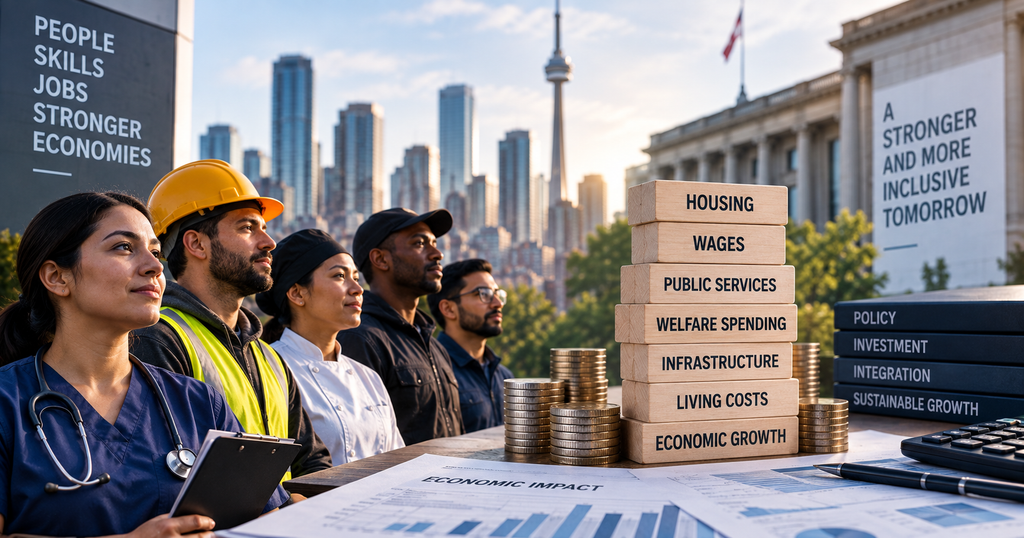
Beyond schools and hospitals lies a wider network of physical infrastructure: roads, water systems, electricity, public transport, waste management, housing developments, and telecommunications.
When population expands rapidly, maintaining the same infrastructure per resident requires additional investment. Governments may have to borrow, raise revenue, redirect spending from other priorities, or temporarily accept congestion and declining service standards.
This explains why immigration policy and urban planning cannot be viewed entirely separately. A country may have the economic capacity to accommodate more people but still experience severe local problems if migrants concentrate in a few cities where infrastructure expansion is slow. Better forecasting, regional planning, and faster investment can therefore influence whether population growth becomes an economic opportunity or a short-term strain.
6. Some Local Prices Can Rise Even When Overall Inflation Does Not
More residents create additional demand, but immigration does not automatically produce broad inflation. An IMF study of U.S. metropolitan areas published in 2025 found that higher immigration was associated with slightly lower overall local inflation because increased labor supply helped reduce some production costs. Yet the same research found upward pressure on housing and utility inflation, where supply adjusts more slowly.
This is an important distinction. A country can experience little change in overall inflation while particular expenses, especially rent and housing, become more expensive in high-migration areas. Economic capacity again determines much of the outcome. Industries able to expand production quickly respond differently from housing markets where constructing additional supply can take years.
7. Total GDP Can Rise Without the Average Person Feeling Richer
Immigration can increase the overall size of an economy simply because there are more workers producing goods and services and more consumers spending money. That makes total GDP an incomplete measure of how residents are doing.
Suppose economic output grows by 3% while the population grows by 4%. The economy is larger, but output per person has declined. That does not automatically mean living standards have fallen because GDP per capita has its own limitations, but the distinction matters.
Rapid migration should therefore be evaluated using several indicators: total economic growth, GDP per person, wages, housing affordability, productivity, employment, taxation, and public-service capacity. Focusing on a single headline number can obscure who receives the benefits and who bears the adjustment costs. This helps explain why stronger headline growth does not always ease household financial pressure for ordinary residents.
The Real Question Is Whether an Economy Can Adjust
The economic pressure created by rapid immigration is determined less by immigration alone than by the relationship between population growth and a country’s ability to respond.
An economy with labor shortages, abundant housing, functioning infrastructure, and effective integration policies may absorb newcomers with relatively limited disruption. A country already facing housing shortages, weak infrastructure, low wage growth, or strained public finances may experience much greater pressure. That distinction also explains why the same level of immigration can produce different outcomes in different places.
This article has examined the costs and adjustment pressures. That is only half of the economic picture. The second part of this series will examine how immigrants can contribute through employment, taxation, entrepreneurship, consumer demand, innovation, skill supply, and long-term economic growth.
Final Thoughts
Rapid immigration does not produce a single economic outcome. Its effects depend on the scale and pace of migration, the characteristics of newcomers, labor-market conditions, housing supply, public finances, and the ability of institutions to respond.
The greatest pressures tend to emerge when population growth moves faster than housing construction, infrastructure investment, job creation, and public-service capacity. In those circumstances, the effects can become visible through higher housing costs, greater competition in some labor markets, additional government expenditure, and increased demand for essential services.
At the same time, these pressures should not be interpreted as the complete economic effect of immigration. Migrants are also workers, taxpayers, consumers, entrepreneurs, and investors who can expand productive capacity and contribute to long-term growth.
For that reason, a serious assessment should distinguish between short-term adjustment costs and longer-term economic effects rather than treating immigration as automatically beneficial or harmful. The second article in this series will examine that other side of the equation: how migrants contribute to the economies of the countries in which they settle. A balanced assessment of the economic impact of immigration should therefore consider both short-term adjustment pressures and longer-term economic contributions.
Author’s Note
This article approaches the subject from an accounting, finance, and economics perspective and is intended to examine economic mechanisms rather than advocate a political position on immigration. The reader is not required to agree with the author’s analysis or conclusions and is encouraged to consider alternative evidence and perspectives. Immigration systems, welfare eligibility, labor laws, taxation, housing conditions, and public-service structures vary significantly between countries, so examples should be interpreted according to the laws, regulations, economic conditions, and circumstances of the relevant jurisdiction. This article is provided for general educational and informational purposes and should not be regarded as legal, financial, political, or immigration advice.

[…] is the companion to our earlier article examining the pressures rapid immigration can place on housing, wages, infrastructure, welfare spending, and public services. Both sets of effects can […]
[…] infrastructure and successful integration, while rapid population increases can create short-term pressure on housing and public services. As discussed in our previous Busipulse analysis of the economic contribution of immigrants, […]