


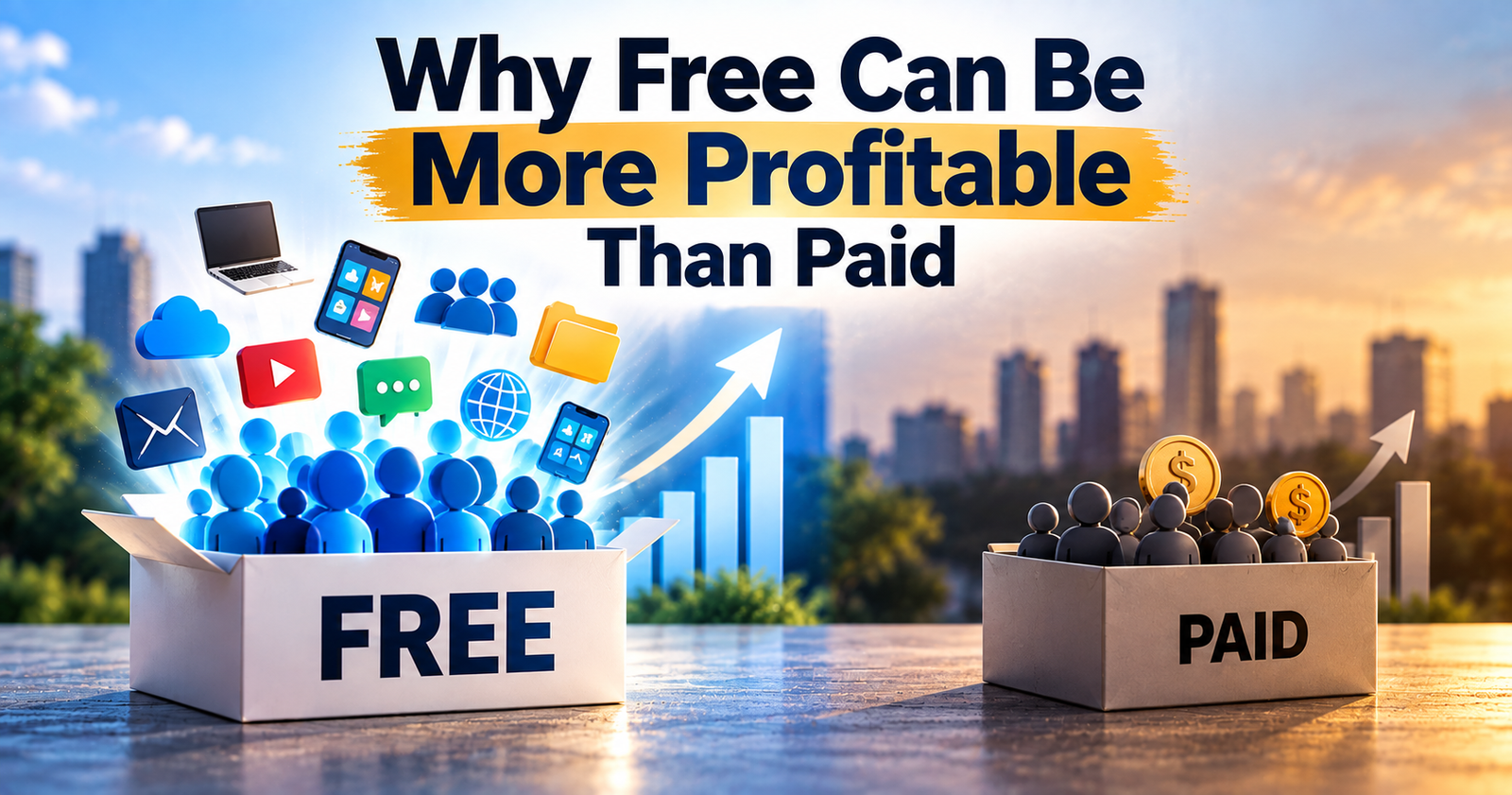
Giving something away appears to contradict a basic rule of business. Free can be more profitable than paid when removing the initial price helps a business attract more users, reduce acquisition friction, and create revenue elsewhere in the customer journey. Businesses still spend money developing products, employing people, operating infrastructure, and attracting customers, which makes charging nothing seem like an unusual route to profit. Yet free software plans, streaming services, trials, samples, and advertising-supported products are common across industries. The reason is that the person using a product does not always have to be the person funding it, and payment does not necessarily have to occur at the beginning of the relationship.
The more useful question is therefore not, “Why would a business give this away?” It is, “What economically valuable behaviour does giving it away create?” Removing the initial price can increase adoption, reduce customer-acquisition costs, generate referrals, attract advertisers or create demand for a higher-value product later. In the right model, charging nothing at the entrance can increase what the business earns further along the customer journey.
That does not make zero-price access a shortcut to success. A large audience that consumes resources without producing enough revenue can become expensive very quickly. The strategy works only when the value created by wider adoption exceeds the cost of supporting it.
Removing the First Barrier Can Accelerate Adoption
Price creates more than a financial cost; it creates a decision. Before paying even a modest amount, a potential customer must judge whether a product is useful, whether alternatives are better, and whether the purchase could be regretted. Removing the initial payment reduces that friction and allows the product to prove its usefulness before asking for money.
This can be particularly powerful for digital products because the cost of serving one additional user may be relatively low once the platform has already been built. Another account still creates expenses through storage, computing, security, and support, but the incremental cost can be far lower than manufacturing and distributing another physical product. That allows some software businesses to open the door much more widely than would be practical in many traditional industries.
Dropbox illustrates this approach. Anyone can create a free account and upgrade to paid subscription plans as their needs grow. Its free accounts allow people to store and share files, while paid plans offer additional features and functionality. The company also identifies word-of-mouth referrals, in-product referrals, and content sharing as important ways new users discover the service. In this model, the entry-level product does more than serve customers; it also contributes to distribution.
A Non-Paying User Can Still Create Economic Value
Traditional retail makes the connection between customer and revenue easy to see: someone receives a product and pays the seller. Digital businesses can separate those events. A person may use a product without subscribing while still inviting colleagues, increasing network activity, creating content, viewing advertisements, or making the service more useful to paying customers.
Consider a collaboration tool adopted by one employee. That person invites five colleagues, the team begins relying on the platform, and another department joins. Eventually the organization needs administration controls, greater storage, security features, or centralized billing. The first account may never have generated direct revenue, yet it helped create a customer that eventually does.

The important qualification is that this value must be measurable. Businesses cannot simply declare every free user valuable because some may convert in the future. Referrals should reduce acquisition costs, network activity should strengthen retention or monetization, and usage should create a realistic path toward revenue. Without that connection, a large user base may represent popularity rather than a healthy business.
Sometimes Someone Else Pays
Freemium is only one way to make a zero-price service work. In advertising-supported businesses, the user receives access while advertisers pay to reach that audience. Marketplaces may charge one side more heavily because keeping participation inexpensive for the other side makes the entire platform more useful.

Spotify combines advertising-supported and Premium services, allowing different parts of its audience to contribute to revenue in different ways. Its Ad-Supported service generates revenue primarily through advertising while also serving as an important channel for acquiring Premium subscribers. The free listener therefore does not have only one possible economic role: that person can contribute to advertising revenue today and may later become a paying subscriber.
The same principle appears in newsletters, media websites, mobile apps and online marketplaces. A reader may pay nothing while a sponsor finances the content; a small seller may enter a marketplace cheaply while the platform earns through commissions or other services. The central question is not how much each individual user pays, but where revenue enters the wider system.
The Upgrade Must Solve a Real Problem
A sustainable freemium model requires a careful boundary between what is available without payment and what becomes valuable enough to buy. If the entry-level product is too limited, people may never experience enough benefit to stay. If it is too generous, many customers may have little reason to upgrade.
The strongest upgrade triggers usually appear when the customer’s needs become more demanding. A casual user may be satisfied with limited storage, while a professional needs greater capacity and backup. An individual may tolerate advertising, while a frequent user values an uninterrupted experience. A small team may manage without advanced controls, while a larger organization requires permissions, security, and reporting.
This is stronger than deliberately making the basic product frustrating. The entry level should demonstrate genuine usefulness; the paid version should solve problems that become increasingly important as usage or complexity grows. Payment then becomes a logical extension of the customer’s needs rather than simply the price of escaping an intentionally weak experience. As those needs grow, some free users may upgrade to paid plans, creating a source of recurring revenue for the business.
Unit Economics Decide Whether the Strategy Works
The biggest danger is confusing user growth with business success. Every account can consume bandwidth, storage, computing power, support, moderation, or fraud-prevention resources. One million users may look impressive while quietly becoming an expensive liability.
Suppose one million non-paying users cost an average of $1 each per year to support. The business spends $1 million before salaries, marketing, and other overheads. If 2% convert to a $50 annual plan, 20,000 paying customers generate $1 million in revenue. The audience is large, but the economics are weak.
Now change the assumptions. If each non-paying account costs only $0.20 annually and 5% eventually pay $100 a year, supporting the free audience costs $200,000 while 50,000 paying customers generate $5 million in revenue before other expenses. The word “free” has not changed; conversion, revenue per customer, and cost to serve have. This is where free can be more profitable than paid: the value created by conversion and retention exceeds the cost of supporting the wider audience.
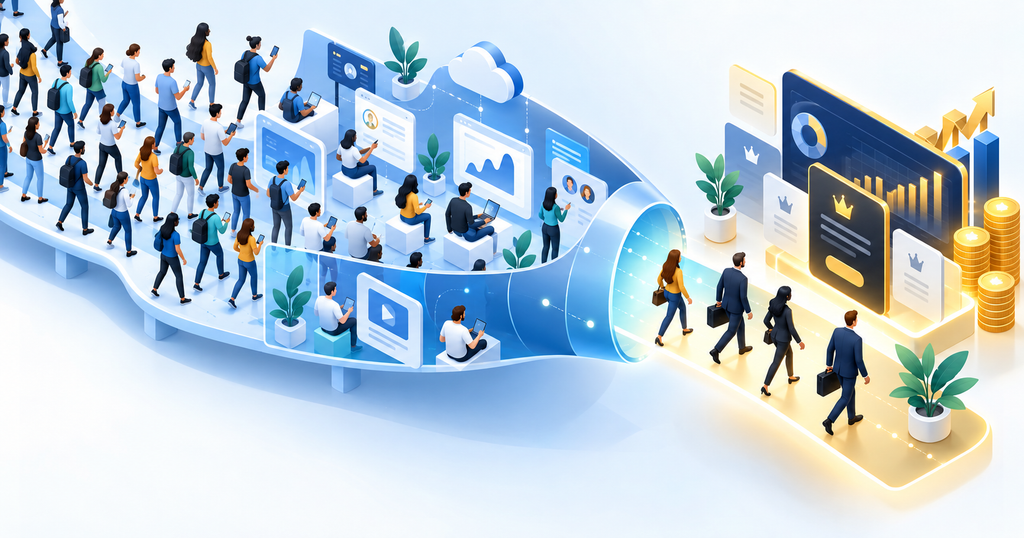
That is why registration numbers alone reveal little. The useful measures are the cost of acquiring and supporting users, the percentage who become valuable customers, how long paying customers remain, and how much revenue or indirect value the wider audience produces.
Trials and Freemium Solve Different Problems
A free trial and a freemium product may look similar because neither requires full payment immediately, but their economics are different. A trial gives temporary access to a paid product and creates a decision when the trial ends. Freemium generally allows indefinite use of a limited version while charging when the customer requires greater capability.
Trials can work well when users need to experience the complete product before understanding its value. Freemium can be stronger when sharing, collaboration, and gradual increases in usage help distribute the product. Products with substantial onboarding or support costs, however, may need customers to pay much earlier. The right model depends on how quickly customers discover value and how expensive they are to serve.
The BusiPulse Test: What Is the Giveaway Supposed to Achieve?
Before reducing a price to zero, a business should be able to explain the economic purpose. Is the offer designed to create paid conversions, referrals, advertising revenue, network growth, or demand for another service? If the only objective is “more users,” the strategy is incomplete.
The business should then calculate what those users cost and what economically valuable behaviour they produce. Infrastructure, service and acquisition expenses should be compared with conversion, retention, customer lifetime value and any indirect revenue created by the wider audience. Management should also understand what happens if conversion remains lower than expected.
Finally, there must be a clear reason for customers to pay eventually. If users cannot easily understand what the paid product adds, the business may have designed an excellent giveaway but a weak commercial proposition. A successful model connects entry, usage, and monetization rather than treating them as separate achievements.
When Free Can Be More Profitable Than Paid
Charging every customer from the beginning can generate revenue sooner, but it can also reduce the number of people willing to try the product. In businesses where the incremental cost of serving additional users is low, adoption creates referrals and some customers have high lifetime value; removing the initial price can expand the audience enough to outweigh the revenue forgone from people who never pay. But as BusiPulse has previously examined, lower prices win customers only when the underlying economics remain sustainable.
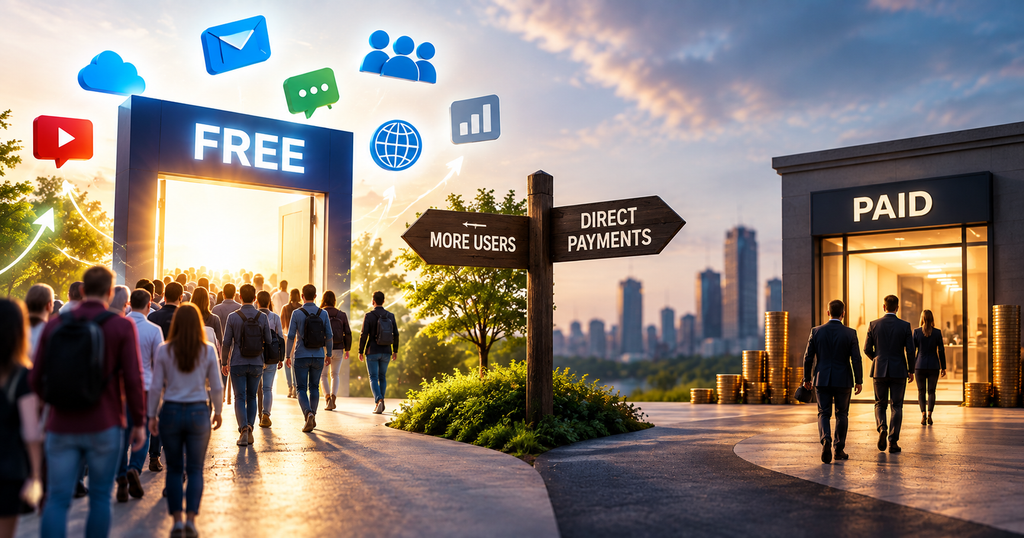
The important word is can. Zero-price access becomes more profitable only when additional adoption creates enough future economic value to exceed its cost. That value might come through subscriptions, advertising, referrals, network effects, or related services, but somewhere in the system revenue must eventually exceed the resources being consumed.
This principle also extends beyond technology companies. A consultant can publish useful analysis without charge and earn from higher-value advisory work. A media company can offer open content while earning through advertising, sponsorships, or specialist products. The lesson is not to give everything away; it is to decide which part of the value chain should carry the price.
Final Thoughts
Free can be more profitable than paid when removing the initial price generates enough value through wider adoption, referrals, advertising revenue, or paid conversions to outweigh the cost of serving non-paying users. The economics become clearer when the entire customer journey is considered. Removing the first payment can reduce friction, increase distribution, attract advertisers, create network activity, or allow customers to experience enough value to justify purchasing something more valuable later.
The model succeeds only when those benefits exceed the cost of supporting the audience. A company that cannot explain who eventually pays, why they pay, and what it costs to reach them does not have a sophisticated strategy simply because it has millions of users. It may only have an expensive giveaway.
That is why the most revealing question is not whether a product is free. It is where the money enters the system. Once that is understood, an apparently strange business decision becomes easier to explain: sometimes the most profitable place to remove the price is at the beginning.
Author’s Note
This article is intended for general educational purposes and does not constitute financial, investment, business, marketing, pricing, or legal advice. Freemium models, trials, advertising-supported services and other pricing strategies can produce very different outcomes depending on operating costs, customer behaviour, competition, regulation, conversion, retention and execution. Company examples are used to illustrate economic principles and should not be interpreted as endorsements of any business, product or investment.
The author writes about economics, finance, business and everyday financial decisions, drawing on an academic background in Accounts, Finance and Economics. BusiPulse aims to make practical economic ideas easier to understand through transparent examples, evidence and accessible analysis. Readers are not required to agree with the author’s conclusions and are encouraged to consider alternative evidence, market conditions and their own circumstances when evaluating business strategies.

[…] pricing models can change those economics further, as discussed in BusiPulse’s analysis of how free products can sometimes become more profitable than paid ones. What once appealed only to small customers can eventually become adequate for mainstream buyers. […]