


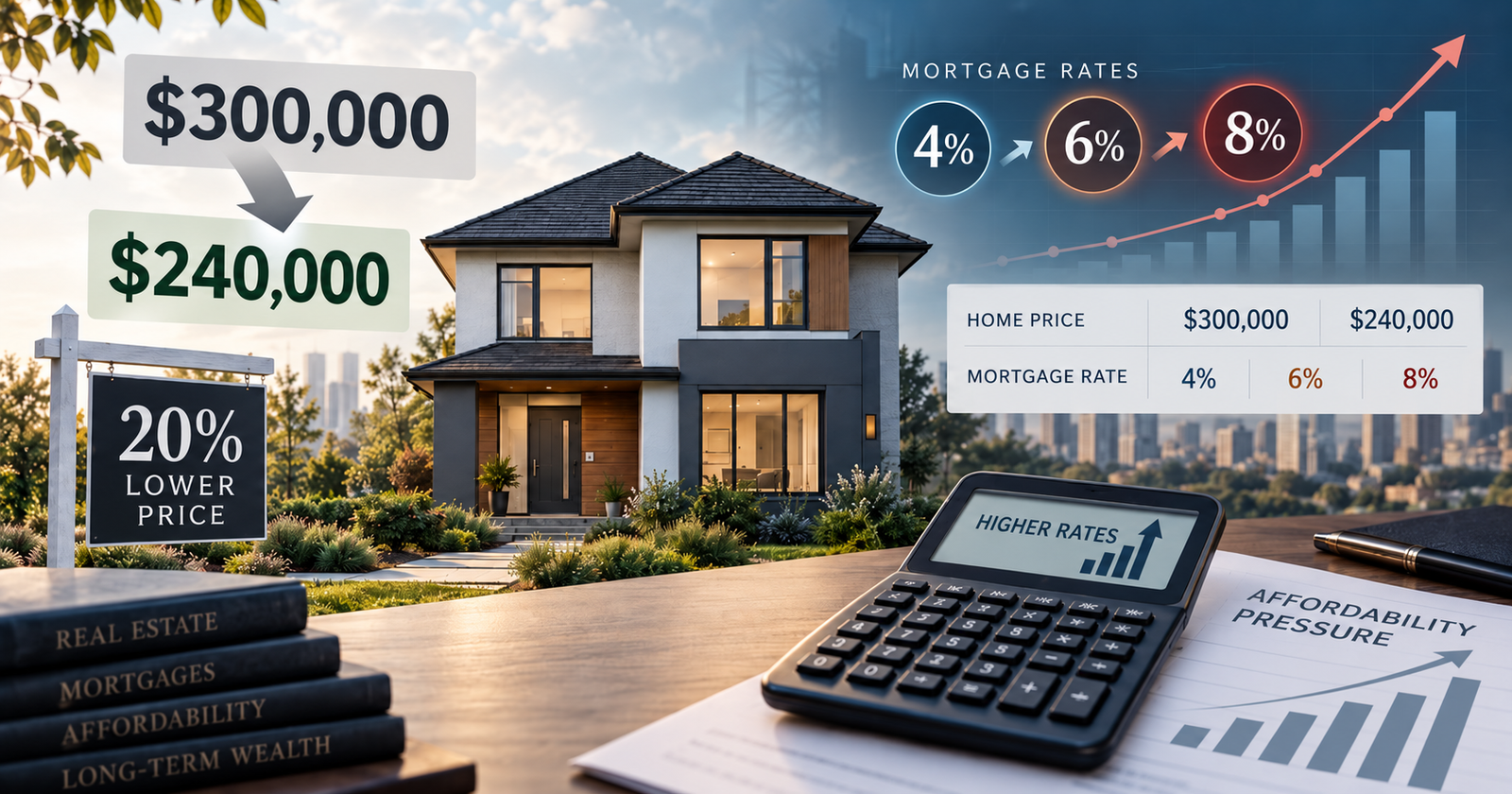
When property prices fall, the immediate assumption is that homes have become more affordable. A house that once cost $300,000 and now sells for $240,000 is, after all, 20% cheaper. For a cash buyer, that difference is straightforward. For someone relying on a mortgage, however, the answer can be very different.
Housing affordability depends on more than the purchase price of a property. The interest rate attached to the mortgage can significantly change the monthly payment and the total amount ultimately paid to the lender. This means a buyer can purchase a property for substantially less than someone did a few years earlier and still face a higher monthly housing cost.
To see how large that effect can be, BusiPulse ran a simple mortgage comparison. The result illustrates an important lesson for homebuyers and property investors: a lower purchase price does not automatically mean better housing affordability.
The BusiPulse Housing Affordability Test
For this comparison, we used a hypothetical home originally priced at $300,000 and assumed that its market value later fell by 20%, bringing the purchase price down to $240,000. In every scenario, the buyer makes a 20% down payment and finances the remainder using a 30-year fixed-rate mortgage. We then compare three interest-rate environments: 4%, 6%, and 8%.
The calculations include mortgage principal and interest only. They deliberately exclude property taxes, homeowners insurance, maintenance, closing costs, and association fees because those costs vary considerably by location. The US Consumer Financial Protection Bureau also warns that principal and interest are only part of the true monthly cost of homeownership; taxes, insurance, and other expenses should be added when assessing affordability. (Consumer Financial Protection Bureau) Here is what happens.
| Scenario | Home Price | Down Payment | Mortgage | Interest Rate | Monthly Principal & Interest | Total Interest Over 30 Years |
| Original price | $300,000 | $60,000 | $240,000 | 4% | $1,146 | $172,487 |
| Price falls 20% | $240,000 | $48,000 | $192,000 | 6% | $1,151 | $222,409 |
| Price falls 20% | $240,000 | $48,000 | $192,000 | 8% | $1,409 | $315,178 |

Higher Mortgage Rates Can Offset the Savings From a 20% Price Drop
In the first scenario, the buyer pays $300,000 for the property, puts down $60,000, and finances $240,000 at 4%. The monthly principal-and-interest payment is approximately $1,146. Now suppose the property market falls by 20%. The same type of home is available for only $240,000. The new buyer needs a smaller $48,000 deposit and borrows just $192,000. That sounds significantly more affordable. But at a 6% mortgage rate, the monthly payment rises to approximately $1,151.
In other words, despite the home price falling by $60,000, the buyer’s mortgage payment is almost exactly the same. Our calculation shows that a mortgage rate of roughly 5.96% on the cheaper $240,000 property produces approximately the same monthly principal-and-interest payment as the original $300,000 property financed at 4%. That is the first important result: a 20% fall in the purchase price can be largely cancelled out by a mortgage-rate increase of roughly two percentage points.
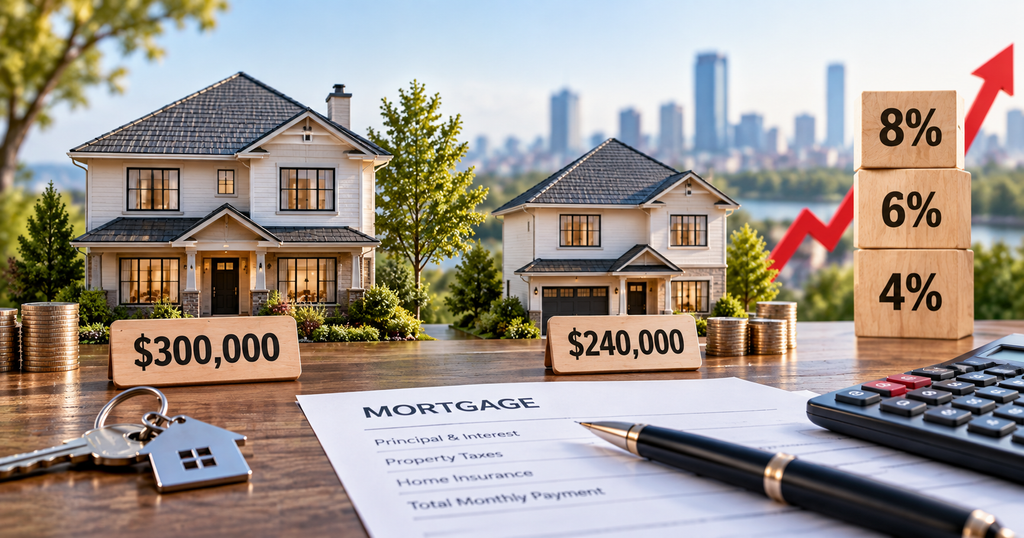
At 8%, the Cheaper House Actually Costs More Each Month
The difference becomes much more striking in the third scenario. The buyer still purchases the discounted property for $240,000 and still borrows only $192,000. But with an 8% mortgage, the monthly principal-and-interest payment rises to approximately $1,409. That is about 23% higher than the $1,146 monthly payment on the original $300,000 house financed at 4%. The buyer has therefore obtained a house at a 20% lower price but faces a substantially higher mortgage payment.
This does not mean the cheaper house is always the worse deal. The buyer needs $12,000 less for the down payment, owns the property at a lower purchase price, and could potentially refinance later if interest rates decline. However, none of those possibilities changes the immediate affordability problem: the monthly financing burden is higher.
The Lifetime Interest Difference Is Even Larger
Interest rates do not affect only the monthly payment. They also change how much a borrower can pay over the life of a mortgage. On the $240,000 loan at 4%, total interest over 30 years is approximately $172,487. The cheaper property’s $192,000 mortgage at 6% generates approximately $222,409 of interest. At 8%, total interest rises to approximately $315,178.
That means the buyer financing the 20%-cheaper house at 8% could pay about 83% more interest over 30 years than the person who financed the more expensive property at 4%, assuming both mortgages remain in place for their full terms.
This comparison uses nominal dollars paid over three decades and does not adjust those future payments for inflation or the time value of money. Many homeowners will also refinance, sell, or repay their mortgage before 30 years. Nevertheless, it demonstrates how strongly financing costs can influence the economics of a property purchase.
Why Looking Only at the Asking Price Can Mislead Buyers
Property discussions frequently focus on whether prices have risen or fallen. For an individual buyer, however, housing affordability depends on the interaction between price, down payment, interest rate, income, and other ownership costs.
The Consumer Financial Protection Bureau advises buyers to consider their total monthly housing payment rather than simply the mortgage principal and interest. Property taxes, insurance, mortgage insurance, and other recurring expenses can substantially change what a household can actually afford. (Consumer Financial Protection Bureau)
This means a housing market can experience falling prices without becoming easier for buyers to enter. If borrowing costs rise faster than prices decline, monthly affordability can actually deteriorate. The reverse can also occur. Property prices may rise modestly while declining mortgage rates reduce the financing burden enough to keep monthly payments manageable. There is therefore no useful affordability calculation that looks at the property price alone.

What Does This Mean for Property Investors?
While housing affordability is important for homebuyers, property investors must also consider how rental income compares with financing costs. Assume, purely for illustration, that the property can generate $1,800 per month in rent. At a $300,000 purchase price, that produces a gross annual rental yield of 7.2%. When the property price falls to $240,000 while rent remains unchanged, the gross yield improves to 9%. On paper, the cheaper property looks significantly more attractive.
But financing changes the picture. With the $300,000 property financed at 4%, the $1,800 rent exceeds the $1,146 mortgage principal-and-interest payment by about $654 per month before taxes, insurance, repairs, vacancies, and other expenses.
On the $240,000 property financed at 6%, that gap is approximately $649, almost identical despite the much higher gross rental yield. At an 8% mortgage rate, the gap falls to only around $391. So the property is 20% cheaper, and its gross rental yield looks better, yet its financing leaves roughly 40% less monthly room before other ownership expenses than the original 4% scenario. That is why investors should not confuse a lower purchase price or higher headline rental yield with stronger cash flow.
A Property Discount Should Be Tested, Not Celebrated Automatically
When a market falls, buyers naturally focus on how far prices have declined from their peak. A home previously priced at $500,000 and now available for $400,000 appears to offer a $100,000 discount. However, the previous price alone does not establish whether a property offers genuine value or improved housing affordability.
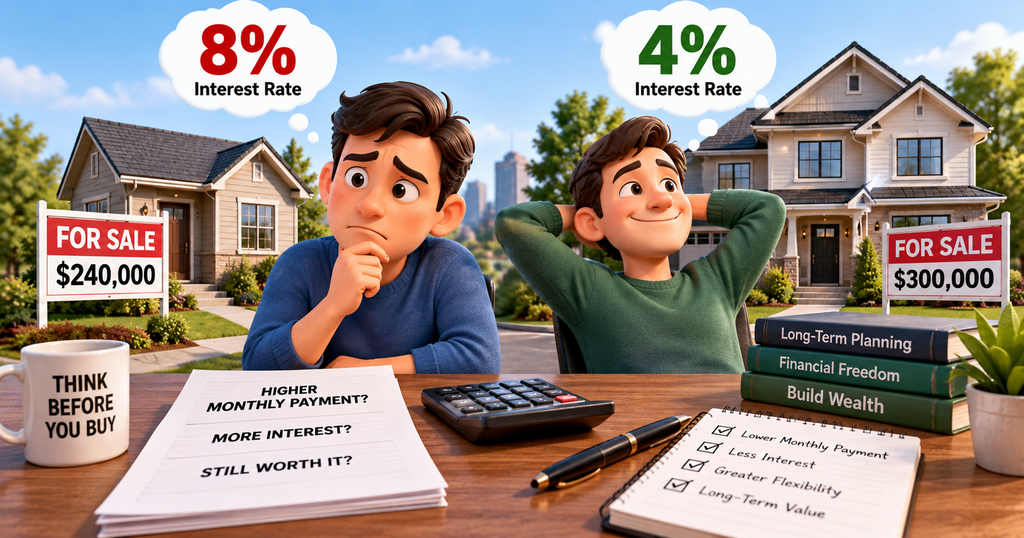
A more useful analysis asks several questions together: What will the monthly financing cost be? How much cash is required upfront? What would the property reasonably rent for? What are taxes, insurance, and maintenance likely to cost? How secure is the buyer’s income? How long does the buyer expect to own the property?
For investors, vacancy risk and realistic net rental income matter as well. For homeowners, financial resilience matters because a mortgage must remain affordable during periods when other household costs may rise. The word “discount” therefore deserves caution. A property can be cheaper than its previous market price while still being expensive relative to the buyer’s income or financing conditions.
Lower Rates Later Could Change the Calculation, but That Is Not Guaranteed
One argument commonly made during high-interest-rate periods is that a buyer can purchase the cheaper property now and refinance when mortgage rates fall. That is possible, and refinancing can materially improve the economics of the purchase. However, the opportunity to refinance at a lower rate is not guaranteed.
Future interest rates are uncertain. Refinancing may involve fees, eligibility requirements, and new underwriting. Property values can also decline further, potentially affecting the borrower’s ability to refinance on favourable terms. A financially resilient purchase should therefore make reasonable sense under today’s known conditions rather than depend entirely on a favourable future interest-rate move.
What Our Calculation Does and Does Not Prove
This BusiPulse comparison is not a forecast of house prices or mortgage rates, and it does not claim that 4%, 6% or 8% are the correct borrowing rates in any particular country or market. It is an illustration designed to isolate one relationship: how a change in mortgage rates can offset a decline in property prices.
Mortgage products also vary internationally. Some countries commonly use long-term fixed-rate loans, while others rely more heavily on shorter fixed periods or variable rates. Taxes, down-payment requirements and transaction costs differ substantially as well. The exact numbers will therefore change from buyer to buyer. The underlying principle does not: when borrowing is involved, the cost of money is part of the cost of the property.
Methodology: How BusiPulse Calculated the Results
For transparency, the analysis used three assumptions: a 20% down payment, a 30-year fully amortising fixed-rate mortgage and no additional repayments. Monthly principal-and-interest payments were calculated using the standard mortgage amortisation formula, with each interest rate converted into a monthly rate and the loan repaid over 360 monthly instalments. The starting case was a $300,000 property with a $240,000 mortgage at 4%. The comparison cases used a $240,000 property with a $192,000 mortgage at 6% and 8%.
Taxes, insurance, maintenance, mortgage fees, closing costs and inflation were excluded so that the comparison could isolate the relationship among purchase price, loan size and interest rate. Rental figures used in the investor example are hypothetical and are included only to demonstrate how financing can affect apparent investment returns. Readers should therefore treat the exercise as a model rather than a quotation for any specific property or mortgage product.
Final Thought
Falling home prices can create genuine opportunities. A lower purchase price reduces the amount of capital required and may improve long-term value for buyers who can afford to hold the property. But housing affordability cannot be judged by price declines alone. Our calculation shows that when a $300,000 home falls 20% to $240,000, an increase in the mortgage rate from 4% to around 6% can almost completely erase the monthly-payment benefit.
At 8%, the buyer of the cheaper property actually faces a substantially higher mortgage payment. For buyers and investors, the lesson is straightforward: do not ask only how much the property costs. Ask how much it costs to own and finance it. Sometimes a cheaper house really is a bargain. Sometimes the financing quietly takes the discount back.
Author’s Note
This article presents an illustrative BusiPulse calculation for general educational purposes and does not constitute financial, mortgage, investment, tax, or property advice. Mortgage structures, interest rates, taxes, insurance costs, lending requirements, and property-market conditions vary significantly among countries and individual borrowers. The scenarios are hypothetical and are intended to demonstrate how financing costs can interact with changing property prices. Readers should use actual local costs and qualified professional advice when evaluating a specific purchase. Readers are not required to agree with the author’s interpretation and are encouraged to test the assumptions using their own circumstances.

[…] The difference is not the discount. The difference is what would have happened without the discount. This idea is extremely useful because it establishes a financial baseline. When evaluating a promotion, consumers should compare the purchase not only with the higher advertised price but also with the realistic alternative of postponing the purchase, choosing another product, or buying nothing. A similar principle applies to larger financial decisions, where a lower headline price does not necessarily mean greater affordability, as BusiPulse explored in its analysis of housing affordability. […]
[…] Not every decline is undesirable. In places where property values moved far ahead of incomes, lower prices can improve access for younger households and first-time buyers. More affordable land can also reduce costs for new businesses and future construction. But a lower price is not the same as better affordability. […]
[…] Now look at the same house through the eyes of someone trying to buy it today. What represents greater wealth for the existing owner represents a more expensive purchase for the aspiring buyer. […]